
Understanding The Bible – Episode 9
Well, here we are in Episode Nine of our Understanding the Bible series.
As we said in the last episode, we’re now going to look at what happened in that crucial time period between Acts Chapter 1 and Acts Chapter 9.
Many Christians say Peter and the others “ran ahead of God” when they replaced Judas with Matthias in Acts chapter 1. But that idea only comes from not reading the text. Acts 1 shows they followed Scripture exactly. And Paul himself never says he was supposed to replace Judas. In fact, Paul makes it clear in Galatians 2 that his apostleship is distinct from Peter’s. Paul is not the 13th apostle to Israel. He’s the apostle of the Gentiles, with the gospel of the uncircumcision, not the gospel of the circumcision.
“Speed Slider”
 Press Image To Enlarge

Understanding The Bible – Episode 9 – Transcript
Well, here we are in Episode Nine of our Understanding the Bible series.
As we said in the last episode, we’re now going to look at what happened in that crucial time period between Acts Chapter 1 and Acts Chapter 9.
This is a good point to take stock and define exactly why we’re undertaking this series. It’s called Understanding the Bible, and as we said in the first episode, it’s not for the person who hasn’t yet come to the realisation that the 66 books that go to make up our Bible are the infallible word of God. Nor is it about the stories of the Bible. It’s about a secret key to understanding the Bible that’s hidden in plain view! We find that key in 2 Timothy 2:15-16, which reads,
Study to shew thyself approved unto God, a workman that needeth not to be ashamed, rightly dividing the word of truth.
But shun profane and vain babblings: for they will increase unto more ungodliness.
Failure to see that God works with mankind in different ways through different ages, as Hebrews 1:1-2 states, is the number one reason people get confused about the Bible and fail to get the message that God’s plainly written for all men to see.
God Himself, His Character and Who He is never changes, He’s the same yesterday, today and forever, but the way in which He has and will deal with man through the ages most definitely has and will change.
God Himself, His Character and Who He is never changes, He’s the same yesterday, today and forever, but the way in which He has and will deal with man through the ages most definitely has and will change.
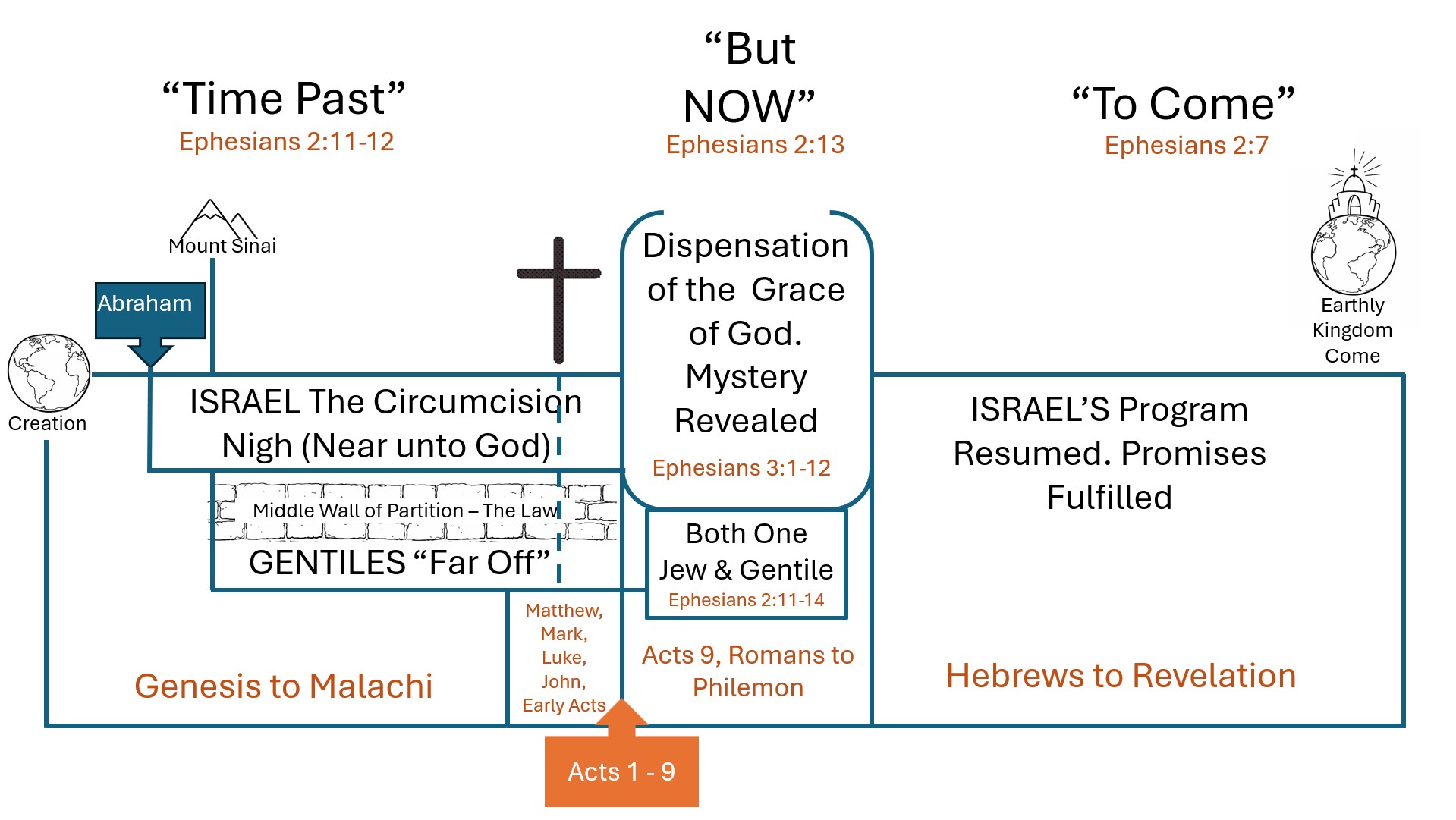
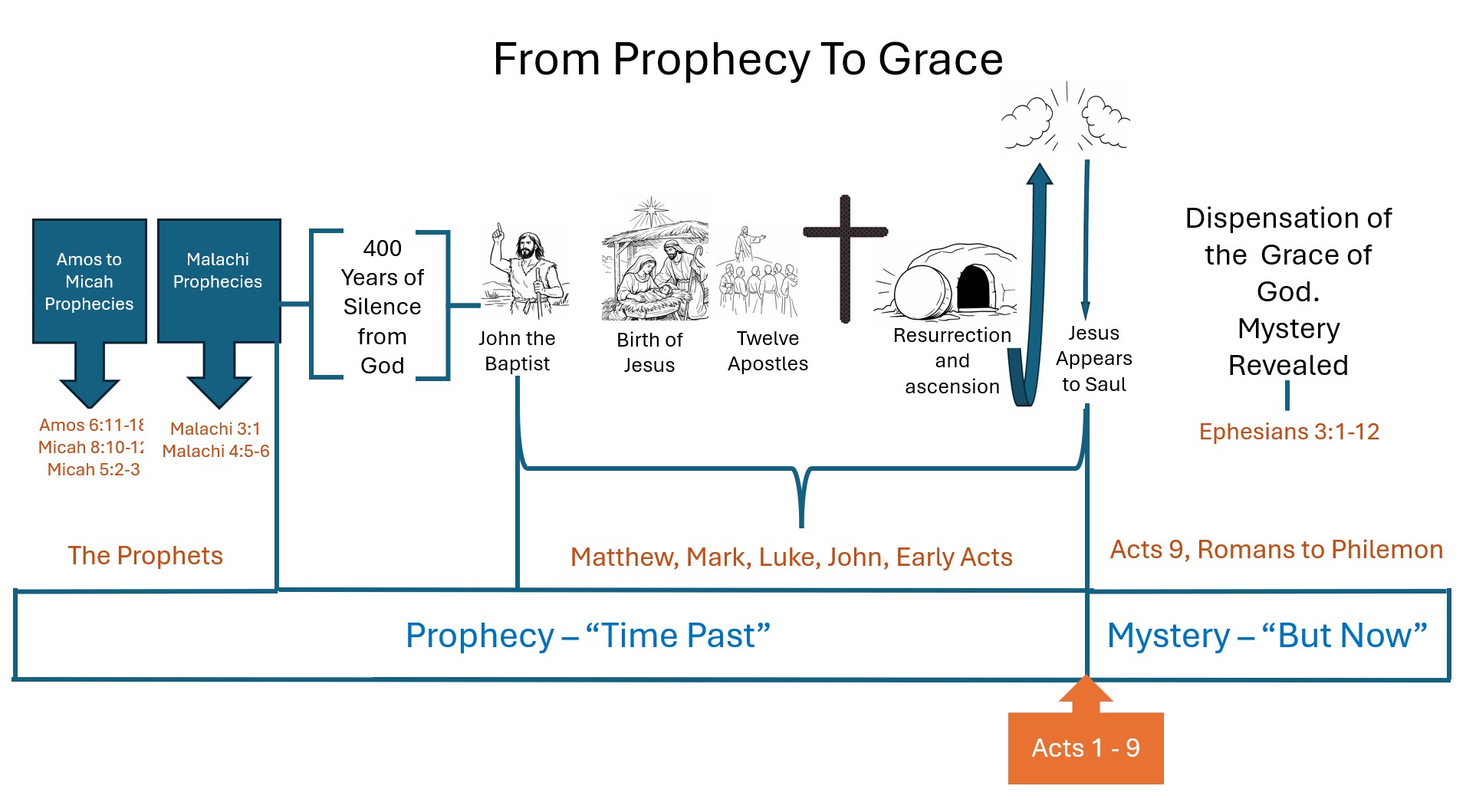
In our two timeline charts below, we’ve added an orange marker to show this very small but highly important place these verses occupy, the little space in the line between the Cross and the dispensation of grace NOT begun yet until in Acts chapter 9. That whole section up until that line is still Israel’s program and still time past on our timeline.
These opening chapters of Acts are critical to our understanding of the Bible. Many Christians think our program today started here, and that one of the main events taking place in these passages, the feast of Pentecost, is “the birthday of the church.” But that’s not what the Bible says.
The dispensation of grace did not begin in the gospel accounts, and it did not begin at Pentecost, and with that statement, I will lose many listeners who have stayed with the series so far.
God did not reveal this new dispensation until He raised up Paul as a brand‑new and different apostle in Acts chapter 9. Paul was not one of the twelve. He was not chosen during Christ’s earthly ministry. His apostleship is separate, unique, and tied to the revelation of the mystery of Ephesians 3.
Many Christians say Peter and the others “ran ahead of God” when they replaced Judas with Matthias in Acts chapter 1. But that idea only comes from not reading the text. Acts 1 shows they followed Scripture exactly. And Paul himself never says he was supposed to replace Judas. In fact, Paul makes it clear in Galatians 2 that his apostleship is distinct from Peter’s. Paul is not the 13th apostle to Israel. He’s the apostle of the Gentiles, with the gospel of the uncircumcision, not the gospel of the circumcision.
So, at this point on our timeline charts, everything from Matthew to John, to Acts 1–9, is still in Israel’s prophetic program. There’s nothing about the mystery, nothing about the body of Christ and nothing about our dispensation as yet. Israel’s being offered her kingdom. The Lord has gone back to heaven by this point, and Israel is entering her last days, as shown in Acts 2. That’s why these chapters matter so much.
But Christians often mix these different time periods together, thinking that the gospel accounts and Pentecost are the start of the church today. They claim the promises, the signs, the commands, and the kingdom instructions, and try to make them fit our dispensation. That confusion keeps people from seeing what God is actually doing today. Satan delights in that.
Acts 1–9 is not the beginning of the church, the body of Christ. It’s the continuation of Israel’s program, moving toward the kingdom, until God interrupts it by saving Saul and revealing the mystery.
In the next episode, we’ll look more closely at Paul’s unique apostleship and why it proves that the dispensation of grace did not begin until Acts 9.
If we’re honest with the Scripture, we’ll clearly see that Pentecost is not when the Body of Christ, the Church and the dispensation of grace began, and Paul’s epistles open our eyes to that. People seldom study details, so they see this big event of Acts 2 and assume it must be the start of our program. But if we let the text tell us what’s going on, it’s clear: Israel’s program is still running in Acts 1–9.
In our last episode, we looked at the gospel accounts—Matthew, Mark, Luke, John—and we’d need to be willingly blind to miss the fact that the kingdom program’s in effect.
The Lord’s rejection, His death, His resurrection, and His return to the Father did not end Israel’s program. All of that was expected and prophesied. Jesus told Peter, James, and John in Mark 10:34 that the Christ must suffer before entering His glory. The cross was a necessary step toward the kingdom, not the beginning of something new.
In Matthew 24, the Lord prepared them for what they would be doing after He left, all according to the prophetic time schedule in Daniel chapters 11–12. He said nothing about the mystery, nothing about Jew and Gentile being made one, nothing about forming the church, the body of Christ or the dispensation of grace to the Gentiles. He did not teach them what Paul later teaches in Romans 11 about Israel falling, God turning to the Gentiles, and Israel’s fullness being delayed until the fullness of the Gentiles comes in. He kept the mystery hidden.
So when Christ ascends, Peter, James, John, and the rest continue right on in Israel’s kingdom program. And that’s exactly what we see in the opening chapters of Acts. The great dispensational change does not happen in Matthew 1, Acts 1, Acts 2, or anywhere before Acts 9, when God raises up Paul as this brand‑new apostle with a brand‑new message.
Failing to see this is a dangerous mistake, and it causes endless confusion in the church.
Now, let’s look at Acts 1:1–3, where Luke, the writer of Acts, continues the story from his gospel. He says,
The former treatise have I made, O Theophilus, of all that Jesus began both to do and teach,
Until the day in which he was taken up, after that he through the Holy Ghost had given commandments unto the apostles whom he had chosen:
To whom also he shewed himself alive after his passion by many infallible proofs, being seen of them forty days, and speaking of the things pertaining to the kingdom of God:
Notice, it was what Jesus “began”. This was the climactic stage of Israel’s program—confirming the promises made to the fathers as Romans 15:8 depicts. And He handed the finishing of that work to the twelve apostles and keep in mind, Paul’s nowhere in the story yet.
Turn to Matthew 16 and Hebrews 2. In Matthew 16, about two years into His ministry, Jesus begins to show the apostles that He must go to Jerusalem, suffer, be rejected, and rise again. Before that, He never told them about the cross. They didn’t understand it, didn’t preach it, and didn’t include it in their gospel. They preached the gospel of the kingdom, not the gospel of the grace of God. Luke 18 says God even hid the meaning of the cross from them.
So how could they be preaching the same gospel Paul later preached? They couldn’t. It’s impossible. Two different messages for two different programs.
So, in Matthew 16, the Lord also prepares them to carry on the kingdom program after His departure. The cross would not stop Israel’s program. Jesus going back to the Father would not start the body of Christ. All of that fits the prophets.
So, as we’ve said so often, and we’ll keep saying, when we step onto our timeline charts below, everything from Matthew → John → Acts 1–9 is still Israel’s prophetic program, still time past, still moving toward the kingdom—until God interrupts it by saving Saul in Acts 9 and revealing the mystery.
In Matthew 16:13, Jesus asks,
…Whom say ye that I am?
Peter answers in Matthew 16:16,
Thou art the Christ, the Son of the living God.
In Matthew 16:17, Jesus says this was revealed by the Father, not by flesh and blood. Then He says,
Thou art Peter, and upon this rock I will build my church.
The “rock” is the revelation Peter just confessed—not Peter himself.
Most people today hear the word church and think only of the body of Christ, but the Bible uses the word many times for Israel’s assemblies. There was a church long before Paul. Psalm 22 speaks of it. Isaiah 65 speaks of it. It is the remnant, the little flock of Ezekiel 34, the believing group inside Israel who would receive the kingdom. That’s a prophesied church, not the mystery church, the Body of Christ, revealed to Paul.
Stephen, in Acts 7, even talks about “the church in the wilderness” under Moses. Hosea 2 says God would call Israel again into the wilderness. Jesus in Matthew 24 tells the remnant to flee into the wilderness when the abomination of desolation appears. All of that is Israel’s prophetic church—not the body of Christ.
So when Jesus says, “I will build my church,” He’s talking about that remnant church, believing Israel, who’ll inherit the kingdom. This is the group Peter, James, and John will lead once Christ returns to the Father. That’s why Jesus gives Peter the keys of the kingdom of heaven in Matthew 16:19. The message has not changed, and the program has not changed. Peter will use those keys in the opening chapters of Acts, and he expected to use them all the way through Israel’s last days, because nothing about a Gentile dispensation had been revealed yet.
Then comes the surprising command in Matthew 16:20,
Then charged he his disciples that they should tell no man that he was Jesus the Christ.
That sounds strange to us today, because in our dispensation, we’re told to preach Christ openly. But back then, during the Lord’s earthly ministry, the remnant church was not to be built until after He left. So for that last stretch of time, the twelve were ordered not to announce Him as the Christ. If they had preached it anyway, they would have been disobeying Him. That alone shows the message back then is not our message today.
Everything Jesus “began to do and teach” as we saw in Acts 1:1, belonged to Israel’s kingdom program. Luke understood that. Anyone studying the Bible God’s way—not hopping around into random verses all over the place—would see that before reaching Acts 1.
The Lord prepared the twelve to carry on the kingdom message in His absence. He gave them authority to bind and loose. He gave Peter the keys. He prepared them for the last days of Israel’s prophetic timeline.
None of this is the dispensation of grace.
By the time we reach Acts 1, Luke expects that we’ve already read Matthew, Mark, Luke, and John. We’ve already seen the Lord prepare Peter, James, and John to carry on Israel’s program after He returns to the Father. Acts simply records the history of the continuation of that same program and the apostles doing exactly what Jesus trained them to do.
Now look at Hebrews, because that book shows how God resumes Israel’s program after the interruption of the dispensation of grace. Hebrews sits after Paul’s epistles on purpose. God designed it to be exactly where it is. It belongs to the last division of the Bible, dealing with Israel’s resumption and fulfilment of their prophetic program. Revelation then shows the Day of the Lord’s wrath, the kingdom, and the new heavens and new earth—none of which describe us in this dispensation.
Hebrews is a reorientation of the Hebrew people as to where their program stood before God interrupted it with the mystery. It reminds them what the Lord taught when He was here, and what the apostles confirmed. That’s why Hebrews begins simply with “God…”, no human author named. When God resumes Israel’s program, He speaks to them again, just like the silence of Amos 8 was broken by John the Baptist.
Hebrews 1 points them back to time past, to the prophets, the covenants, the Messiah seated at the Father’s right hand, ready to bring the kingdom. None of this describes the mystery of Christ. It describes the situation in Acts 1, right before the program was interrupted.
Now open Hebrews 2:3–5, and this is a key. We’ll paraphrase those verses here.
How shall we escape if we neglect so great salvation, which at the first began to be spoken by the Lord…
That salvation is the kingdom salvation promised to Israel—the same salvation Luke 1 speaks of: deliverance from their enemies and entrance into the kingdom.
It quote “began to be spoken by the Lord” in His earthly ministry. Then it was confirmed by “them that heard Him”—that’s the twelve apostles. Their ministry in Acts 1–7 is a confirming ministry, not a new dispensation. God bore them witness with signs, wonders, miracles, and gifts of the Holy Ghost—the very things we see at Pentecost. Those signs validated the gospel of the kingdom, not the gospel of the grace of God.
Verse 5, Hebrews 2:5, says this message concerns “the world to come.” That’s the kingdom age—the same “world to come” Paul mentions in Ephesians 1, which arrives after this dispensation ends.
Hebrews quotes Psalm 8 about the Son of Man having all things put under His feet. But then Hebrews 2:5 says, “We see not yet all things put under him.” Why? Because the dispensation of grace interrupted Israel’s program.
So, Hebrews helps us understand the ministry of the twelve and what’s happening in the opening chapters of Acts.
Matthew, Mark, Luke, and John prepare us for Acts. Hebrews confirms what Acts is doing. And all of it shows the same truth on our chart, that Israel’s program continues from the gospels into Acts 1–8, until God interrupts it in Acts 9 by raising up Paul and revealing the mystery.
When this dispensation of grace ends, God’ll turn Israel’s program back on, and the Hebrew people will look again at the gospel accounts and the opening chapters of Acts. That’s why we must understand Acts 1 as the continuation of Israel’s program, not the start of ours.
Come back to Acts 1. Acts 1:2 says Jesus continued what He began to do and teach until the day He was taken up, after giving commandments through the Holy Ghost to the apostles He had chosen. Those commandments included replacing Judas. Peter wasn’t running ahead of God. He was obeying what the Lord had taught them during the forty days after the resurrection. The Holy Spirit had already been given to them in a special way so they could understand the Scriptures—things that were hidden from them earlier. Peter understood Psalm 69 and the other passages perfectly. Anyone saying Peter made a mistake simply doesn’t believe the text.
Acts 1:3 says Jesus spent forty days speaking to the apostles of the kingdom of God. He didn’t change the program. He didn’t tell them the kingdom was postponed or that a new heavenly body was about to begin. He didn’t reveal anything that Paul later teaches. He kept speaking the same kingdom truths that He always spoke.
In Acts 1:4, He commands them to stay in Jerusalem and wait for “the promise of the Father.” This fits the order He already gave them—Jerusalem, Judea, Samaria, then the rest of Israel. He’d told them in Matthew 10 that they’d not finish going through the cities of Israel before the Son of Man returned. They knew their order. They knew their territory. They knew the kingdom program was still moving forward.
Then, in Acts 1:5, Jesus reminds them of what they already heard:
“John truly baptised with water, but ye shall be baptised with the Holy Ghost not many days hence.”
They had heard this from Jesus, and even earlier from John the Baptist in Matthew 3:11–12. John said the Messiah would baptise Israel with the Holy Ghost and with fire, gather the wheat, and burn the chaff. John outlined the whole prophetic program. He knew nothing of the dispensation of grace.
Acts 1 shows that the same program is still in effect. The coming of the Holy Ghost was not a mystery event. It was prophesied. To see that, go to Ezekiel 36. God lays out Israel’s cleansing process, and we see:
- Clean water — John’s baptism, Ezekiel 36:25
- A new heart and new spirit — Christ’s atoning work, Ezekiel 36:26
- The Spirit within them — the Pentecost outpouring, Ezekiel 36:27
- Entrance into the land and kingdom, Ezekiel 36:28
That’s the exact order. Pentecost is step three in Israel’s prophetic cleansing—not the beginning of the body of Christ.
Everything in Acts 1–9 fits the timeline chart of Israel’s program continuing from the gospels. Nothing here belongs to the mystery. Nothing here belongs to the church, the body of Christ. All of it is prophecy being fulfilled, right up until God interrupts it in Acts 9 by raising up Paul.
When the dispensation of grace ends, God will turn Israel’s program back on, and the Hebrew people will look again at the gospel accounts and the opening chapters of Acts. That’s why Acts 1 is so important—it shows Israel’s program continuing, not changing.
Back in Acts 1, the first verses already tell us the program’s still Israel’s. Jesus continued what He began to do and teach until He was taken up, after giving commandments through the Holy Ghost to the apostles. One of those commandments was to replace Judas, and we can see this when we read Acts 1:12-26, closely paying attention to the details.
Peter wasn’t acting in the flesh. He was obeying what the Lord taught them during the forty days after the resurrection. The Spirit had already opened their understanding so they could grasp the Scriptures—things hidden from them earlier, as in Luke 18. Peter understood Psalm 69 better than any theologian today.
Acts 1:3 says Jesus spent forty days speaking of the kingdom of God. He didn’t change the message. He didn’t tell them the kingdom was cancelled or postponed. He didn’t reveal anything about the body of Christ. He kept teaching the same kingdom program that He taught in the gospels.
In Acts 1:4, He commands them to stay in Jerusalem and wait for “the promise of the Father.” This fits the order He already gave them—Jerusalem, Judea, Samaria, then the rest of Israel. In Matthew 10, He told them they would not finish going through the cities of Israel before the Son of Man returned. They knew their territory. They knew the kingdom program was still moving forward.
Now look at Acts 1:6. The apostles ask,
Lord, wilt thou at this time restore again the kingdom to Israel?
People mock them for this, but they understood the program perfectly. The only thing they didn’t know was the timing, so they asked.
Jesus doesn’t correct their doctrine. He doesn’t say, “No more kingdom.” He simply says in Acts 1:7 that the timing is in the Father’s hands. The kingdom itself is still the program.
In Acts 1:9–12, Jesus ascends from the Mount of Olives, and two angels tell the apostles He’ll return in the same manner. That points straight back to Zechariah 14, where the Lord returns at the end of the tribulation, His feet standing again on the Mount of Olives and with the mountain splitting to protect the remnant. That prophecy has never been fulfilled. The Roman, Titus, didn’t fulfil it when he and his legion destroyed Jerusalem in 70 AD. It’ll happen after this dispensation ends.
Those angels are not announcing a rapture here. They’re confirming the prophetic second coming, the kingdom return. The rapture is part of the mystery revealed only to Paul that Paul speaks of in 1 Corinthians 15, 1 Thessalonians 4–5 and 2 Thessalonians 2.
Peter, James, and John knew nothing about it. They expected to go through Israel’s last days, just as the prophets said.
Now look at Acts 2, which we’ll look at more next time. The day of Pentecost arrives. It’s one of Israel’s feast days that we saw in previous episodes. Acts 2:1 says,
When the day of Pentecost was fully come…
That means Israel’s prophetic calendar was moving forward exactly as God laid it out. The feasts in the Law were shadows of things to come or prophetic pictures of the days of the Messiah. Passover pictured His death. Unleavened Bread pictured His burial. Firstfruits pictured His resurrection. Pentecost pictured the Spirit poured out on the remnant, just as the prophets said.
Acts 2:1–4 shows the Spirit coming with wind and fire, and the apostles speaking in other tongues. This is not the start of the body of Christ. This is the third step in Israel’s cleansing program. Remember the steps?
- Water — John’s baptism
- Blood — Christ’s atoning work applied to the remnant
- Spirit — Pentecost
- Kingdom — preservation through the tribulation into the land
You can see this whole order perfectly prophesied in Ezekiel 36:25–28. Pentecost fits perfectly. Nothing here is mystery truth. Nothing here belongs to the church, the body of Christ. Everything is prophecy.
That’s why in Acts 2:44-45 they had all things in common, sold their possessions and goods and distributed to every person according to their need and walked in perfect unity. God’s causing them to walk in His statutes. This is how they’ll survive the tribulation to come. That’s definitely not how God deals with us today in the dispensation of grace.
When you follow the timeline chart, Acts 1–7 flow straight on from Matthew, Mark, Luke, and John. There’s no hint of a new program. The shock comes in Acts 9, when Christ suddenly returns from heaven and raises up Paul. That’s the true dispensational change.
In the prophecy-filling days of the Messiah, Israel’s feast days weren’t just shadows—they were fulfilment of prophecy.
When Christ died, the Passover feast had fully come. In Acts 2, when Pentecost was “fully come,” the event it pictured in Israel’s program had arrived, perfectly fulfilling God’s calendar from Leviticus 23.
God expects us to read His book from the beginning, not just jump into the middle somewhere randomly. You wouldn’t open any other book halfway through and expect to know the characters it writes about. It’s the same when we get to Acts 2. Before we ever reach Pentecost, God expects that we’ve read Genesis through to Acts 1, and that we already understand Israel’s program, the feast calendar, and how those shadows become fulfilled in the days of the Messiah. Now, if we haven’t done that, how is it possible to know God’s program? However, that doesn’t stop the multitude of teachers and preachers from passing on what they don’t fully know and understand and the millions who suck it in.
So, Acts 2:1 shows that the day of Pentecost was another prophetic event on Israel’s calendar taking place, not the start of the body of Christ. Peter will explain this in Acts 2:16 and following. Peter never says that Pentecost is the birthday of the church, the body of Christ.
In the next episode, we’ll see :
– the day of Pentecost in detail
– the opening seven chapters of Acts
– why God brought in the dispensation of grace
– Paul’s unique apostleship
– who you are in the body of Christ
– and the satanic policy of evil designed to keep Christians “biblical but not dispensational.”
How about reading Acts 2:1-21, slowly and methodically, in preparation for the next episode.
Until then, may God bless you in the knowledge of Him.


Leave a Reply
Want to join the discussion?Feel free to contribute!