
Understanding The Bible – Episode 3
Here we are at Episode 3 in our Understanding the Bible series.
We’re looking at the different ways in which God’s dealing with us, you and me, today in this dispensation of grace.
To do that, we’ve got to what Paul says in 2 Timothy 2:15,
Study to shew thyself approved unto God, a workman that needeth not to be ashamed, rightly dividing the word of truth.
“Speed Slider”
 Click Image To Enlarge
Understanding The Bible – Episode 3 – Transcript
This present dispensation of grace is a new program in God’s overall purpose, and it was a mystery, something that wasn’t expected, prophesied about, or looked for in generations past.
God kept it a secret, as we see in many places in the Bible, like Ephesians 3:3-5.
God’s dealing with us in an entirely different manner than He dealt with his people Israel, back there in time past, and in a different manner than when God resumes His program with the nation of Israel, after this dispensation of grace is over.
So, we must understand the vast differences in the things going on in this dispensation of grace, now, from what was going on before and from what’s going to go on in the ages to come and to do that, we must rightly divide the Word of Truth.
So many Christians fail to do that. They take portions of God’s Word, especially dealing with time past, and especially that portion of God’s Word called the gospel accounts and the earthly ministry of the Lord Jesus Christ, and they try to apply those things to their lives today.
They claim promises that the Lord gave to Peter, James and John and the remnant of Israel, before He brought in the dispensation of grace. But they fail to appreciate the glorious and wonderful things freely given to us in this dispensation of grace.
They don’t see God’s dealings with us as the one new man, the new creation, the church, the body of Christ, and the vast differences in the way in which God deals with us and treats us today as opposed to what He did do and will do with Israel.
The result is a lot of heartache, discontent and dissatisfaction and a lot of deceit as Christians try to make things fit in this dispensation of grace that don’t.
So in this episode, we’re going to look at how God’s Word
is laid out in the order of the outworking of His plan and purpose. It naturally divides itself into “time past”, “but now” and “to come”.
The books of the Bible were, of course, written at different times, and this often matters a lot when we’re studying. For example, 1 Thessalonians was Paul’s first letter, then 2 Thessalonians and then Galatians, but that’s not the order they appear in the Word.
So when Paul refers to a letter he wrote earlier than the one we’re currently reading, it helps to know which was written before.
However, when they were written has little effect on how they’re placed in the Bible. God’s placed them perfectly to outline His plan and purpose.
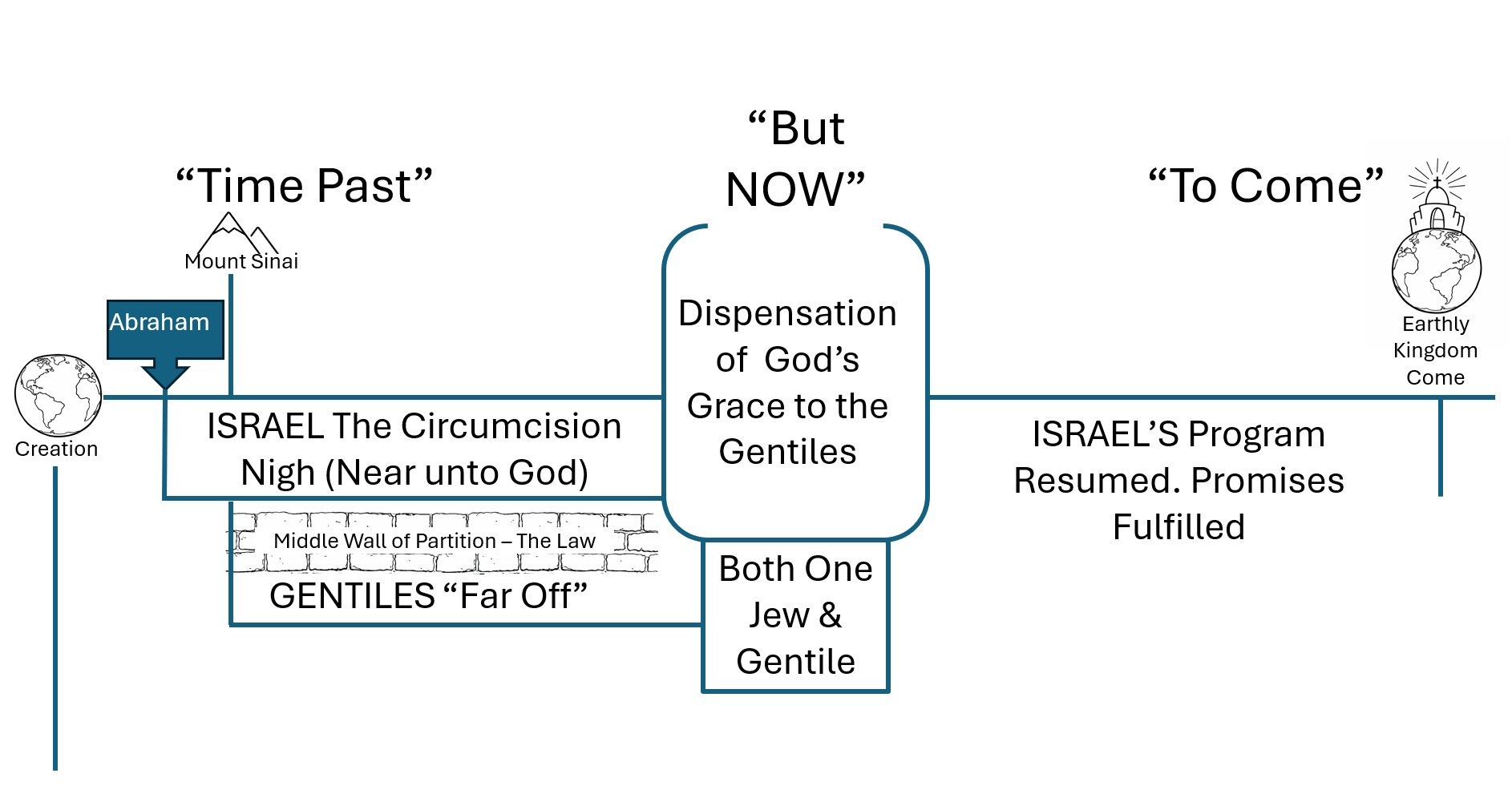
In the timeline chart below, we see the creation of the world on the far left. God’s Word opens up with the book of Genesis, the Book of Beginnings, where God begins to describe the outworking of His plan and purpose with the creation of the heavens and the earth.
In the book of Genesis, we eventually come to chapter twelve, where God separates the man Abraham, and we get the beginning of the nation, Israel, and the beginning of God’s program with Israel, the circumcised people.
Then we go to the book of Exodus, and the bringing in of that law contract and the setting up of that middle wall of partition that we’ve seen Paul talking about. We commonly call the books from Genesis to Malachi the Old Testament.
Everything from Genesis through to Malachi falls into this “time passed” era. But that’s not all the books in “time past”.
When we come to the cross of the Lord Jesus Christ, we’re in the gospel accounts of Matthew, Mark, Luke, and John. The “Gospels” as they’re known, deal with the earthly ministry of the Lord Jesus Christ, His birth as the seed of David, of the Virgin Mary, there in Bethlehem, and the details of John the Baptist’s ministry.
Most Christians don’t understand that we’re still in “time past” at that time. More on that as we go.
The Bible, from Genesis through to the book of Revelation, is laid out in accordance with God’s plan and purpose.
God hasn’t put His word together in a haphazard manner where the books that make up the Bible are just jumbled together randomly.
God’s the one who wrote it. He utilised certain men to put the words down on paper, but God’s the author of the book. It’s His Word. It’s His book.
God Himself oversaw every aspect of it, its construction and preservation. What we hold in our hand when we pick up the Bible, either as a physical book or as software, is the preserved word of God translated into the English language for you and me today.
God’s Word is put together in the order in which God wants it put together.
Sometimes people don’t understand that. There are so-called scholars and theologians out there who tell us that the best way to study the Bible is to find out the chronological order in which the books were written, and then study them that way, and that’s a bunch of tripe. God’s smarter than any theologian, and He’s smarter than me and you.
He’s put His word together in the order in which he designed us to study it.
And He’s put it together in the order in which He’s working out His plan and purpose. He had the books written at particular times for particular purposes, but he’s put the word together so it corresponds with the outworking of His plan and purpose.
As we study the Bible from Genesis to the Revelation, we go through in perfect order, time passed, then, now and then the things to come, the details of God’s timing.
We go through past dealings with His nation, Israel, and then we come to a break in Israel’s program, and deal with a portion of God’s word that’s focusing on now and this dispensation of grace. Then we come to a portion that ends the Bible, which focuses on the resumption and the fulfilment of God’s program with Israel. God’s word is laid out in the order of time past, but now and to come.
In 2 Timothy 2:15, which we continue to refer to time and time again, we see,
Study to show thyself approved unto God, a workman that needeth not to be ashamed, rightly dividing the word of truth,
Timothy understood what Paul was saying. He had followed up on his education with Paul, and he understood the things we’ve briefly gone over in Romans nine, ten and eleven, and in Ephesians two and three, regarding time past, now, and to come.
Timothy wasn’t puzzled or confused by what the Apostle Paul meant when he said, rightly dividing the word of truth.
He knew that God’s Word records things in connection with God’s time, past dealings with Israel, his present dealings with us in Paul’s epistles in this dispensation of grace, and the things yet to come when God resumes and fulfils his program with Israel.
Timothy knew what it meant. And you and I can know what it means, because the one who said it explained it all in his earlier epistles.
Because of that, we understand the need to rightly divide the word of truth.
There’s a portion written in God’s Word that looks towards the resuming of, and the fulfilment of, God’s program with Israel. It follows after the collection of the thirteen epistles of the Apostle Paul, after the dispensation of grace is over.
If, at that time, a member of the remnant of Israel out there in the future, after God resumes His program with Israel, tries to walk after Paul’s epistles about this dispensation of grace, and thinks he’s a member of the church, the body of Christ, he’s going to be mishandling God’s word.
He’ll be mishandling it just as much as if a member of the church, the body of Christ today, goes back into the Old Testament scriptures and thinks that they’re talking about him, today, and so starts applying things in connection with God’s program with Israel.
God’s Word contains the record of all His dealings with mankind, and they’re not designed to be all blended. Sure, they’re all part of God’s overall plan and purpose, but that plan and purpose is made up of different parts, each with its own purpose within the main purpose.
The reason why Paul tells Timothy of the necessity to rightly divide the Word of Truth is that God’s word was being mishandled there in Ephesus, and Christians were acting as if the dispensation of grace either didn’t exist or wasn’t any different from God’s program with Israel. These folk were preachers, pastors of churches, who were desiring to be teachers of the law, not understanding what they were saying.
Paul says they were teaching things that were out of line with the revelation that was committed to him about and for this dispensation of grace.
They weren’t able to see the separation between the mystery revelation for today and the prophecy program that God’s had since the world began in connection with his nation, Israel.
How common that is today.
God’s Word lays itself out in accordance with that right division into time past, but now and to come, and we need to see that.
Let’s take a look at the layout of the books of the Bible and appreciate the natural breakdown into those 3 time spans.
The circle to the left on our chart below represents the creation of the world. We’re first and foremost in the things recorded in the opening chapters of the book of Genesis.
The book of Genesis is the Book of Beginnings. That’s what the name stands for. And there’s a number of beginnings that’re recorded there in the book of Genesis.
One particular beginning is in Genesis chapter twelve. It’s the beginning of the nation, Israel.
It’s here where we find out about that separation of this man, Abraham. God set him apart from the rest of the world, called him out to make of him a great nation, setting the rest of the nations of the world aside.
As we go through the book of Genesis, we read about the process that established that great nation.
We read about it being multiplied in the land of Egypt and, in later chapters, God’s dealings with Jacob, who was later named Israel, and his sons, who would become the foundation of the twelve tribes of Israel.
After the book of Genesis, we come to the book of Exodus, and we see this great nation now greatly increased in numbers.
God prepares to bring them out of the slavery they had fallen into in Egypt to fulfil one of his promises to Abraham there in Genesis fifteen.
As we go through the book of Exodus, which follows the book of Genesis, we eventually come to a point where God brings the law in connection with the nation, Israel, and, as we know from Ephesians chapter two, that law contract functioned as a middle wall of partition between Israel and the Gentiles, the other nations of the world.
The law established Israel’s being nigh, near, to God, while the Gentiles, the rest of the nations of the world, were not nigh unto God; they were afar off.
As you go through the rest of what we call the Old Testament scriptures, we’ve got this time past period being established. That is, of course, time passed in relation to us today.
The record goes on in the Old Testament scriptures through the books of Leviticus, Numbers, Deuteronomy, and all the way through the book of Malachi.
We’re in time past ground while we’re in Genesis, through to Malachi. The dispensation of grace isn’t in view anywhere there. God’s still keeping that a secret at that time. It’s still hidden in Himself.
But that’s not all. It’s a secret beyond that, too. We’re not only in time past, in Genesis, through Malachi. The gospel accounts follow on after Malachi.
Matthew, Mark, Luke and John are shown on our chart where the cross of the Lord Jesus Christ depicts their space in time. The gospel accounts record Israel’s rejection of the Lord Jesus Christ as their Messiah. The Lord’s earthly ministry went on for three and a half years and is testified to in Matthew, Mark, Luke and John. That period is a very critical yet very confusing portion of God’s Word, and we’ll see why in a few episodes up the track.
These things may not sit well with you, because you’ve never heard them from your pulpit. But stick with me, and we’ll go over those things in detail and always from the Word of God.
But at the moment, I just want to alert you to the fact that when you’re in Matthew, Mark, Luke, and John, the gospel accounts, you’re still in time past.
The Apostle Paul once again makes it plain and clear there in his epistles that the revelation of the mystery and this dispensation of Gentile grace was first revealed to him, and wasn’t known in ages and generations past until him. That so called gospels accounts were before him.
No one before Paul knew anything about it.
That means that the dispensation of grace begins with God’s raising up of Paul as that brand new apostle. And he is that, a brand new apostle, to the Gentiles!
He didn’t replace Judas as so many teach that he did, and he’s not aligned with the twelve. He’s a brand new and different apostle. We’ll clarify those things later in their correct context, but it’s plain and clear that Matthew, Mark, Luke and John are still in the time passed period. In fact, those Gospels are also Old Testament scriptures.
The editors of the Bible stuck a blank page between Malachi and Matthew, and then on one side of that blank page, they printed the words “the New Testament”; however, the truth is that Scripture shows plainly and clearly that the earthly ministry of the Lord Jesus Christ was under the law under that old covenant.
In fact, the New Covenant wasn’t even established for the nation of Israel, because it was impossible to do so until Christ died upon the cross. Hebrews 9:16-17 proves this saying,
For where a testament is, there must also of necessity be the death of the testator.
For a testament is of force after men are dead: otherwise it is of no strength at all while the testator liveth.
Paul states in Galatians chapter four, that Christ was born of a woman, made under the law, and the things that He did in his earthly ministry acknowledged the law’s existence and its authority, and, in effect, that it’s still in force while Christ was alive.
When we talk about the New Testament, it’s a misapplied and inappropriate, there where it is in our Bibles. We understand why it’s done, but human publishers put that label there, not God.
So, the misunderstanding that widely exists regarding the Lord’s earthly ministry and record of it in Matthew, Mark, Luke and John starts with the placement of those books. They’re not in the wrong place in the Bible. We must be absolutely clear on that, but they’re misplaced in people’s minds because of the publisher’s placing them in the “New Testament” section.
That New Testament publishers’ division leads people to think that the new program, the dispensation of Grace, began between the end of Malachi chapter 4 and the beginning of Matthew chapter 1.
When most people think about rightly dividing the word of truth, they usually think of the artificial division that men have created between the Old Testament and New Testament sections of the book. That just confuses things all that much more, and that’s not what Paul’s talking about there.
When we rightly divide the Word, we’re not relying on man’s division but on the way God has plainly and clearly divided His program with Israel from His program with us Gentiles.
We understand God began His program with Israel back in the book of Genesis, and when we come to Matthew 1:1, nothing has changed in that program. The Lord’s coming to earth and His earthly ministry are part of that program with Israel.
The gospel accounts are still in time past. When the Lord Jesus Christ was born here, He was made of a woman made under the law. Born of the seed of David, to save his people, Israel, from their sins in perfect accordance with prophecy going back to Genesis.
He’s the horn of salvation for us in the house of His servant David, as Luke 1:69 tells us.
Zacharias, John the Baptist’s father, being filled with the Holy Spirit, makes that plain and clear in Luke 1:67-68, and we read,
And his father Zacharias was filled with the Holy Ghost, and prophesied, saying,
Blessed be the Lord God of Israel; for he hath visited and redeemed his people…
And Paul, in Romans 15:8, says this,
Now I say that Jesus Christ was a minister of the circumcision for the truth of God, to confirm the promises made unto the fathers:
Paul’s writing that from the perspective of the dispensation of grace. He looks back at the earthly ministry of the Lord Jesus Christ, and he says Jesus Christ was a minister of the circumcision when He was here.
We’ll look at that more as we go on in our series, but for now, we see that the earthly ministry of the Lord Jesus Christ is in time passed.
We’re in God’s time past dealings with man when we’re in the gospel accounts, but that’s not what He’s doing today.
That’s why we hear the Lord say in Matthew 15:24 when He was on earth,
… I am not sent but unto the lost sheep of the house of Israel.
He didn’t say He was sent to the Gentiles. In fact, in Matthew 10:5-7, He told the disciples this,
These twelve Jesus sent forth, and commanded them, saying, Go not into the way of the Gentiles, and into any city of the Samaritans enter ye not:
But go rather to the lost sheep of the house of Israel.
And as ye go, preach, saying, The kingdom of heaven is at hand.
How in the world could a dispensation of grace be in effect to the Gentiles when he told them not to even go to the Gentiles?
All this should begin to make us realise that if we’ve been thinking of the gospel accounts as describing what God’s doing today, we haven’t been understanding the way we need to. We haven’t been rightly dividing the word of truth.
Back in Ephesians 2:12, now where Paul says,
That at that time ye were without Christ, being aliens from the commonwealth of Israel, and strangers from the covenants of promise, having no hope, and without God in the world:
Which “at that time” is Paul referring to?
The time recorded in the gospel accounts was Christ’s earthly ministry. And yet Paul says, “That’s time passed”.
And at that time, we were without Christ. He didn’t come to us Gentiles because we were aliens from the Commonwealth of Israel. His problem was with Israel at that time, and when we’re in Matthew, Mark, Luke and John, we’re still in time past.
John the Baptist’s ministry and the ministry of the twelve apostles are all “time passed” ministry.
Even in the first eight chapters of the book of Acts, with the Day of Pentecost in Acts chapter two, it’s still time passed. No wonder there’s so much confusion in Christianity, around Charismatics, Pentecostals and the gifts and things. Those things don’t pertain to the dispensation of grace.
Those things were going on before the dispensation of grace was even revealed. They all pertain to God’s program with Israel, and it’s very clear when we go back and read it and just let the text tell us what’s going on instead of assuming that it must be for us today.
This is hard to see for a person who’s had a long term involvment with modern teaching and preaching where there’s often a lot to “unlearn”.
Genesis, through to Malachi, Matthew, Mark, Luke and John and the opening chapters of the Book of Acts, is all “time passed”.
Everything that’s going on in most of that portion of God’s Word pertains to God’s program and dealings with the nation, Israel.
All the individuals involved in that period of time knew nothing about the dispensation of grace and the mystery of Christ, because, as we’ve said repeatedly, God kept it secret.
He didn’t reveal it until the Lord Jesus Christ came back from heaven, as recorded in Acts chapter nine and raised up Saul of Tarsus, later called Paul, and revealed the mystery of Christ to him. He gave him the dispensation of grace for us today and taught him how He was interrupting His program with Israel because of their unbelief.
Christ revealed to Paul this big dispensational change, how He was now making both Jew and Gentile one and forming the new creation, the one new man, the church, the body of Christ.
It was all kept hidden until He revealed it to the Apostle Paul.
So the main point we’re trying to establish is that this “time past” period is from Genesis through to those opening chapters of the book of Acts.
It’s not until we come to the apostle Paul’s epistles that we come to the time period of “now”.
We should appreciate how God’s Word naturally falls into parts or divisions that, although dealing with mankind differently, are all part of the outworking of God’s plan and purpose.
This dispensation of grace has been just like the parentheses, the brackets, on our chart below. And, just like Paul teaches in Romans nine ten and eleven, a divine interruption in God’s program with Israel.
God has put Paul’s epistles right in there, following the book of Acts. Three-quarters of the book of Acts is dedicated to the history and the activities of this brand new apostle from chapter nine on.
And it’s all done in perfect harmony with the interruption of His program with Israel.
So on our chart, it’s Romans through to Philemon that we’re dealing with now. That’s the portion of the Word of God and the time period that’s talking to you and me today. Those books contain the instructions, the promises, the doctrines and so forth that we need to understand. It’s in them that we learn what we should be doing.
Now, again, we need to understand the whole book. The whole counsel of God, all God’s Word, is for us.
2 Timothy 3:16 tells us that all Scripture is profitable. God desires us to get profit from it. But not all Scripture is designed for our obedience, because not everything in Scripture is said to you and me today.
But when we’re in Romans through to Philemon, those things are said to us today because Paul’s writing as our apostle, the apostle to the Gentiles, to us as who and where we are in God’s plan and purpose, and we’re not members of the nation of Israel.
Since the moment we trusted Jesus Christ as our Saviour, we’re members of the new creation, and God’s dealing with us in a very special way.
Every one of Paul’s epistles, from Romans to Philemon, opens with Paul saying grace to you, and peace from God the Father and from the Lord Jesus Christ.
That’s what God’s extending to us today: grace and peace. And those words are from God the Father and from the Lord Jesus Christ to us through the Apostle Paul.
That’s our mail, yours and mine.
All the Bible is a collection of all the mail that God’s written to His people in all His dealings, but not all that mail has our name on it. Paul’s letters do.
Every one of those letters is written to the members of the church, the body of Christ. And that’s the mail we’re supposed to read and understand.
Romans through to Philemon naturally follow God’s program with Israel, just as the dispensation of grace does. But the Bible doesn’t end with Philemon.
God’s program with Israel isn’t over with, and He’s had a portion of His Word written by the very individuals, the very apostles, who were ministering at the time the program was interrupted.
That portion of his word, Hebrews to Revelation, was written by them, in advance, looking to the resuming and the fulfilment of Israel’s program.
God’s put it in His word, and His word is complete. It’s not only set for the duration of this dispensation of grace for you and me. It’s also set out for the resumption of His program with Israel, after the dispensation of grace ends by the rapture of the church.
The books that follow Philemon immediately put us back into Israel’s program.
The book that follows Philemon is addressed to those very people. Hebrews.
Hebrews through to the book of Revelation focus upon and deal with the things connected with the resumption of Israel’s program and its fulfilment.
As we said, God’s Word is laid out in an order that makes sense of the outworking of God’s plan and purpose.
On our chart, we see the present time, the time past and the future, the time to come, and that’s how God expects us to look at His Word, rightly dividing it.
It’s not just dividing the Bible publisher’s Old Testament and New Testament.
Do you know that there was a time in God’s dealings with men in which there wasn’t even an Old Testament?
Just think about it for a few minutes. When did that law contract, that Old Testament, come into effect? Was it given to Adam? No. Was that given to Noah? No. Was it even given to Abraham? No. We don’t come across it until Exodus chapter nineteen. We’re not even on Old Testament ground, much less the New Testament. It’s no testament ground.
Now we realise that there’s a testament connection with Abraham, and a covenant in connection with Noah, but we should realise that the right division of God’s Word isn’t about Old Testament verses New Testament.
The right division of God’s Word is acknowledging God’s two programs: His program with the nation of Israel and His program with the new creation, the church, the body of Christ.
Israel is something He’s spoken about since the world began.
Let’s look at Luke chapter one and Romans chapter sixteen.
Luke chapter one is the time of the beginning of the gospel period, and we’re still in time past.
The Lord Jesus Christ has been conceived and will soon be born of the Virgin Mary. John the Baptist has just been born, and his father is filled with the Holy Ghost and prophesies about this critical time in God’s dealings with Israel. What he talks about is that everything’s coming to a head at this time in God’s program with Israel. At this point, there’s no knowledge whatsoever of a dispensation of grace, even to this man whose filled with the Holy Ghost.
He says that what’s coming to a head is what God’s been speaking about by the mouth of his holy prophets since the world began.
Look at it here, in Luke 1:67-73,
And his (John the Baptist’s) father Zacharias was filled with the Holy Ghost, and prophesied, saying,
Blessed be the Lord God of Israel; for he hath visited and redeemed his people,
And hath raised up an horn of salvation for us in the house of his servant David;
As he spake by the mouth of his holy prophets, which have been since the world began: That we should be saved from our enemies, and from the hand of all that hate us;
To perform the mercy promised to our fathers, and to remember his holy covenant;
The oath which he sware to our father Abraham,
And he goes on to amplify that. Zecharias is prophesying, filled with the Holy Ghost. This is not just his misguided opinion. It’s God’s testimony to the nation.
What’s going on?
At that time, when John the Baptist was born, and the Messiah was conceived and ready to be born in the land, the issue is the salvation that God has promised to his people Israel, by the mouth of all his holy prophets since the world began.
Zacharias is confirming here that God had a plan and a purpose of which the nation, Israel, was the focal point, and it’s been that way since the world began. He’s also confirming that the time for the fulfilment of that program had actually arrived. But that’s getting a bit ahead.
Now, we talk about the nation, Israel, beginning with God separating Abraham in Genesis chapter twelve. And historically, that is where the nation began. But in God’s mind, He was beginning a new aspect of a program that’s already been in effect since the world began. It’s just that the nation, Israel, is the means by which he’s going to fulfil that program.
He spoke about that program to Adam, but Israel is the means by which it’s going to be fulfilled.
That’s why Zacharias can talk here about the horn of salvation being raised up for them, the nation Israel, and this being that spoken about by the mouth of all his holy prophets since the world began.
We want to appreciate that that’s what Zacharias recognised. There’s a message that’s recorded in the Word of God through the mouth and pen of His holy prophets. And it’s been the issue since the world began. And it’s the only message that anybody knew of up until that time.
But now open Romans 16:25. And when we come to Paul’s epistles, we see that same terminology about “being spoken about since the world began”, but Paul spins it.
Let’s read,
Now to him that is of power to stablish you according to my gospel, and the preaching of Jesus Christ, according to the revelation of the mystery, which was kept secret since the world began,
But now is made manifest, and by the scriptures of the prophets, according to the commandment of the everlasting God, made known to all nations for the obedience of faith:
See something that’s been kept secret since the world began. It can’t be the same thing that was spoken about since the world began, can it?
They aren’t the same thing. They’re two separate and distinct messages. And it’s on that basis that God expects us to rightly divide the word of truth.
The right division of God’s Word is dividing the prophetic message, which was spoken of since the world began, from the mystery message that was hidden since before the world began.
The prophetic message spoken of since the world began is God’s program with Israel.
The mystery message hidden since the world began is God’s program with the Gentiles.
Rightly dividing the word of truth is understanding that the two don’t go on at the same time, and they aren’t the same thing.
Trying to blend these two messages together only makes for confusion and error.
We need to let the God-inspired text do the talking, even when that means chucking out our denominational baggage that’s been there through our exposure to wrong teaching. Many of us also need to put aside the pride that makes us think we know something in ourselves and realise that only in God’s Word, His entire Word, do we come to the knowledge of Him.
If we, today, try to follow in the footsteps of Jesus in his earthly ministry, it dishonours the Lord, and that’s the plague in Christianity today.
Now we can say, “The Bible says this, and that’s what I’m doing, and I’ve got chapter and verse to back it up.”
We can be one hundred per cent scriptural and be dead wrong in God’s sight.
We can be one hundred per cent scriptural and dishonour the Lord. We can be one hundred per cent scriptural and disobey God. Now, if I said that to you before you had an appreciation for rightly dividing the word of truth, you’d have called me a heretic. But even with the basic things that we’ve gone over so far, maybe you’d look at it a little differently.
In Leviticus chapter eleven, God gives a long and complex list of dietary commands relating to eating certain foods.
If I say, “Since God said not to eat those things, I’m going to ban them from my diet.” I’d be dishonouring God.
Why? Because this is not the program for the dispensation of grace, and it’s not a commandment to me as a member of the church, the body of Christ today.
In fact, our own apostle, the Apostle Paul, explicitly warns against returning to the commandments and to Israel’s dietary ordinances in Romans 14:2–3, 1 Timothy 4:3–5, and Colossians 2:16–17. Those ordinances belonged to the law, and not in the body of Christ. They were given to Israel.
We’d be disobeying God by trying to fulfil Leviticus eleven, because that’s not part of this dispensation of grace. That’s God’s program with Israel. That’s time past.
Now, let’s go to 1 Timothy 4:1–5.
NOW the Spirit speaketh expressly, that in the latter times some shall depart from the faith, giving heed to seducing spirits, and doctrines of devils;
Speaking lies in hypocrisy; having their conscience seared with a hot iron;
Forbidding to marry, and commanding to abstain from meats, which God hath created to be received with thanksgiving of them which believe and know the truth.
For every creature of God is good, and nothing to be refused, if it be received with thanksgiving:
For it is sanctified by the word of God and prayer.
Here, the Holy Spirit speaks expressly to us, telling us that in the latter times some shall depart from the faith, giving heed to seducing spirits and doctrines of devils.
Sound doctrine is going to be ripped apart by a Satanic policy of evil.
Ministers are going to come into local churches and into Christian ministries speaking lies in hypocrisy, having their conscience seared with a hot iron. What does that mean?
When skin is seared with a hot iron, it becomes numb, insensitive, unable to feel pain, and scarred and hardened.
The conscience that warns, convicts, and restrains can end up in the same condition.
A seared conscience no longer responds to truth. It’s no longer troubled by error or pricked by guilt, and it’s no longer able to discern right from wrong.
It’s not that the person never had a conscience; it’s that they destroyed its sensitivness through repeated rejection of truth.
Paul’s just told us here some of the things they’ll preach.
But didn’t we just see in Leviticus chapter eleven that there were some things to be refused? Sure, we did, and that was the Word of God!
But Paul comes along now and says that the Word of God sanctified them all. Who’s right?
Well, they’re both right. They’re two different programs. It’s that simple, and that’s what we need right now, and that’s what this whole series is all about. Simplicity. A simple approach to basic Bible understanding.
The key is proper handling of God’s Word of truth by rightly dividing it and understanding that God has said different things to you and me for obedience in this dispensation of grace from what he said to Israel. In fact, some of those things are so different, they’re the exact opposite.
And for us to follow things back in Israel’s program will cause us to be out of line with this dispensation of grace, and in many cases, we’ll be doing the exact opposite of what God wants us to do.
Next episode, we’ll look at the gospel accounts and the opening chapters of the Book of Acts. Until then may God richly bless you.


Leave a Reply
Want to join the discussion?Feel free to contribute!