
Understanding The Bible – Episode 4
We’re now in Episode Four of ourUnderstanding the Bible series.
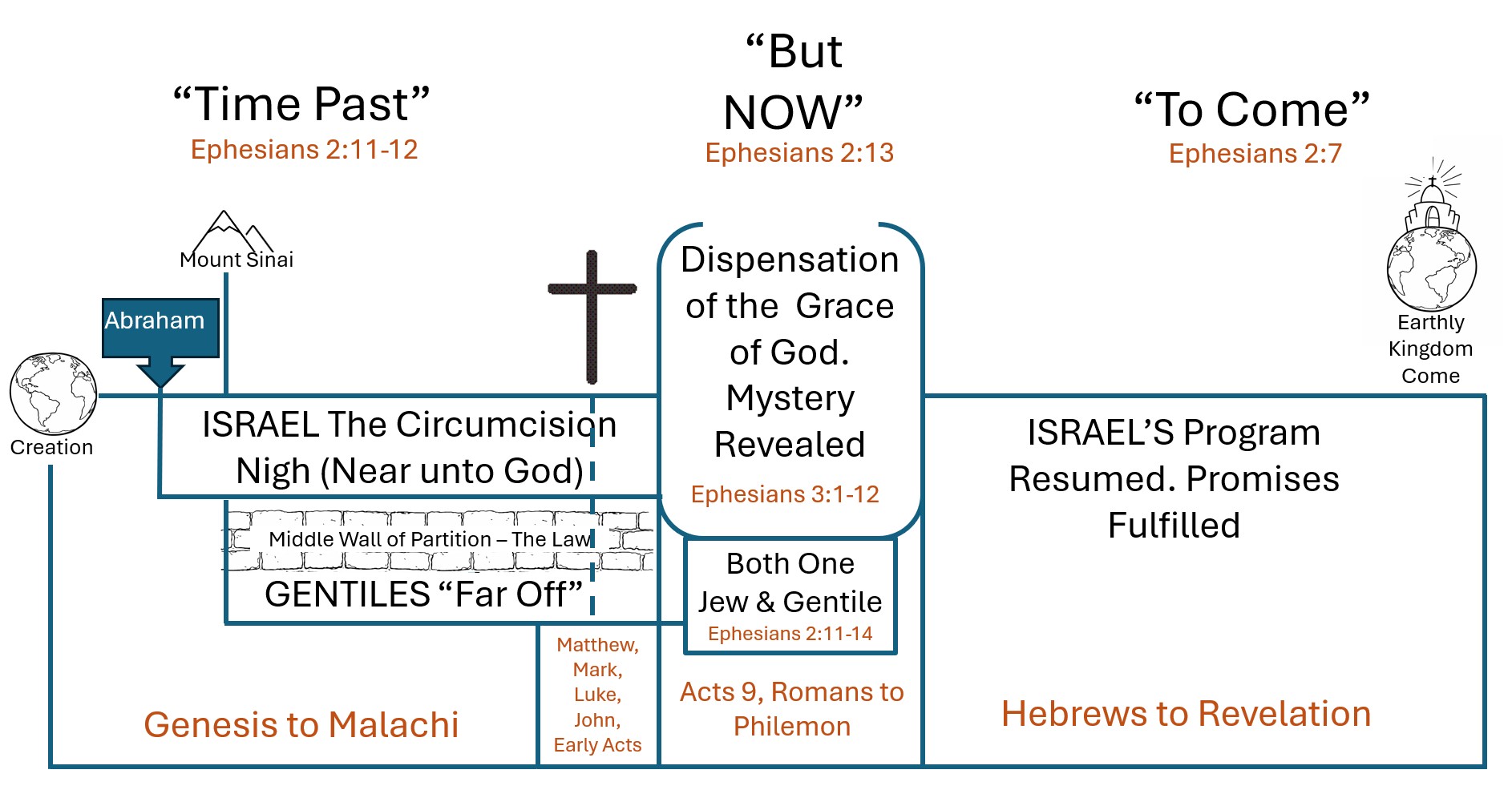
On the chart below this recording, we’re looking at the plain differences between what God told Israel in time past and what He tells us today in this dispensation of Gentile grace, or the era the Apostle Paul calls “But Now”. As we saw in the previous episodes, this chart is a visual representation of how we should rightly divide the Word of Truth as we’re told to by Paul in 2 Timothy 2:15.
“Speed Slider”
 Click Image To Enlarge
Understanding The Bible – Episode 4 – Transcript
We’re now in Episode Four of our Basic Bible Understanding series.
On the chart below this recording, we’re looking at the plain differences between what God told Israel in time past and what He tells us today in this dispensation of Gentile grace, or the era the Apostle Paul calls “But Now”. As we saw in the previous episodes, this chart is a visual representation of how we should rightly divide the Word of Truth as we’re told to by Paul in 2 Timothy 2:15.
This matters because if we don’t rightly divide the word of truth, you can be scriptural and still disobey the Lord. We can quote the Bible and yet grieve the Holy Spirit if we take something God said to Israel and try to make it fit us today. God made a great dispensational change when He set Israel aside and began forming the new creation, the church, the body of Christ.
So we see these three sections on the timeline:
Genesis through to the early chapters of Acts is “time past” or God’s dealings with Israel.
From the later chapters of Acts and Romans through to Philemon, we have the “but now ” era, God, dealing with us today through Paul.
Hebrews through to Revelation are the “ages to come”, when God resumes Israel’s program.
Right division simply means we don’t mix these programs. We don’t take Israel’s laws, promises, or instructions and lay them on the church. And we don’t take church doctrine and push it back into Israel’s program. God didn’t design His book to work that way.
A very obvious example is the one we started last time with the dietary laws.
In Leviticus 11, God told Moses and Aaron to command Israel not to eat certain meats. Those laws had force. If an Israelite ate unclean food, he became unclean and had to go outside the camp. That was God’s program with Israel.
But when we come to 1 Timothy 4, God says the exact opposite to us today.
Through Paul, the Spirit warns that in the latter times some will depart from the faith by listening to seducing spirits and doctrines of devils. And what will these false teachers say? They’ll forbid meats or take Israel’s old dietary laws and try to put them on the church today.
Paul says that kind of teaching is not from God — it is from devils.
So if a Christian today tries to follow Leviticus 11 as if it were written to us, he’s not being obedient. He’s mixing programs. He’s ignoring the dispensational change God made.
This is why Bible critics love to point out “contradictions.” They see Leviticus say one thing and Paul say the opposite. But the problem isn’t the Bible; the problem is not rightly dividing it. When Christians don’t understand this, they get confused, and scoffers use that confusion to attack the Scriptures.
Right division clears it up.
Leviticus 11 belongs to Israel’s “time past” program.
1 Timothy 4 belongs to our program today.
Both are Scripture. Both are true. But they’re not written to the same people or for the same dispensation.
This is why we must handle God’s Word the way God tells us to — by rightly dividing it.
Now look here in 1 Timothy 4. Paul says these false teachers will stand with a Bible in their hand, quote chapter and verse, and still lead God’s people away from the truth.
Take the example we’re dealing with: commanding to abstain from meats. It’s in the Bible, and Leviticus 11 is full of it. God told Israel, “Don’t eat this, don’t touch that.” Those meats were unclean to them. But that was Israel’s program, back in time past on our timeline.
Now look at what Paul says about this in 1 Timothy 4:3–5,
Forbidding to marry, and commanding to abstain from meats, which God hath created to be received with thanksgiving of them which believe and know the truth.
For every creature of God is good, and nothing to be refused, if it be received with thanksgiving:
For it is sanctified by the word of God and prayer.
He says these meats are created by God to be received with thanksgiving. He says every creature of God is good, and nothing is to be refused if received with thanksgiving, because it’s sanctified by the word of God and prayer.
So in Leviticus 11, God said, “Refuse it.”
In 1 Timothy 4, God says, “Don’t refuse it.”
How can both be true?
Because God changed the program. Leviticus 11 was never spoken to the church, the body of Christ. Paul’s epistles, Romans through to Philemon, are the portion of God’s Word written to us and about us today.
This is why right division is not optional. A Christian today cannot follow Leviticus 11 and please God. The only ones pleased by that are the flesh and the devils who promote it, and the Holy Spirit expressly warns us not to do it.
Satan doesn’t want Christians to throw their Bibles away. He wants them to use the Bible wrongly. He wants members of the church, the body of Christ, to live as if they were back in “time past” under Israel’s law, or out in the “ages to come”, instead of living in the dispensation of grace God has given us today.
So Satan puts his ministers right where the Bible is taught—churches, seminaries, Bible colleges, and home studies. They quote Scripture, but they don’t divide it correctly. They take things God said to Israel and lay them on us, and Paul says that kind of teaching is not from God at all.
Why? Because Satan knows that when we go back to trying to do the law, we will fail dismally every time, just like Israel did. That will succeed in bringing condemnation, a sense of defeat and hopelessness to the Christian. It will rob him of the great treasures he has now under the dispensation of grace, and it will cause him to live a totally defeated life, always feeling worthless and separated from God. Satan rejoices at this!
Zeal and sincerity are no excuse. Paul said in Romans 10 that Israel had a zeal for God, but not according to knowledge, and God still held them accountable.
The same is true today. If we ignore the knowledge God’s given us through Paul, we’ll end up disobeying God while thinking we’re serving Him.
This is one of Satan’s main goals in this age: to get Christians to be biblical but not dispensational. And when we look around, we can see how successful he’s been. Many Christians try to live under Israel’s program and don’t even know the mystery of Christ exists.
Now let’s look at another obvious example.
We’re going to look now at John 7 and Galatians 5 and keep our timeline in mind as we compare them.
Now, when we’re in John’s Gospel, you’re back in time past on our timeline, and we’re dealing with Israel’s program, not the church, the body of Christ.
Here in John 7, the Lord Jesus Christ is speaking to unbelieving Israel about something that was a huge issue for them — physical circumcision.
Look at John 7:21–22 where,
Jesus answered and said unto them, I have done one work, and ye all marvel.
Moses therefore gave unto you circumcision; (not because it is of Moses, but of the fathers;) and ye on the sabbath day circumcise a man.
Jesus says Moses gave them circumcision, though it really began with the fathers, back in Genesis 17, when God gave Abraham the sign of the covenant. Circumcision marked Israel as God’s people. The uncircumcised were “cut off.” This wasn’t optional. Moses himself almost died for failing to circumcise his sons in Exodus 4:24 -26. That shows how serious it was under Israel’s law.
Jesus even says they would circumcise a child on the Sabbath day because the command was that important.
And in Luke 2:21, we read,
And when eight days were accomplished for the circumcising of the child, his name was called JESUS, which was so named of the angel before he was conceived in the womb.
Even the Lord Jesus Christ Himself — born of a woman, made under the law — was circumcised on the eighth day. Under Israel’s program, no man could afford to ignore circumcision.
Now move forward on the timeline to Galatians 5:1-2, where Paul speaks to the new creation, the church, the body of Christ, in this dispensation of grace. Paul says,
STAND fast therefore in the liberty wherewith Christ hath made us free, and be not entangled again with the yoke of bondage.
Behold, I Paul say unto you, that if ye be circumcised, Christ shall profit you nothing.
That’s something Moses could never say! It’s the exact opposite of what Israel was told. Under the law, circumcision was required. Under grace, Paul says if you get circumcised for religious reasons, you lose the profit of Christ.
That’s why he says, Behold, I Paul say unto you…”
We’d better know who this man is, because he’s saying something totally different from Moses, Abraham, and even Jesus in His earthly ministry.
Why?
Because we’re in a different program! Circumcision has no place in the dispensation of grace. Look at Galatians 5:6,
For in Jesus Christ neither circumcision availeth any thing, nor uncircumcision; but faith which worketh by love.
And again in Galatians 6:15,
For in Christ Jesus neither circumcision availeth any thing, nor uncircumcision, but a new creature.
That’s the issue today. The one new man, the new creation God’s forming. In this body, there’s no Jew or Gentile, no male or female, no bond or free. The old distinctions of Israel’s program simply don’t apply.
This is simple, but that’s the point. When we can see the simple differences, we can handle the harder ones. And this shows yet again why we must rightly divide the word of truth.
If a Christian today tries to follow Israel’s circumcision law, he’s not pleasing God. He’s pleasing his flesh and the devils who push that confusion. The Holy Spirit expressly warns us not to go back under that bondage.
Now let’s look at another clear comparison.
Turn to Leviticus 23 and Galatians 4, while keeping our timeline chart in mind as we compare Israel’s holy days with what God says to us today.
Here, in Leviticus chapter 23, the Lord gives Israel a whole calendar of holy days, Sabbaths, feast days, new moons, Passover, Unleavened Bread, Firstfruits, Pentecost, Trumpets, Day of Atonement, and Tabernacles. These were not optional. God calls them “My feasts.” They were holy convocations, sacred assemblies set apart to honour God. Israel could not worship God properly without keeping this calendar. These holy days were part of the outward ceremonies God gave Israel under the law.
Now move forward on the timeline to Galatians 4, where Paul’s writing to the church, the body of Christ, in the dispensation of grace. The Galatians had been tricked by the very thing Paul warns about in 1 Timothy 4—seducing spirits and doctrines of devils. False teachers came in with Bibles in their hands, so to speak, and bewitched them.
Paul says in Galatians 3:1,
“O FOOLISH Galatians, who hath bewitched you, that ye should not obey the truth, …
They didn’t even know it happened.
In Galatians 1:6, Paul says,
I marvel that ye are so soon removed from him that called you into the grace of Christ unto another gospel:
They were removed from the grace of Christ to “another gospel.” That’s how powerful Satan’s policy of evil is when Christians don’t rightly divide the word of truth.
Now, by the way, Paul’s not saying they lost their salvation, but the power of the true gospel and all the treasures they had under that gospel were no longer the foundation of their daily walk.
What were these Galatians doing? They were opening their Bibles, the scriptures, to Leviticus 23 and had started keeping Israel’s feast days.
They were being scriptural, but they were not remembering the new dispensation Paul had taught them.
They brought Israel’s program into the dispensation of grace, and Paul says that’s disobedience.
Look at Galatians 4:3–7.
Even so we, when we were children, were in bondage under the elements of the world:
But when the fulness of the time was come, God sent forth his Son, made of a woman, made under the law,
To redeem them that were under the law, that we might receive the adoption of sons.
And because ye are sons, God hath sent forth the Spirit of his Son into your hearts, crying, Abba, Father.
Wherefore thou art no more a servant, but a son; and if a son, then an heir of God through Christ.
Paul explains that in time past, Israel was under the elements of the world, the law, the holy days, and the ceremonies. But now, in the fullness of time, God sent His Son to redeem those under the law so that we might receive the adoption of sons. That’s a different standing.
Under the law, Israel was treated as children under tutors and governors. But in grace, God deals with us as adult sons, not servants. We have the Spirit of His Son in our hearts crying, “Abba, Father.” Paul says plainly, “Thou art no more a servant, but a son.”
Two different positions.
Two different ways God deals with His heirs.
Two different programs on the timeline.
Israel’s heirs in time past lived under the law, the Sabbaths, the feasts, and the new moons. But the heirs in this dispensation of grace are not under those things. God’s dealing with us differently.
But the Galatians didn’t walk in that truth. They were persuaded—Paul says in Galatians 5:8,
This persuasion cometh not of him that calleth you.
They were persuaded by Satan’s policy of evil to go back under Israel’s program. They thought they were honouring God by keeping feast days, but they were actually disobeying Him.
This is why Paul warns them in Galatians 4:9–11
But now, after that ye have known God, or rather are known of God, how turn ye again to the weak and beggarly elements, whereunto ye desire again to be in bondage?
Ye observe days, and months, and times, and years.
I am afraid of you, lest I have bestowed upon you labour in vain.
He says he’s afraid for them. They were scriptural, but not orrect and that’s where the trouble always comes in.
Rightly dividing the Word protects us from this. It keeps us from dragging Israel’s holy days into the dispensation of grace and calling it obedience. It keeps us walking in the liberty God’s given us as sons, not servants.
Here’s another clear example of how Satan works. He doesn’t tell Christians to throw the Bible away. He wants believers to be scriptural, but following the wrong program. On our chart below, he wants the church, the body of Christ, to live as if we were still in the time past era, under Israel’s law, instead of living as sons in the dispensation of grace.
We just read Paul saying in Galatians 4:7–9 that we are no more servants, but sons. God isn’t treating us like children under the law. Yet the Galatians turned back to the, quote, weak and beggarly elements, the very things God gave Israel when He was treating them as children.
Paul asks, “How turn ye again… to be in bondage?” They were observing days, months, times, and years. Where did they get that? From Leviticus 23, where God told Israel to keep Sabbaths, feast days, and holy convocations.
Those things were right for Israel. They were part of their worship. God called them “My feasts”, but they were never given to the church. And Paul says plainly that for us, those things are now weak and beggarly. Moses could never have said that, because Israel was supposed to live under those elements. But we’re not Israel, and we’re not under that program.
It’s impossible to obey Leviticus 23 and Galatians 4 at the same time. If a Christian today observes holy days to please God, he’s not pleasing God at all. He’s pleasing his flesh and the devils who push that confusion.
Paul warns again in Colossians 2:8,
Beware lest any man spoil you through philosophy and vain deceit, after the tradition of men, after the rudiments of the world, and not after Christ.
These rudiments are the same outward ceremonies Israel had: meats, drinks, holy days, new moons, Sabbaths. In Colossians 2:16–17, Paul says, “Let no man therefore judge you” in these things. Why? Because they’re a shadow of things to come, not the things we do today. They belong to Israel’s future kingdom program, in the “times to come” era, not the body of Christ.
There’s no such thing as a “Christian Sabbath.” That’s just a clever way to drag the law into grace. The only Sabbath God ever gave was the one He gave to Israel. All those Sabbaths and feast days in Leviticus 23 are shadows, pictures of what God will do when He finishes His program with us. They’re not for the church today.
When a believer follows those shadows, he’s acting as if he belongs to Israel’s program, or even to Israel’s future kingdom, and that’s way out of line with what God’s doing now in the dispensation of grace.
Now look again at John 7 and Romans 6. In John 7, Jesus tells Israel that Moses gave them the law, and they were under it. The law was the whole structure of God’s dealings with Israel. Jesus Himself was born under the law and told Israel to obey those who sat in Moses’ seat.
But in Romans 6, Paul tells us something completely different. We are not under the law, but under grace. God’s not dealing with us by the Ten Commandments or the law system. That belonged to Israel’s program in time past and will belong to them again in the future. But not now.
This is why we must rightly divide the word of truth. If we don’t, we will end up scriptural—but disobedient.
Now let’s look at one more major issue on our timeline — the law itself. In John 7, Jesus tells Israel plainly, “Did not Moses give you the law?” Israel was under the law, and God dealt with them by that law.
Jesus Himself lived under it. He was circumcised, Mary offered the purification sacrifice, He kept the feasts, and He told Israel that whoever broke even the least commandment would be least in the kingdom. The law was the tenor, or the voice of God’s dealings with Israel — the whole structure of their program.
But when you move forward on the timeline into Paul’s epistles, you find the exact opposite.
In Romans 6:14, Paul says this,
For sin shall not have dominion over you: for ye are not under the law, but under grace.
Moses could never say that. Jesus never said that to Israel. The twelve apostles never said it. Yet Paul says it with full authority because God has made a dispensational change. In this dispensation of grace, God deals with us under grace, not under the law.
Grace is the key word of this whole program — from why it began to how God works in us today. And if a believer doesn’t understand what it means to live under grace, he has no capacity to please the Lord. Trying to live under the law today doesn’t honour God. It grieves the Holy Spirit and pleases the adversary.
Now look at 1 Timothy 1. Paul warns Timothy about people in this age who “desire to be teachers of the law.”
The false teachers were Judaizers, who tried to mix Judaism and Christianity, law and grace. They taught that faith in Christ was not sufficient for salvation. They insisted that a man must be circumcised and must keep the Law of Moses.
This false teaching has been present in every century of church history, and it is the plague that has been most successful in corrupting Christianity. It states that although faith in Christ is necessary for salvation, a person must also be baptised, or join the church, or keep the law, or do penance, or tithe, or perform some other type of “good works.” Those who teach this fail to realise that salvation is by faith in Christ without the deeds of the law. They don’t realise that good works are the result of salvation and not the cause. They don’t see that Christ, and not the law, is the believer’s rule of life. They fail to understand that a man cannot be under the law without being under the curse. The law condemns to death all who fail to keep every letter of it. Since no man can obey the law perfectly, all are condemned to death. But Christ has redeemed believers from the curse of the law because He was made a curse for us.
The apostle says that these false teachers did not understand what they were saying. They couldn’t speak intelligently about the law because they didn’t understand the purpose for which the law was given or the relationship of the believer to the law.
That could never be said in Moses’ day, because Israel was supposed to live under the law. But today, in grace, that kind of teaching is, as Paul describes, vain jangling, empty noise.
Paul left Timothy in Ephesus to charge certain men to teach no other doctrine. Once a person stops rightly dividing the Word, they end up with fables, genealogies, and confusion. Godly edifying today is in faith, not in the law system. Paul says the law is good if a man uses it lawfully, and the lawful use is to show up the sin in a person and how hopeless a person’s position is without a redeemer.
1Timothy 1:9 says,
The law is not made for a righteous man…
Every believer in this dispensation is righteous by justification. The law was made for the lawless, not for the saints.
So any attempt to put Christians under the Ten Commandments as a rule of life is false doctrine. It denies the very nature of this dispensation. God is dealing with us in a totally different way than He dealt with Israel in time past.
All these examples — circumcision, feast days, meats and drinks, Sabbaths, and now the law itself — show the absolute need to rightly divide the word of truth. This dispensation of grace is a new program with new instructions, and if we mix it with Israel’s program, our Christian life becomes confused and displeasing to God, no matter how sincere we are.
In the next episode, we’ll pull these threads together and then step into that critical section of the four gospels, Matthew, Mark, Luke and John, where so many Christians think the dispensation of grace is operating. We’ll see clearly what’s really happening there and how God is dealing with us today under grace.


Leave a Reply
Want to join the discussion?Feel free to contribute!