
Understanding The Bible – Episode 7
We’re moving on now in our Understanding the Bible series, and we’re on episode seven.
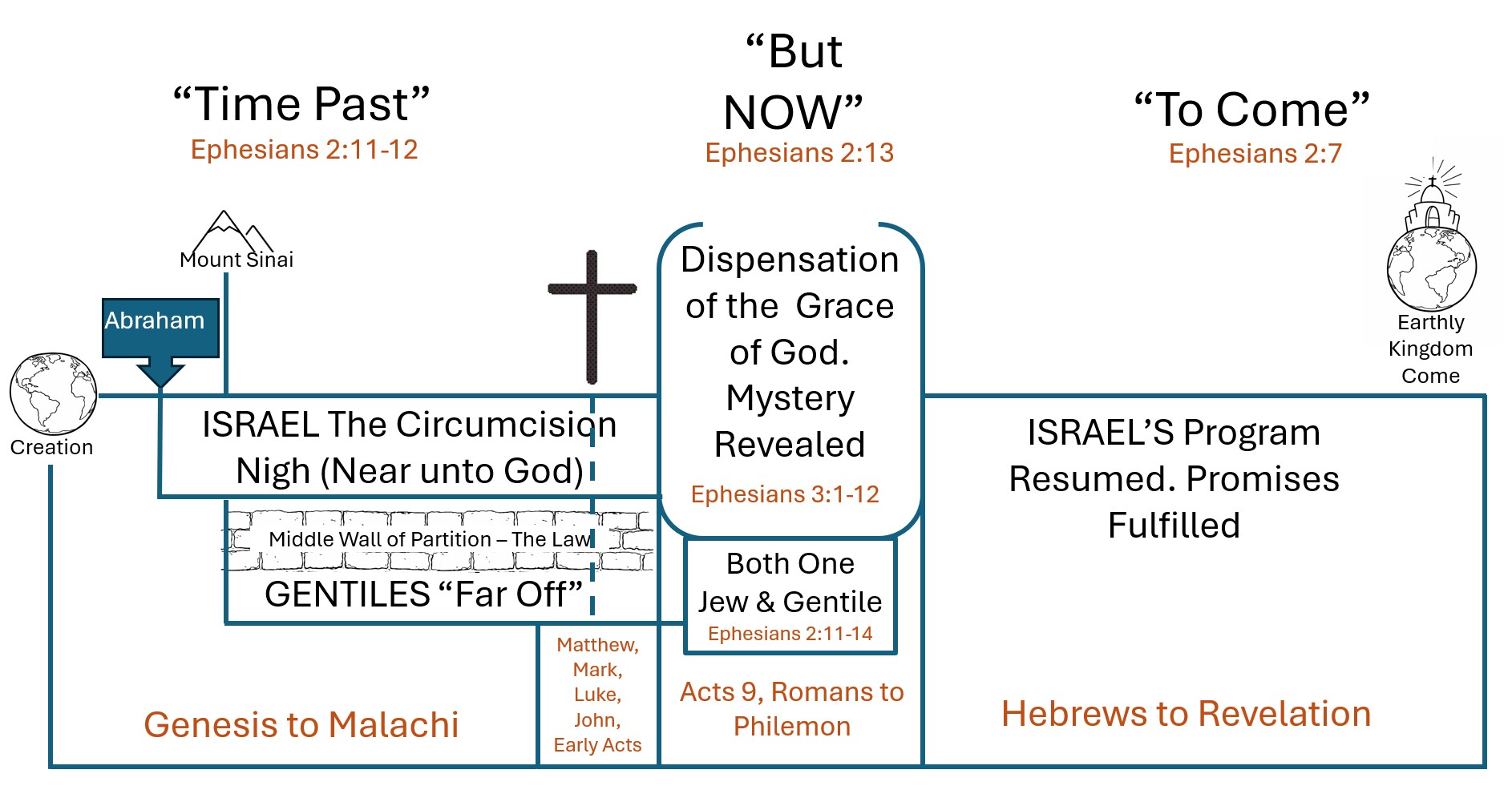
We’re using the charts below this recording as a visual tool to help us see the timeline we’re talking about.
As with the last episode, we’re looking at what was happening in God’s program with Israel just before He brought in the dispensation of grace.
“Speed Slider”
 Press Image To Enlarge
 Press Image to Enlarge
Understanding The Bible – Episode 7 – Transcript
As with the last episode, we’re looking at what was happening in God’s program with Israel just before He brought in the dispensation of grace. This was right before God suspended His dealings with Israel and raised up Saul and changed his name to Paul. Paul was a brand‑new apostle, revealing the mystery that had been kept secret since the world began, none of which was spoken about by the prophets. Paul says that over and over again.
Before God interrupted Israel’s program, Israel had entered the climactic time that the prophets spoke of — the days of the Messiah. The prophets showed two stages:
- The meek and lowly first coming, where Christ confirmed the promises made to the fathers.
2. The Day of the Lord, still future, when He returns in wrath and glory, purges Israel, judges the nations, and establishes the kingdom promised in the Abrahamic and Davidic covenants.
That’s what we’re reading when we open the Gospel accounts, and this is where so many Christians get confused. Most believers today open Matthew, Mark, Luke, and John to find their instructions for Christian living — but that’s out of line with what God’s doing today. The Gospel records, and Acts 1–7, belong to Israel’s program, not the present dispensation of grace.
Paul says plainly in Romans 15:8 that Jesus Christ was “a minister of the circumcision for the truth of God, to confirm the promises made unto the fathers.”
We’ve seen that in Ephesians 2, and we’ve seen the Gospel accounts themselves showing the same thing.
The first stage that we looked at was Christ’s first coming, where He confirmed the promises made to the fathers.
The people Jesus dealt with then were Israel. He said Himself that He was sent only to the lost sheep of the house of Israel. He told the Twelve apostles not to go to the Gentiles. We saw that the Gentiles were called dogs, and we saw that the middle wall of partition, separating the circumcision and the uncircumcision, was still fully in effect.
No change to that was expected, and no change to that was happening. The Bible’s perfectly clear on this, and the only way Christians can miss it is if we don’t pay attention to what God actually says. Today, we tend to listen to too many so-called authorities on the Word of God teaching from their own positions of misunderstanding instead of understanding the whole counsel of God themselves before turning their listeners to confusion and error.
I’ve been the subject of that myself for many years, but I don’t blame the teachers. It was me who was either too lazy or too busy to properly check out what I was being taught using the entire Bible, even though looking back now, the timings of God’s overall plan and purpose were in full view all the time.
Also, I absolutely understand how living in this world can consume us, demanding our full attention, and even though we believe in God, the pressure of the “now” drags us away from studying the Bible properly and understanding our eternal destiny and the truth relating to our lives that’s at stake.
Now we’re on the second stage of the message being preached in the Gospel records.
Turn to Luke 1:31–33, and it’s where the Angel, Gabriel, tells Mary why the Messiah is coming. Let’s read,
And, behold, thou shalt conceive in thy womb, and bring forth a son, and shalt call his name JESUS.
He shall be great, and shall be called the Son of the Highest: and the Lord God shall give unto him the throne of his father David:
And he shall reign over the house of Jacob for ever; and of his kingdom there shall be no end.
That’s the Davidic covenant, the promise that God made to David, which was itself built on the Abrahamic covenant, the covenant God made with Abraham. That’s why Christ came — to bring in that long-promised and prophesied kingdom.
He, Jesus, will be “great” because God promised to make Israel a great nation, not by fleshly greatness but by Jehovah’s working in them and through them. That’s what the kingdom of heaven, the kingdom of God, is in the Gospel accounts — God establishing His covenant kingdom in and through Israel.
Nothing here is about forming the church, the body of Christ, where Jew and Gentile are equal. That truth was still hidden in God. The message preached by John the Baptist, and then by the Lord Himself, and then by the twelve apostles and the “seventy”, and then by the twelve again after the resurrection and His ascension to heaven, was all the gospel of the kingdom, the good news that the promised kingdom for Israel was at hand.
That kingdom of heaven on earth, ruling and reigning through the seed of Abraham and Jacob.
Look again at Luke 1:33,
And he shall reign over the house of Jacob for ever; and of his kingdom there shall be no end.
God the Father will give Christ “the throne of His father David.” That’s a literal, physical throne, not a spiritual kingdom in men’s hearts, not heaven itself, but the actual kingdom on this earth that was promised in the covenants.
Christ will reign over the house of Jacob forever. That’s His house, a real nation, in a real land, with real borders. And “of His kingdom there shall be no end.” It’ll be here, on earth, forever! That’s the Abrahamic covenant being fulfilled.
This is the same kingdom Jesus teaches the apostles to pray for in Matthew 6:5-13. “Thy kingdom come, Thy will be done on earth.” God’s will is destined to be done on earth, with Christ reigning as Jehovah in human flesh, the Son of David, Jesus, the Christ, fulfilling the Abrahamic and Davidic covenants. Gabriel knows this. He isn’t speaking his own ideas — he’s sent from the Father, who wrote the plan.
We see it confirmed again before the public message even begins. Luke 1:67, John the Baptist is born, and his father Zacharias is filled with the Holy Ghost and prophesies.
He says, “Blessed be the Lord God of Israel, for He hath visited and redeemed His people.”
His people are Israel, not the world, not Gentiles. God has raised up a horn of salvation for Israel in the house of David. This is all fulfilling prophecy, not revealing a mystery.
Zacharias says it plainly: “As He spake by the mouth of His holy prophets, which have been since the world began.”
Nothing secret here. Nothing new. This is the climactic stage of God’s program with Israel.
Zacharias explains the salvation he has in mind: Israel saved from their enemies in verse 71. Those enemies are Gentiles, friends. In time past, the Gentiles were the nations Satan used against Israel. Joel 3:9 even records God’s message to the Gentiles in the Day of the Lord. It reads,
Proclaim ye this among the Gentiles; Prepare war, wake up the mighty men, let all the men of war draw near; let them come up:
That’s what we would have heard if God had not brought in the dispensation of grace. Without the mystery of Christ, God’s message to us would have been, “Get ready — I’m coming to fight you.”
Here in Luke 1, the salvation is God delivering Israel from their enemies to perform the mercy promised to the fathers and remember His holy covenant (verses 72–73).
God staked His holiness on that covenant. Paul says in Romans 11 that the gifts and calling of God to Israel are without repentance. God swore to Abraham that Israel would be delivered and would serve Him without fear, in holiness and righteousness all their days (verses 74–75).
That’s what the Holy Spirit was declaring through Zacharias. That’s what was happening in the Gospel accounts. And notice how there’s nothing at all there about the mystery of Christ. Nothing about Jew and Gentile being made one, nothing about the body of Christ and nothing about a dispensation of grace given to the Gentiles. None of that is in Luke 1 because none of that was the issue. This is still Israel’s program.
And what was our status as Gentiles at that time? Enemies of God, not only as sinners but on the basis of just being Gentiles. Paul says in Colossians 2:13 that before God saved us in this dispensation of grace, we Gentiles were dead twice. Dead in sins as Adam’s children, and dead in the uncircumcision of our flesh. One of those deaths was simply being a Gentile.
Gentiles were Israel’s enemies, and Luke 1 shows that clearly. God promised Israel deliverance from those enemies in the Day of the Lord’s wrath.
In Luke 1:76, Zacharias tells his son John what his ministry will be:
And thou, child, shalt be called the prophet of the Highest: for thou shalt go before the face of the Lord to prepare his ways;
John will give knowledge of salvation to Israel — not salvation from hell, but salvation from their enemies, performed by the Horn of Salvation, the Messiah. That’s why John preaches the wrath to come and why he speaks of the Lord purging His floor, burning the chaff, and gathering the wheat as we see in Matthew 3. That’s the salvation he’s talking about.
Luke 1:77 says He gives this knowledge “by the remission of sins,” which is where his water baptism fits. John’s baptism identified the believing remnant of Israel who would escape the coming wrath. This is tied to the Dayspring from on high that Luke 1:78 mentions.
This is a Davidic‑covenant title, visiting Israel to give light to those sitting in darkness. It’s Israel under Gentile oppression, as in Isaiah 9:2 says,
The people that walked in darkness have seen a great light: they that dwell in the land of the shadow of death, upon them hath the light shined.
This is the program in the Gospel accounts: Israel entering the climactic stage of prophecy, the kingdom being offered, the wrath approaching, and the Messiah ready to deliver the nation and bring in the promised kingdom. The message is about national deliverance, kingdom blessing, and Jehovah’s reign on earth through the Son of David.
This is not the message God’s preaching today. You can’t go out and preach John the Baptist’s message, or the Lord’s kingdom gospel, or the Twelve apostles’ message, and be doing God’s will today. That would be preaching something God’s not doing in this dispensation of grace. It would make the Word of God of none effect by ignoring the timeline.
Now turn to Matthew 3. John the Baptist breaks the 400‑year silence. Luke 3 says the Word of God came to John in the wilderness. John 1 says he was a man sent from God, and Matthew 3:1-3 says,
In those days came John the Baptist, preaching in the wilderness of Judaea,
And saying, Repent ye: for the kingdom of heaven is at hand.
For this is he that was spoken of by the prophet Esaias, saying, The voice of one crying in the wilderness, Prepare ye the way of the Lord, make his paths straight.
Matthew 3:3 quotes Isaiah 40:3, the voice crying in the wilderness, preparing the way of the Lord.
Malachi 3 also foretold him. Jesus later quotes both passages and applies them to John in Matthew 11 and Mark 1.
This proves something important for our timeline:
John is a prophesied messenger with a prophesied message.
He’s not preaching anything new, secret, or hidden. He’s preaching exactly what the prophets said would come. That means he’s not preaching the mystery of Christ, not the body of Christ, not Jew and Gentile made one, not the dispensation of grace. His message belongs to Israel’s prophetic program, not ours.
Look at Isaiah 40. The whole context shows the message John would preach:
“Comfort ye my people… speak comfortably to Jerusalem… her warfare is accomplished… her iniquity is pardoned.”
This is comforting news to Israel, just like Zacharias said: “Blessed be the Lord God of Israel, for He hath visited and redeemed His people.”
This is what was happening in the Gospel accounts, Israel’s kingdom program, not the mystery program revealed later to Paul.
The Messiah is Israel’s deliverance, the means by which everything in Isaiah 40:1 will happen — Israel comforted, no longer oppressed, delivered from all who hate her, and finally receiving her kingdom. John will proclaim this publicly. None of this is a mystery. It all sits in the Abrahamic covenant, the mercy promised to the fathers, and the words spoken by the prophets since the world began.
John’s message is simple: Everything God promised is now at hand. He begins the comforting news. The end of that comfort will be Israel’s warfare finished, her iniquity pardoned, and her kingdom given. John prepares the people for the Lord in a very specific way. He is in the wilderness because God said in Hosea that He would bring Israel back there and speak to her heart again.
John matches Elijah in 1 Kings 17 and 2 Kings 1:8, where prophecy is about Elijah coming before the Messiah.
These fine details show Israel’s program is in full operation, and the climactic stage has arrived.
In Isaiah 40, the voice asks, “What shall I cry?” The answer begins with a personal indictment: all flesh is grass. Israel must face her condition. Then comes the good news to Zion, “Behold your God”.
The Messiah is here. He will come with a strong arm, ruling in power and glory. He will also feed His flock like a shepherd.
John announces both stages of the Messiah — the meek and lowly One now present, and the powerful One who will come in judgment and glory.
This is a prophesied message, not a mystery. John could never say he was preaching something “kept secret since the world began.” Everything he says was spoken by the prophets. Jesus Himself said in Matthew 11 and Luke 16, “The law and the prophets were until John.”
That doesn’t mean the law ended with John — it means the law and prophets kept saying, “It’s coming, it’s coming,” until John arrived and said, “It’s here. It’s at hand.”
Daniel even put the kingdom on a time schedule. When the schedule reached its point, the kingdom would be declared “at hand”. That is exactly what John does in Matthew 3:2: “Repent ye, for the kingdom of heaven is at hand.”*
That marks this climactic stage of Israel’s program on our timeline.
When something is “at hand,” it’s within reach — ready to be established. And we know what that kingdom is: the literal, physical kingdom of God on this earth, promised in the Abrahamic and Davidic covenants, confirmed by Gabriel in Luke 1, and tied to Daniel’s prophecy in Daniel 2:44, which says:
“In the days of these kings shall the God of heaven set up a kingdom…”
The kingdom of heaven is not heaven itself, and it’s not a spiritual reign in men’s hearts, but God ruling on earth through Israel in an actual, physical kingdom. That’s the good news of the Gospels — the gospel of the kingdom — because the issue in the Gospel accounts is God’s program with Israel, not the mystery program revealed later to Paul.
In Mark 1:14, we read,
Now after that John was put in prison, Jesus came into Galilee, preaching the gospel of the kingdom of God,
See? The same message John preached. The Kingdom of God and the Kingdom of heaven are the same thing — God’s kingdom, set up by the God of heaven on this earth. Moses, in Deuteronomy 11:21, spoke of the days of heaven upon the earth, because God Himself will come down and reign here. Jacob saw the same thing in his ladder vision in Genesis 28:10–22, heaven’s business carried out from the land God promised to him. That’s why he called it Bethel, the house of God.
Moses said in Exodus 15 that Israel would be brought to God’s sanctuary, His habitation, and that the Lord would reign forever and ever from that land. This’s been God’s plan for the earth since the world began, carried out through the seed of Abraham. In the Gospel accounts, the time schedule has reached the point where this kingdom can be declared at hand.
So Jesus says in Mark 1:15,
…The time is fulfilled, and the kingdom of God is at hand: repent ye, and believe the gospel.
See how the “at hand” message is tied directly to time. John, Jesus, and later the Twelve all say the same thing because the time schedule given to Daniel was almost complete.
Daniel, in his incredible prophecy relating to the fulfilment of God’s plan, in Daniel 9, laid out a 490‑year program for Israel and Jerusalem. After 483 years, Messiah would be “cut off.” The Lord’s earthly ministry lasted about 3 years, placing His preaching at roughly the 480‑year mark, which makes about 98% of the prophetic clock completed. That’s why Jesus could honestly say, “The time is fulfilled.” They couldn’t say that in Daniel’s day, nor during the 400‑year silence. But once John and Jesus appear, the prophetic clock is near its end.
This answers an important question on our timeline chart below:
Why did the kingdom not get established, even though it was truly “at hand”?
The only honest answer is that God interrupted the program. When Israel rejected their Messiah, and the last seven years of Daniel’s prophecy, which we know as Daniel’s 70th week, were ready to begin, God brought in the dispensation of grace. He stopped the prophetic clock, and it hasn’t started ticking again since! And it won’t start again until after this dispensation ends.
That’s why Paul says in 1 Thessalonians 5:1,
But of the times and the seasons, brethren, ye have no need that I write unto you.
Times and seasons belong to Israel’s program, not ours. In Matthew 24, Daniel 11–12, and the Lord’s own teaching, Israel is given detailed timing for the last seven years. But in the dispensation of grace, we’re not on a time schedule, at least not one that God’s revealed to man in any way.
So when Jesus and John preached, “The kingdom of heaven is at hand,” they were speaking truth because the prophetic time schedule was nearly complete. The kingdom they preached was the literal, physical kingdom promised in the Abrahamic and Davidic covenants, confirmed by Gabriel in Luke 1, and tied to Daniel 2:44, which says,
And in the days of these kings shall the God of heaven set up a kingdom, which shall never be destroyed:
That’s the gospel of the kingdom — the good news in the Gospel accounts of God’s program with Israel. It’s not the mystery program revealed later to Paul.
The time schedule God gave Daniel lets us know exactly whose program is operating in the Gospel accounts. That prophetic clock is still ticking in Matthew, Mark, Luke, and John. Nothing mysterious is happening there. It is all prophesied, and even scheduled. That’s why the kingdom can finally be called “at hand.”
The kingdom wasn’t at hand in Abraham’s day, or Moses’, or David’s, or Isaiah’s, or even Daniel’s days. It becomes “at hand” only when the prophetic clock reaches its final years. So when Jesus says, “The time is fulfilled, and the kingdom of God is at hand: repent and believe the gospel,” He means exactly that — the timeline is almost complete.
Back to Matthew 3. This could be called the “gospel of the Gospels” — the good news that the time for God to fulfil His program with Israel has arrived. The message is preached to Israel, the lost sheep of the house of Israel. It’s their kingdom, their covenants and their promises.
John the Baptist shows the rest of Isaiah 40 being fulfilled. In Matthew 3:7, he warns the Pharisees and Sadducees:
But when he saw many of the Pharisees and Sadducees come to his baptism, he said unto them, O generation of vipers, who hath warned you to flee from the wrath to come?
That wrath is the final seven years of Daniel’s timeline — the Day of the Lord, the time of Jacob’s trouble. After 483 years, Messiah would be cut off. Only seven years remain. John’s announcing the urgency of that moment.
In Matthew 3:10, John says,
And now also the axe is laid unto the root of the trees:
God is ready to cut down the unfruitful trees in Israel. The axe is already in place during Christ’s meek and lowly ministry. In the Day of His wrath, He’ll swing it. Every tree not bearing good fruit will be cast into the fire — the purging fire of the tribulation spoken of in depth in Malachi 4.
John says he baptises with water, but the One coming after him will baptise with the Holy Ghost (Acts 2) and with fire (the Day of the Lord).
Pentecost is not the beginning of the dispensation of grace. It is a prophesied event, spoken of in Isaiah 40, Isaiah 42, Joel 2, and many other places. Nothing about Pentecost was a mystery. John knew it was coming because the prophets said it.
In Matthew 3:12, John says of the Messiah,
Whose fan is in his hand, and he will throughly purge his floor, and gather his wheat into the garner; but he will burn up the chaff with unquenchable fire.
The wheat is the believing remnant — the little flock. The chaff is the rebellious part of Israel.
This is the message of the Gospels — the gospel of the kingdom. It may sound severe to us today, but to Israel back then, it was good news: repent, escape the wrath, be part of the remnant, and receive the kingdom.
Now look at Luke 12:32. Jesus speaks to that believing remnant — Peter, James, John, and the others who believed the gospel of the kingdom:
Fear not, little flock; for it is your Father’s good pleasure to give you the kingdom.
They’ll go through the Day of the Lord, but God will provide for them. Their treasure will be in heaven, but they’re not going to heaven — the kingdom will be brought back to earth when Christ returns, just as Gabriel told Mary in Luke 1.
The Father will give the kingdom to that generation — the generation that goes from being a “generation of vipers” to His generation, fulfilling Psalm 22.
These believing Israelites are counted as His generation, and they’ll enter and inherit the kingdom with Him, which the terrifying but glorious Isaiah 65 prophesied.
Because of that, Jesus tells them in Luke 12:33 to Sell that ye have, and give alms.
In that coming time, they’ll not need earthly possessions — God will miraculously provide for them. That command is not for us today. It’s not a test of our dedication, and it’s not some sort of spiritual symbol or image. It was a real instruction for the remnant of Israel in their program.
Peter and John understood this.
In Acts 3, they say, *“Silver and gold have I none.”* They weren’t lying. They had obeyed the Lord’s instruction. They didn’t twist the passage or spiritualise it like preachers do today when they fail to rightly divide the word of truth.
For those who believed the gospel of the kingdom, their hope was the earthly kingdom, not heaven. They were not looking for a rapture, not looking for a heavenly citizenship like we have today. Their promise was the kingdom on earth, brought by the Messiah.
Come down to Luke 12:49. Jesus says,
I am come to send fire on the earth…
There’s no dispensation of grace in view here. John the Baptist had already said the Messiah would baptise with the Holy Ghost and with fire, and that His fan was in His hand to purge His floor. Now Jesus Himself says the fire is already kindled. The wrath is ready to break out according to the prophetic timeline.
Paul later calls this present age the longsuffering of God — God holding back wrath, but in Luke 12, Jesus is not talking about longsuffering. He’s talking about wrath that’s ready to fall as soon as His baptism (which is the cross) is accomplished.
Then He says in Luke 12:51,
Suppose ye that I am come to give peace on earth? I tell you, Nay; but rather division:
Peace comes only when the kingdom’s established. Until then, there’ll be division — exactly what Micah 7 foretold, families divided, households split, because God’s separating the believing remnant from the rebellious nation. This also fulfils the powerful Ezekiel 34, where God separates “cattle and cattle,” gathering His flock and judging the rebellious.
That is why Jesus calls the believing remnant His little flock in Luke 12:32. That is why He calls Himself the Good Shepherd in John 10. He’s fulfilling Ezekiel 34 and Psalm 23 — passages about Israel, not you and me today and the body of Christ.
John the Baptist is the porter, water baptism is the door into the sheepfold, and the believing remnant becomes His generation.
This is the gospel of the Gospels — the gospel of the kingdom. It’s the good news that the long‑promised kingdom is at hand, the prophetic clock is almost complete, the wrath is near, and the remnant who believe will escape the fire and inherit the kingdom.
We’ll say a few more things about this at the start of the next episode, then we’ll move into the third and final point that makes the Gospel accounts clear on the timeline.


Leave a Reply
Want to join the discussion?Feel free to contribute!