
Understanding The Bible – Episode 5
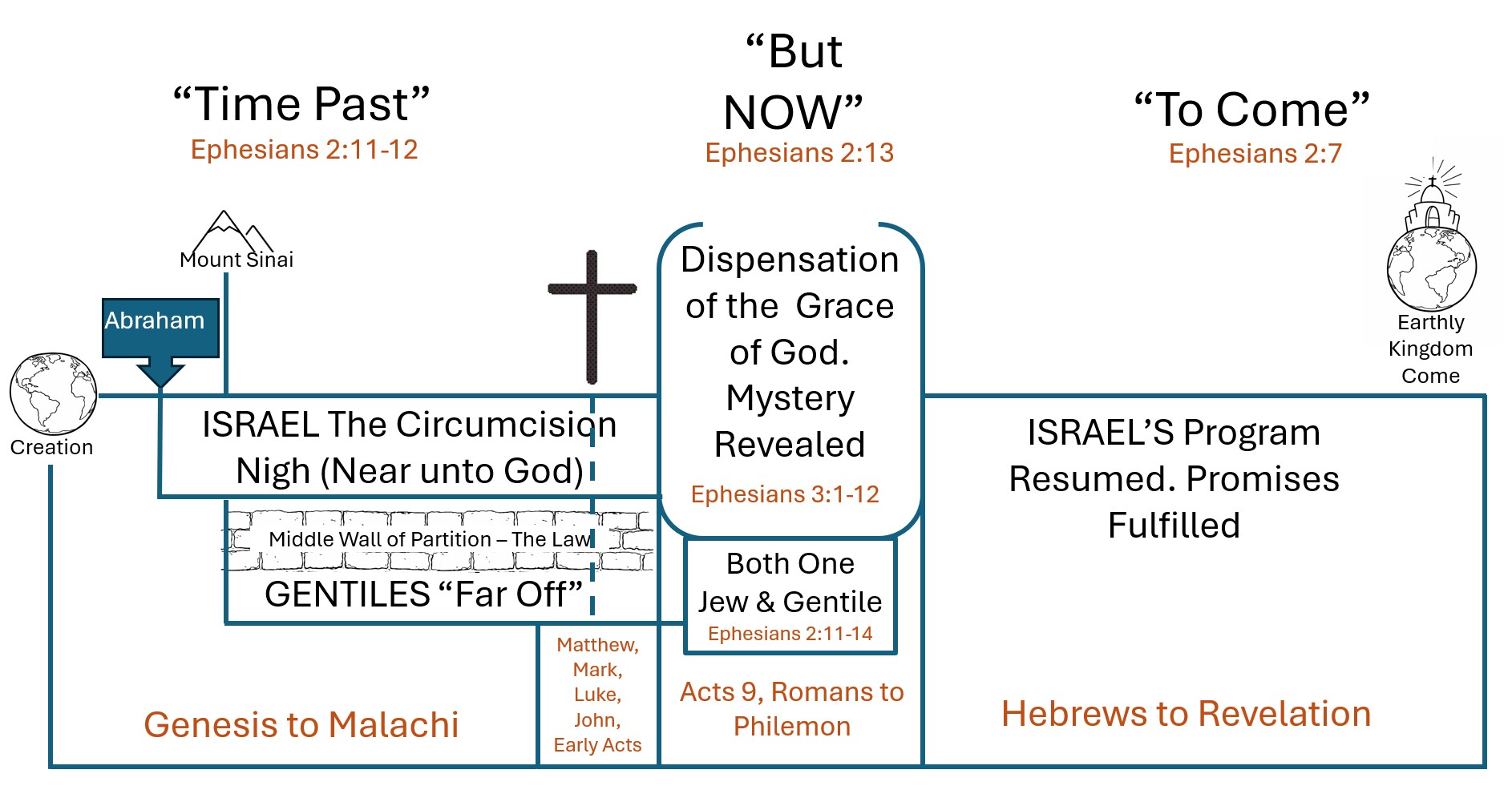
Paul makes it clear in Ephesians chapters 2–3 that The mystery—the revelation of this present dispensation of grace—was not revealed before Paul. God raised up Paul as the other apostle, the one who came later, the one not found in the gospel accounts, because his apostleship is unique. He’s the apostle of the Gentiles, and the doctrine for this dispensation was committed to him alone.
“Speed Slider”
 Click Image To Enlarge
Understanding The Bible – Episode 5 – Transcript
We’re now in Episode Five of our Understanding the Bible series.
Turn to Matthew 1—or to Malachi 4.
I just want you to see that blank page between those two books. Most Bibles have “The New Testament” printed on that page, making it seem like God’s program changed right there in Matthew 1.
We’ve already touched on this, but we need to emphasize because it matters a lot for rightly dividing the word of truth. Most people think the Bible is divided into “Old Testament” (Genesis–Malachi) and “New Testament” (Matthew–Revelation), and that rightly dividing the Word is simply that editorial break. So they assume time past is Genesis through to Malachi, and that the dispensation of grace begins in Matthew 1. This means that most people naturally think the earthly ministry of Christ in Matthew, Mark, Luke, and John is written directly to us today.
But when we look at the timeline chart below this recording, we can see that’s not true.
The books of Matthew, Mark, Luke and John still sit in time past. The earthly ministry of Christ, John the Baptist, the twelve apostles, and even the early chapters of Acts (up to Acts 9) all belong to God’s program with Israel, not the church, the body of Christ.
Paul makes this clear in Ephesians chapters 2–3. The mystery—the revelation of this present dispensation of grace—was not revealed before Paul. God raised up Paul as the other apostle, the one who came later, the one not found in the gospel accounts, because his apostleship is unique. He’s the apostle of the Gentiles, and the doctrine for this dispensation was committed to him alone.
The marker page, between Malachi and Matthew, is deceiving because it suggests that everything following it, from Matthew 1:1 to Revelation 22:21, is the New Testament, or the New Covenant prophesied in Jeremiah 31:31–34 and Ezekiel 36:24–28 and many other places both directly and indirectly.
But everything after that marker page is not about the New Testament. Jesus Christ came to this earth, God in the form of man, to bring in and fulfil the New Covenant that God had promised to Israel. But as we’ll see in detail through this series, this was not completed.
Because of Israel’s unbelief, their rejection of their prophesied Messiah, the New Covenant was never fulfilled. It was put on hold, temporarily, and a new dispensation was introduced by God, the Dispensation of Grace.
So, if we were going to use marker pages to segregate the sections of the Bible correctly, we’d have one between Acts and Romans chapter 1, printed with “Dispensation of Grace” or “New Dispensation” or something like that.
Then there should be another marker page between Philemon and Hebrews 1 printed with something like “New Testament Resumed” or something.
Everything in Paul’s epistles deals with this dispensation of grace and how God has made Jew and Gentile one new man, and how He deals with us now, today. And as we saw in the last episode, there are huge differences between God’s dealings with Israel in time past and His dealings with us today. The examples we looked at, such as the dietary laws, holy days, and rudiments of the world, were just the most obvious ones.
But the differences go far deeper than that. They reach into things like personal prayer. Prayer in this dispensation works differently than it did for Israel. God expects it to accomplish something different in us today, and He responds to it differently. That’s why rightly dividing the Word of Truth isn’t just a chart; it affects the details of our life, our walk, our expectations, and our ability to honour God.
Sometimes the obvious examples don’t hit home. But when we start seeing how rightly dividing the Word affects something as close to us as prayer, we begin to feel the weight of it.
In this episode and the next, we’re going to look at some clear examples from the gospel accounts that show the dispensation of grace was not in effect during Christ’s earthly ministry. But before we do that, we need to understand that marker page in our Bibles and what it does not mean.
Now we’re at the point we mentioned last episode: where we take a clear look at the time when the Lord Jesus Christ was on earth, and those opening chapters of Acts.
Most Christians think that Matthew, Mark, Luke, John, and early Acts contain the main instructions for their daily walk on earth today. They don’t ignore Paul on purpose, but when they need help, they almost always turn to the gospel accounts.
Many Bibles encourage this. They load the four gospels and Acts with notes, applications, charts, and advice, such as lists saying, “if you have this problem, read this verse”. And then you have red‑letter editions, which make people think the words in red are more inspired than the rest of Scripture, as if the whole Bible isn’t the Word of Christ.
That kind of thinking damages a new believer. Jesus Christ never told anyone to highlight His earthly ministry above the rest of His word. If anything were to be printed in red, it should be Romans through to Philemon, because that’s where Christ speaks directly to us today through our apostle, Paul.
Paul tells us how to divide God’s word: Time past – God’s program with Israel, but now – the revelation of the mystery given to Paul, and Ages to come – when God resumes and fulfils Israel’s program.
Rightly dividing the Word of truth is not Old Testament vs. New Testament. It’s prophecy vs. mystery, Israel’s program vs. the body of Christ, earthly kingdom vs. heavenly purpose.
And this shouldn’t surprise us. In Genesis 1:1, the very first verse of the Bible, God shows us that He has two realms: heaven and earth. Two spheres. Two purposes. Two programs. From Genesis onward, the focus is mainly on the earth, because that’s Israel’s realm. But when the mystery’s revealed to Paul, we finally see God’s purpose for the heavenly realm—and that’s where the church, the body of Christ, fits.
So when we come to the gospel accounts, we need to keep in mind that the “New Testament” marker page is not marking the start of the dispensation of grace, and it’s only partially marking the New Testament. The gospel accounts still belong to Israel’s program. The Lord’s earthly ministry is still time past on the timeline. Israel is still under the law. The Kingdom is being preached. The twelve apostles are ministering to Israel. Nothing about the mystery or the body of Christ has been revealed yet.
In Matthew, Mark, Luke, John, and early Acts, Israel’s program is still in view. The dispensation of grace has not yet begun, and it’s plain to see that the Lord Jesus Christ lived under the law.
Paul says in Galatians 4:4,
But when the fulness of the time was come, God sent forth his Son, made of a woman, made under the law,
Everything in Christ’s earthly ministry shows that. He taught His disciples that they were under the law. In Matthew 23:1-3, we read,
Then spake Jesus to the multitude, and to his disciples,
Saying, The scribes and the Pharisees sit in Moses’ seat:
All therefore whatsoever they bid you observe, that observe and do; but do not ye after their works: for they say, and do not.
The people were to obey what Moses said.
In Matthew 5:17, Jesus said,
Think not that I am come to destroy the law, or the prophets: I am not come to destroy, but to fulfil.
In Matthew 5:19, He said,
Whosoever therefore shall break one of these least commandments, and shall teach men so, he shall be called the least in the kingdom of heaven: but whosoever shall do and teach them, the same shall be called great in the kingdom of heaven.
Jesus came not to destroy the law, but to fulfil it.
But He did not fulfil the whole law at the cross!
He fulfilled the sacrificial part, the shadow of His once‑and-for‑all offering, but the law also includes the prophets, and the prophets pointed to things still future in Israel’s program.
The kingdom, the judgments, the rewards, the last stage of Israel’s dealings with God, those things were still ahead. So during Christ’s earthly ministry, the Old Covenant was still in force.
The sacrifice for sin that was critical to the New Covenant was provided for at the cross, but that New Covenant does not become active for Israel until their program resumes, as Hebrews explains, and Israel finally accepts their Messiah.
Even in early Acts, the law is still operating. WE see priests believing the gospel of the kingdom, yet still serving in the temple. That wasn’t disobedience. That was exactly where Israel’s program was at that time. Nothing in Matthew, Mark, Luke, John, or early Acts is the dispensation of grace given to the Gentiles. So, again, when we open Matthew 1, we’re in time past on the timeline.
Just because “New Testament” is printed there on that marker page before Matthew 1, we mustn’t assume God’s program changes at that point. As we said in the last episode, the Old Covenant didn’t even begin until Exodus 19, and it wasn’t confirmed until a few chapters later. Genesis isn’t “Old Testament ground” in the covenant sense at all. The break between Malachi and Matthew is mostly because the language changes from Hebrew to Greek.
The page marked “New Testament” does belong there, just not for the reason most people think. It represents the so-called 400 years of silence between Malachi and John the Baptist. God had warned through the prophets that a time was coming when He would “give them up” and there would be a famine of hearing the word of the Lord. Amos 8:11-12,
Behold, the days come, saith the Lord GOD, that I will send a famine in the land, not a famine of bread, nor a thirst for water, but of hearing the words of the LORD:
And they shall wander from sea to sea, and from the north even to the east, they shall run to and fro to seek the word of the LORD, and shall not find it.
No prophets. No fresh revelation. That silence lasted until John the Baptist appeared.
On our timeline chart below, Amos and Micah stand back there in Israel’s history, speaking of things that would come in the earthly ministry of Christ and the final stages of Israel’s program. Their prophecies look forward to John the Baptist, the birth of Christ, the twelve apostles, the cross, and the early chapters of Acts, all still part of Israel’s program.
So when we hit Matthew 1, were not entering the New Covenant, and we’re not entering the body of Christ, and the dispensation of grace. We’re stepping into the next phase of Israel’s prophetic program after 400 years of silence, exactly as the prophets said.
In Micah 5, God gives one of the clearest prophecies about the coming Messiah. Remember, this is 700 years before Matthew chapter 1.
He names Bethlehem as the birthplace of Christ, and He looks ahead to the days when the Messiah will finally begin Israel’s redemption, comfort, and deliverance.
Micah—and Amos with him—are looking forward to the Kingdom, the literal kingdom God will set up on this earth through the nation of Israel.
None of these prophets sees anything about the dispensation of grace. That program was still a secret, kept hidden until God raised up Paul in Acts 9.
That famine of the word spoken of in Amos chapter 8 that we just saw didn’t happen in Amos’ day. Nor did it happen in the days of Haggai, Zechariah, or Malachi either. And it didn’t happen during Christ’s earthly ministry.
John the Baptist, Christ Himself, the twelve apostles, and even the seventy, because, quite plainly, were all speaking God’s word.
It didn’t happen in early Acts either, because the apostles were still preaching with the Spirit.
So when did that famine happen?
Between Malachi and John the Baptist. It lasted for about 400 years where God said nothing to Israel.
That’s what the marker page in our Bible really stands for. It’s not the start of the New Testament church and the beginning of the dispensation of grace, but the silence of God before the Messiah came.
Micah confirms this in Micah 5:2, he names Bethlehem as the Messiah’s birthplace, then in Micah 5:3 he says,
Therefore will He give them up, until the time that she which travaileth hath brought forth.
God would give Israel up, let them go on without His voice, until the birth of Christ. That’s the silence. That’s the famine. That’s the blank page.
Then comes Malachi, the final prophet.
In Malachi 3:1, God says,
Behold, I will send my messenger, and he shall prepare the way before me: and the Lord, whom ye seek, shall suddenly come to his temple, even the messenger of the covenant, whom ye delight in: behold, he shall come, saith the LORD of hosts.
That messenger is John the Baptist, as all four gospels confirm. Malachi ends his prophecy, and God goes silent, and the next voice Israel hears is John the Baptist crying in the wilderness.
We’ve included a second chart below to show the sequence of events so far. Amos and Micah prophesy, Malachi closes the Old Testament prophets, 400 years of silence, John the Baptist appears, Christ is born in Bethlehem, the twelve apostles minister, then the cross, then early Acts, then, unexpectedly, Christ returns from heaven and raises up Saul of Tarsus, the apostle Paul, and the dispensation of grace begins.
So again, when we open Matthew 1, we’re not stepping into the New Covenant as God promised Israel through the prophets, and we’re not stepping into the body of Christ, and the dispensation of grace. We’re stepping into the resumption of Israel’s prophetic program after 400 years of silence, exactly as Amos, Micah, and Malachi said.
When we study the prophets and the natural timeline that God’s blended into His Word, we can see exactly why there is this 400‑year gap before Matthew 1. It’s that period God called a famine of hearing the word of the Lord in Amos 8. During these 400 years, there were no prophets and no fresh revelation. God went silent toward Israel. That’s why that blank, separating page is there between Malachi 4 and Matthew 1, belongs there. It marks the silence, not the start of a new program, not the beginning of the New Testament church, and not the dispensation of grace.
If we understand Israel’s history up to Malachi, we would never expect something new to begin in Matthew 1. What we’d expect is exactly what God said: a long silence, then a messenger, then the Messiah, and then the continuation of Israel’s prophetic program. And that is exactly what we see when we open the gospel accounts.
John the Baptist appears preaching a prophesied message, not the mystery revealed later to Paul. Everything in Matthew, Mark, Luke, John, and early Acts fits perfectly with what the prophets said would happen when God resumed speaking to Israel.
Understanding that blank page also helps us avoid another major mistake. Some people—and some Bible publishers—include the Apocrypha as if those books were Scripture. But every one of those books was written during the time when God said He would be silent. If God said He would not speak, then anything written in that period cannot be His word. Books like Tobit, Judith, 1–2 Maccabees, Bel and the Dragon, and the Song of Susanna may have historical interest, but they are not Scripture. Amos 8, Micah 5, Malachi 3, Daniel 9, Hosea 5—all these passages show God Himself set the boundaries of His word. That protects us from thinking we’re missing something or that God’s word is incomplete.
So the blank page is important—but not for rightly dividing the Word of truth as Paul instructs. It marks the 400 years of silence before God spoke again through John the Baptist. And once we see that, we also see that what follows in the gospel accounts is the resumption of Israel’s program. God begins to act again through the Messiah to bring Israel the salvation, deliverance, and kingdom He promised.
On our chart below, the gospel accounts and early Acts mark the second‑to‑last stage of Israel’s program. The last stage—the day of the Lord’s wrath—was ready to begin. Everything Christ said and did was prophesied. Every word He spoke can be traced back to the prophets. The gospel accounts are not mystery ground. They’re prophecy ground.
And it was right at that moment, when Israel’s final stage was ready to unfold, that the Lord Jesus Christ unexpectedly returned from heaven, raised up Saul of Tarsus, and suspended Israel’s program, and that’s when the dispensation of grace began.
So the gospel accounts are not the beginning of something new for us today. They’re the continuation of something old for Israel—the climactic stage of their prophetic program. And the only thing left to be fulfilled after this dispensation ends is the last stage, the “to come” era that the prophets spoke of.
This is why the Lord told the Pharisees, “Search the scriptures.”
Everything He said and did was already written in Genesis through to Malachi. The prophets testified of Him—not only of His coming, but of His words, His works, His miracles and His judgments. Israel could check the Scriptures and see that Jesus of Nazareth was the Messiah.
And once we understand that, we also understand something else:
If everything Christ said and did was prophesied, then He could not have been revealing the mystery of Christ, because the prophets knew nothing about it. The mystery was still hidden in God until He revealed it to Paul. That’s why Christ’s earthly ministry cannot be the beginning of the dispensation of grace.
I know we’ve spent a lot of time laying groundwork, but this prep work matters. Without it, the details of the gospel accounts get twisted, and people start pulling instructions for the body of Christ out of passages that were never written to us.
Now we’re ready to look at the details—the things in the gospel accounts and early Acts that show plainly that God’s program with Israel was still operating, and that the dispensation of grace was not in effect.
Our instructions as members of the church, the body of Christ, are not found in Matthew, Mark, Luke, John, or Acts 1–7.
Pentecost is not the birthday of the church.
The body of Christ was not formed in Acts chapter 2.
Pentecost is part of Israel’s program, prophesied in Joel 2, and Peter says so directly in his famous sermon in Acts 2:14:41.
Everything happening in early Acts is prophecy being fulfilled—not mystery being revealed.
Now, that doesn’t mean Christ’s earthly ministry has no value to us. It absolutely does. But we must understand who He was talking to, what He was talking about, and what program was in effect. The instructions for us today are the words the resurrected Christ spoke from heaven through Paul, our apostle.
In the next episodes, we’re going to look at three major proofs—three out of about forty—that show the gospel accounts and early Acts belong to Israel’s program. Here’s an early summary of those three proofs.
- Who Christ said He came to.
He states plainly, He was sent to Israel, not to Gentiles. That alone settles the issue.
- The message being preached.
John the Baptist, Jesus, and the twelve preached the gospel of the kingdom, also called the gospel of the circumcision, in Galatians chapter 2. That message is about Israel’s covenants, Israel’s promises, and Israel’s kingdom—not the gospel of the grace of God given to Paul.
- The sign ministry.
The miracles, healings, and casting out of devils were signs to Israel, proving that the prophesied last days of their program had arrived, because the prophesied Messiah had arrived. Joel 2 foretold the intensifying of signs in Israel’s final stage, and Peter quotes that very passage at Pentecost.
All of this is prophecy ground, not mystery ground.
Once we finish those three proofs, we’ll take a full episode to walk through Pentecost itself so we can see exactly what the apostles understood was happening—and what they were not saying.
By now, it should be very clear from our two charts below that there was no dispensation of grace in effect during the earthly ministry of Christ or the early chapters of Acts. What was running then was God’s program with Israel, not the program we live in today.
Let’s step back for a moment and appreciate this dispensation of grace—its background, its uniqueness, and our place in it as members of the church, the body of Christ. We need to know who we are in God’s plan, why this dispensation exists, and why Paul’s apostleship is so special.
Later we’ll also look at Satan’s policy of evil against the body of Christ, and how confusion about dispensations is one of his favourite tricks. He loves it when Christians mix Israel’s program with ours. It produces confusion in our doctrine and produces messed‑up Christian living, even in sincere people.
Our adversary will happily keep us comfortable in the wrong program, surrounded by friends, doing things “the popular way” instead of God’s way.
For now, let’s meditate on two key passages where Paul looks back at time past and at Christ’s earthly ministry:
Ephesians 2:11–12 and Romans 15:8.
In Ephesians 2:11–12, which we’ve already studied in this series, Paul tells us this:
Wherefore remember, that ye being in time past Gentiles in the flesh, who are called Uncircumcision by that which is called the Circumcision in the flesh made by hands;
That at that time ye were without Christ, being aliens from the commonwealth of Israel, and strangers from the covenants of promise, having no hope, and without God in the world:
Paul’s not just saying, “remember before we were saved.” He’s saying, “Remember before this dispensation of grace began.” Back then, God’s program was with the circumcision—Israel—and we Gentiles were afar off. When Christ was on earth as the seed of David, we Gentiles were without Christ. He did not come to us. He said Himself in Matthew 15:24,
I am not sent but unto the lost sheep of the house of Israel.
That’s His own words about His earthly mission.
Later in the chapter in Ephesians 2:17, Paul says Christ “came and preached peace to you which were afar off, and to them that were nigh.”
But that coming to us happened after Christ’s earthly ministry, through the preaching of Paul, once the mystery was revealed.
Then in Romans 15:8, Paul sums it up saying:
Now I say that Jesus Christ was a minister of the circumcision for the truth of God, to confirm the promises made unto the fathers:
Notice the word “was.” That was His, Jesus Christ’s role in time past. He was a minister of the circumcision, confirming promises to Israel’s fathers. He was not a minister to you and me as Gentiles. Whenever circumcision vs. uncircumcision is an issue in Scripture, we’re on time‑past ground, not in the dispensation of grace.
My friends, how much more clearly can God spell it out before we get it? Do you see how critical it is to understand the whole counsel of God as one fully integrated message? We’ll never understand the Bible while the only exposure we get to it is cherry-picked verses. Some here and there from the gospels, one ot two from Paul’s epistles. maybe a couple from the Psalms, especially at funerals, and a hand-picked few from Revelation.
So on our timeline charts below, Christ’s earthly ministry sits firmly in Israel’s program, not ours. We Gentiles were without Christ then. He comes to us later—unexpectedly, unprophesied—through the raising up of Paul, and that’s when this dispensation of grace begins.
Before the next episode, why not read Ephesians 2:11–12 and Romans 15:8 slowly and deliberately, letting the weight of those words sink in. They tell us exactly who Christ came to then—and who He comes to now.
God bless you all.


Leave a Reply
Want to join the discussion?Feel free to contribute!