
Understanding The Bible – Episode 2
Time Past, But Now & To Come (Understanding the 3 Part Division of Scripture)
Time Past – God’s prophesied dealings with the nation of Israel
But Now – The dispensation of Gentile grace
To Come – The resumption & fulfilment of Israel’s prophetic program
“Speed Slider”
 Click Image To Enlarge
Understanding The Bible – Episode 2 – Transcript
Welcome to episode two in our series on Basic Bible Understanding, which is designed to help appreciate how to rightly divide the word of truth as Paul tells us we must do in 2 Timothy 2:15, which is,
Study to shew thyself approved unto God, a workman that needeth not to be ashamed, rightly dividing the word of truth.
We need to properly handle God’s Word to fully understand it, to know exactly what portion of it deals with us in the dispensation of grace in which you and I live today.
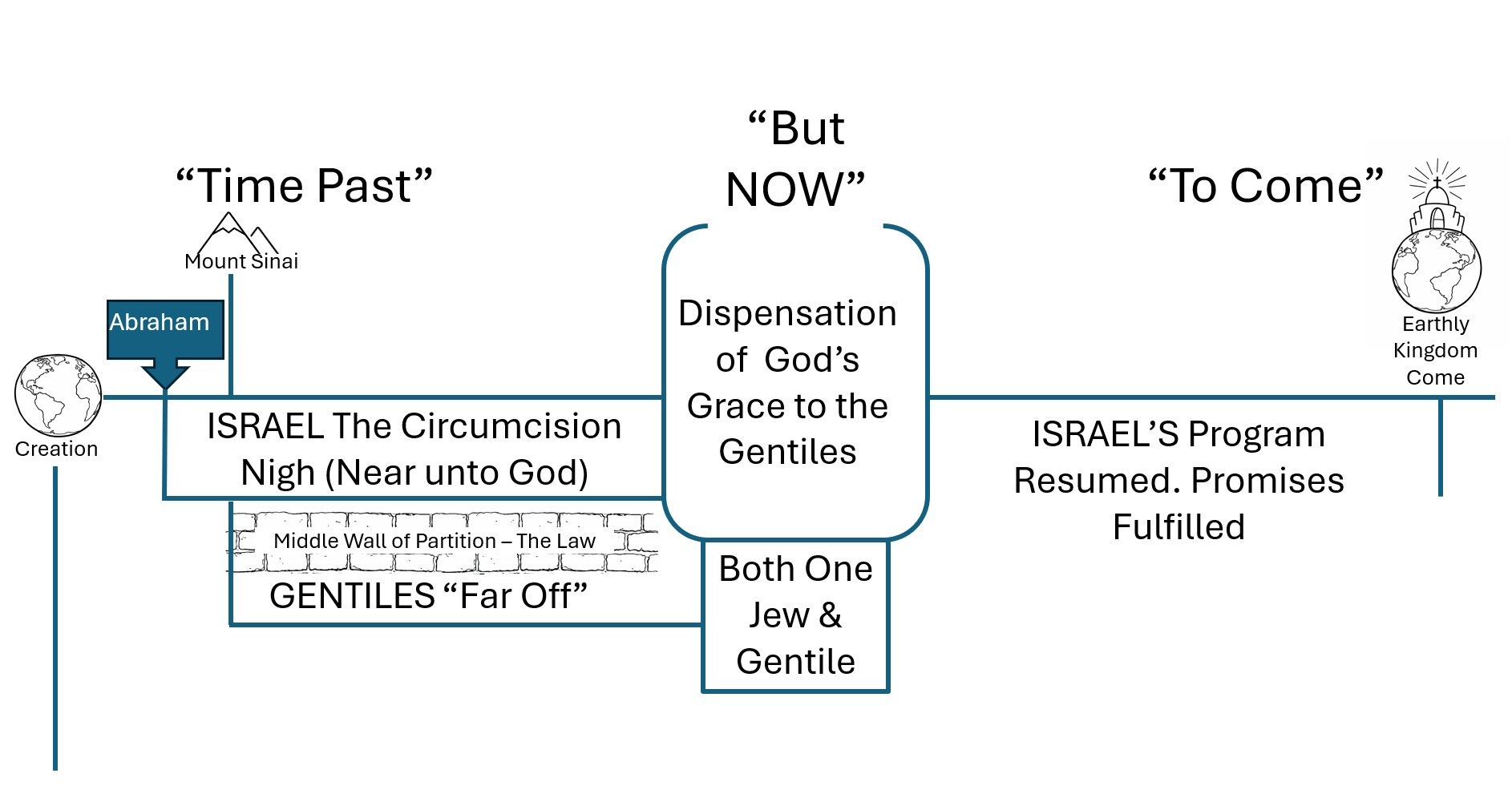
We have a simple chart beneath this recording that lets us see in timeline form what we’re saying.
Let’s open Ephesians chapter two again.
We’re trying to clearly see God’s timing. His program or dispensation, in time past, dealt exclusively with the nation of Israel. Then there was a great dispensational change that took place through Christ’s revelation to Paul. That’s the one in place now, today. Paul calls this change the dispensation of grace.
We saw last time that that’s very different from what God was doing in “time past”.
Then, we need to see the difference between the dispensation of grace that applies today and the things yet to come in God’s dealings with humanity.
This dispensation of grace has not always been in existence, nor is it always going to be in existence in the future. It’s going to end one of these days. It’s been going on for about 2000 years now, since the day of the Apostle Paul, but it will cease one day, and when it does, the things that have yet to be fulfilled in God’s program with Israel are going to come about. These are the things Paul describes as happening in the “To Come” period.
We need to have a basic understanding of that “yet to come” part of God’s plan and purpose.
So, as we saw last time, we have those three time periods. “Time past”, “But Now” and “To come”.
In this episode, we’ll talk a little bit more about the differences that exist in those three time periods.
In this dispensation of grace, God’s dealing with us Christians, members of the church, the body of Christ, members of that one new man.
He’s dealing with us differently today than he dealt with his nation, Israel, in the past, and how he’s going to deal with it in the time to come, and right dividing of the Word of Truth is critical to our understanding of that.
Many, if not most, Christians today are taking promises, commandments, instructions and teachings from God’s former time past program with Israel or from times yet to come, when He fulfils His program with Israel, and trying to make them fit into today’s dispensation of grace, and it simply won’t work.
The result is a lot of heartache and uncertainty, all because of a failure to rightly divide the word of truth.
No matter how sincere a Christian may be, he or she’s not going to force God to do something that contradicts His word by acting outside of His current program and start doing something today that was specifically for the ‘time past’ or the period “to come” just to satisfy our misguided desire.
So, it’s critical for you and me as Christians to rightly divide the word of truth and to know what portion of God’s Word is telling us what to do, and talking to us as members of the church, the body of Christ.
We’re going to deal with some of those things in an introductory manner, and as the series goes on, we’ll deal with them in more detail.
So, to recap, Ephesians 2:11-12,
Wherefore remember, that ye being in time past Gentiles in the flesh, who are called Uncircumcision by that which is called the Circumcision in the flesh made by hands;
That at that time ye were without Christ, being aliens from the commonwealth of Israel, and strangers from the covenants of promise, having no hope, and without God in the world:
Here is that “Time passed” where we see God’s program and dealings are exclusively with the nation of Israel.
He’s nigh, or near, unto them. He’s given them a token of his covenant with them, circumcision, which is a physical manifestation, a sign of his dealings with them, and the special nature of those dealings that excluded the other nations of the world.
God even set up a middle wall of partition between Himself and the nations with the law, which kept Israel on the near side of that wall towards Him and kept the Gentiles on the far side of that wall.
And that separation was so great that the Apostle Paul says at the end of verse twelve, that we Gentiles, at that time before the dispensation of grace, were without God in the world.
Now we’re going to look at each of those expressions there in Ephesians 2:12 later on, and we’ll understand the depth of meaning of them. But now, we’re simply acknowledging that that’s the way it was.
Ephesians 2:13 says,
But now in Christ Jesus ye who sometimes were far off are made nigh by the blood of Christ.
See this “But Now” expression?
It’s making a contrast, an opposite, to what was going on in “time past”.
Now something different applies. Now in Christ Jesus, you who sometimes were far off are made nigh or near by the blood of Christ. Ephesians 2:14 says in continuation,
For he is our peace, who hath made both one, and hath broken down the middle wall of partition between us;
Notice this critical point. God hath made both one!
Israel was near or nigh to God. Gentiles were afar off.
God’s now changed Israel’s “nigh” status and their exclusive nature. He’s also changed the Gentiles “afar off” status.
Now, in the dispensation of grace, He’s made both one.
We, both Jew and Gentile, stand on the exact same level before God in the dispensation of grace.
That wasn’t the way it was in time past, and it won’t be the way it is in time to come, but that’s the way it is right now in the dispensation of grace.
Ephesians 2:15 says that God,
Having abolished in his flesh the enmity, even the law of commandments contained in ordinances; for to make in himself of twain one new man, so making peace;
That’s the purpose of this new dispensation — to create “one new man” out of the “twain”, the two groups of people who were, up until this point, permanently divided from each other and from God. This “One new man” is the true church, the body of Christ. This is a new creation. It’s not Israel, and it’s not Gentiles. It’s something entirely new, as 2 Corinthians 5:7 and Galatians 6:15 say.
Ephesians 2:15 finishes with so making peace.
Making Peace between man and God was the goal; breaking down the wall that permanently separated us from Him was God’s incredible achievement, and it was done by His own death on the cross.
More about that later.
Remember what a dispensation is from the last episode? It’s a program that someone puts into effect and administers to achieve a particular end. A dispensation is never put into effect carelessly or just for the fun of it. It’s got a purpose behind it.
God’s got a distinct purpose with the nation of Israel. His program with Israel had a purpose, and it still does. It’ll be fulfilled out there in the “to come”, the future.
God has set Israel’s program temporarily aside and ushered in this dispensation of grace, making both Jew and gentile one new man, the church, the body of Christ. That’s the purpose behind it.
Why has God done that?
We’ll talk about that in detail as we go on, but right now, we need to acknowledge the fact that He’s brought the dispensation of grace in to create the one new man.
We find that expression a number of times in Paul’s epistles. The church, the body of Christ, is also called the new creation, a new creature. It’s a new thing in God’s overall program. Of course, it wasn’t new to God; He knew about it since before the world was formed, but it was never revealed to mankind throughout the history of the prophets.
Ephesians 2:16-18 begins with the word “And”, which directly links it to Ephesians 2:15, which ends in, so making peace;
Ephesians 2:15-18… so making peace;
And that he might reconcile both unto God in one body by the cross, having slain the enmity thereby:
And came and preached peace to you which were afar off, and to them that were nigh.
For through him we both have access by one Spirit unto the Father.
Then we go to Ephesians 2:19, which opens with,
Now therefore…
All we want up to this point is to note the “now” issue.
We’re not ready yet to deal with the things spelled out in Ephesians 2:19-22, but we need to be aware of this”Now therefore”.
So, “now therefore” means that because of this great dispensational change, we possess now the things that Paul describes in these verses.
That’s now in the dispensation of grace. Now we possess all that as members of the one new man, the church, the body of Christ. We didn’t possess them in “time passed”, but the things revealed by Paul, our apostle today, in connection with the revelation of the dispensation of grace are for us today. We’ll deal with that a little later on in this episode when we open Ephesians chapter 3.
So, what do we have?
We’ve got “time passed, and “but now”, and “to come” as per the chart below.
Paul’s revelation, given to him by the risen Christ Himself, is the outworking of God’s plan and purpose contained in those three time expressions. Paul’s understanding as the apostle to the Gentiles should be our understanding.
Let’s focus on “things to come” for a few minutes.
Go to Romans 11.
In Romans chapters nine, ten and eleven, Paul’s dealing with the same thing we’ve just been talking about in Ephesians chapters 2 and 3, “time past”, “but now” and “to come”.
The only difference is in Romans nine, ten and eleven, he’s looking at it from the time past. He recognises the fact that before this dispensation of grace came in, God’s program was with Israel. He acknowledges the fact that this dispensation of grace has interrupted God’s program with Israel.
In other words, God brought this dispensation of grace in before He’d fulfilled His program with Israel. And from that perspective, Paul deals with the issue of “time past”, “but now”, and “to come”, and he deals with the question of what’s happened to Israel in this dispensation of grace. What does it all mean for Israel? Has God cast his people away? Does that mean that His word, His promises to them, have been broken? Does that mean that the things He’s promised and covenanted with them, they’re now not going to get?
It’s from that perspective that Paul, in Romans, looks at the same issue of the great dispensational change we’re talking about in Ephesians.
So, what we’re concerned with at the moment is getting an understanding of what’s yet to come after the dispensation of grace has ended, which is the resumption and fulfilment of God’s program with Israel.
Now, in Romans, notice the way chapter nine begins.
Romans 9:1-3,
I SAY the truth in Christ, I lie not, my conscience also bearing me witness in the Holy Ghost,
That I have great heaviness and continual sorrow in my heart.
For I could wish that myself were accursed from Christ for my brethren, my kinsmen according to the flesh:
Paul’s talking about Israel, of course, and he goes on to finish his thought in Romans 9:4-5, …For I could wish that myself were accursed from Christ for my brethren, my kinsmen according to the flesh…
Who are Israelites; to whom pertaineth the adoption, and the glory, and the covenants, and the giving of the law, and the service of God, and the promises;
Whose are the fathers, and of whom as concerning the flesh Christ came, who is over all, God blessed for ever. Amen.
The great heaviness and continual sorrow in Paul’s heart is because he recognises that the things that pertain to the nation of Israel, and God’s program with them, haven’t been fulfilled yet, and God’s cut off his dealings with the nation of Israel.
Remember, Paul’s a Jew from the tribe of Benjamin, so Israel is his kinsmen in the flesh.
Paul knows that if God’s cut off His program with Israel, and that’s exactly what He’s done, then God’s program with Israel is not being fulfilled in this dispensation of grace.
Now, as we’re going to see later in Romans 11, Israel’s been set aside, and a blindness has been imposed upon them temporarily.
God’s program with them is not being fulfilled in this dispensation of grace, and Paul acknowledges that here in these opening verses of Romans 9.
God’s now turned to the Gentiles without giving them the things He promised them. Not yet.
Notice the glory in Romans 9:4. That’s the glory of the Kingdom on this earth and the great nation of the Abrahamic Covenant made directly between God and Abraham with the marvellous declarations of glory promised to them in passages like Isaiah 60 and 61.
They don’t have that yet. Also, there are several covenants God made with Israel beyond the Abrahamic covenant. They don’t have the fulfilment of those things yet either.
What about the giving of the law? They certainly had that, didn’t they? Well, in one sense, yes, they had the law given to them, but there are things in that law that they don’t have yet. And the service of God. Well, why aren’t they serving God? There’s provision in the law for serving God in connection with being that great nation and a Kingdom of priests that they have never had yet.
By the way, those things pertaining to Israel don’t pertain to us Gentiles today.
We’ll look more into that, but it’s important to see who those things do and don’t pertain to.
One of the greatest mistakes made by not rightly dividing the word of truth is made when Christians are either taught or think that they’re spiritual Israelites, and that the things that pertain to Israel that God spelled out in the Old Testament scriptures are things that pertain to us today in some weird spiritual sense.
The only reason why people ever come up with ideas like that is that they don’t do what God tells them to do with His Word and rightly divide it, so they fail to recognise the critical importance of the dispensation of grace, to both Jew and Gentile, as God’s program today. If we fail to grasp that we mishandle the Word of God, and when we mishandle it, we come up with ideas like, we’re spiritual Israelites, and we assume that in some manner or form, we’re part of Israel’s program and God’s promises and so forth to Israel are ours. And that just isn’t true. That isn’t what God says. That’s what men say when they mishandle God’s Word.
These things spoken about here in Romans 9:4 pertain to Israel, and Paul’s going to go on to show throughout Romans nine, ten and eleven that they still pertain to Israel.
He’s going to explain that even though Israel, the literal, physical seed of Abraham, hasn’t received those things yet, they’re going to.
What God’s done in bringing in this dispensation of grace isn’t to cast away His people and take away from them things He’s promised them by His inviolate word and by His oath-bound covenants.
Paul’s going to show us at the end of Romans chapter 11 that the gifts and calling of God to Israel are without repentance, which means He hasn’t changed His mind about His program with them. He’s made irrevocable promises and covenants with them, so much so that the very integrity of God Himself is at stake.
When we Christians come along and assume those things and claim them for ourselves, we’re actually declaring that God never meant what He said. We’re calling the very integrity of God into question.
These things pertain to Israel. Notice that in Romans 9:4, it says to whom pertaineth?
It doesn’t say to whom they did pertain once, but don’t anymore. They still do. It’s just that God set their program aside temporarily. He’ll pick it up again. He’ll resume it, and they’ll receive the things He’s promised them and covenanted with them. That’s what times “to come” is all about.
Let’s go to Romans 11:25. If we had time, we would deal with everything from verse eleven on, because in verse eleven, the Apostle Paul explains how God has blinded His nation and temporarily set them aside.
Once again, His program and dealings with them since He separated Abraham from the rest of the world and created Israel, are on hold, but not cancelled.
Romans 11:25 now declares.
For I would not, brethren, that ye should be ignorant of this mystery, lest ye should be wise in your own conceits; that blindness in part is happened to Israel, until the fulness of the Gentiles be come in.
Paul starts off saying, I don’t want you to be ignorant.
Anytime Paul ever says anything like that, we can be sure he’s underscoring something vital for us to understand, and ignorance of it’s going to cause us problems.
The truth is, many of us Christians fall for and accept a whole theological system called covenant theology.
That’s because so many of us are ignorant of Romans 11:25. This system, covenant theology, makes statements and assumptions that are in error, and it misunderstands many things in God’s Word. They talk about us being spiritual Israel and things along those lines. And that just isn’t the case.
Blindness, in part, Paul says in Romans 11:25, has happened to Israel. If it’s in part, it’s not permanent. It’s temporary. Blindness has come upon them until Paul says, “The fullness of the Gentiles be come in”.
God’s turned to us Gentiles. He’s broken off his dealings with national Israel. He’s ushered in this dispensation of grace. But it’s not a permanent thing.
And, by the way, every Jew who has lived for the last 2000 years since Christ ushered in the dispensation of grace through Paul has had access to salvation, but it’s not an access that’s gained by being Israel and following the commandments and ordinances in the law. They proved time and again that they could never do. They come the same way as we Gentiles do, by grace through faith, by believing the gospel, believing in the birth, death, burial and resurrection of Christ. This is why it’s misleading to talk of “Messianic Jews”. If a Jew is saved, it’s on the same basis as you and me, as the true church, members of the body of Christ.
We see this in Galatians 3:28,
There is neither Jew nor Greek, there is neither bond nor free, there is neither male nor female: for ye are all one in Christ Jesus.
And in
Colossians 3:11,
Where there is neither Greek nor Jew, circumcision nor uncircumcision, Barbarian, Scythian, bond nor free: but Christ is all, and in all.
When the fullness or the completeness of what He’s doing with us Gentiles be come in, then that blindness that God brought upon the nation Israel will be removed, and God will resume and fulfil His program with Israel.
In fact, that’s what the whole section of Paul’s “to come” period is all about. It’s Israel’s program resumed and fulfilled.
That’s exactly what he says in Rom 11:26,
And so all Israel shall be saved: as it is written, There shall come out of Sion the Deliverer, and shall turn away ungodliness from Jacob:
The whole chapter of Romans 11 deals with this fact.
And so, since that’s the case. Blindness has happened to Israel until the fullness of the Gentiles be come in. And, after that, all Israel shall be saved. As written and promised back through the prophets.
Paul’s going to quote two hallmark passages in connection with that coming to pass. It’s not going to come to pass in the dispensation of grace, though, it’s going to come to pass once the fulness of the Gentiles be come in, and God’s done with this dispensation of grace, then He’ll get back to His program with Israel, and the salvation promised to that nation will be theirs. And so all Israel shall be saved as it is written.
God wrote it down as part of His Word. He cannot lie. It’s going to come to pass.
Therefore there shall come out of Zion the deliverer, and shall turn away ungodliness from Jacob. For this is my covenant.
God didn’t simply say that to fill up some space in His Word! He made a covenant about it, an oath-bound covenant.
In Romans 11:27, Paul is quoting Isaiah 27:9 and Jeremiah 31:33-34, when God shall take away their sins under the terms of the New Covenant. We’ll read it,
For this is my covenant unto them, when I shall take away their sins.
The resumption and fulfilment of God’s program with Israel rests upon two immovable things, the Word of God and the covenants of God.
When Christians mistakenly come along and assume promises and covenants and things that God promised to Israel and assume them for themselves, they’re literally declaring that God’s Word and his covenants to Israel are useless.
Romans 11:28,
As concerning the gospel, they are enemies for your sakes: but as touching the election, they are beloved for the fathers’ sakes.
God closed them out in accordance with his plan and purpose, but Paul says they are beloved for the fathers sakes. Notice that. But God still values and esteems them. They’re still beloved by him. And notice, “For the fathers’ sakes” – plural, the fathers of Israel to whom God made the promises. The ones with whom He made the covenants.
God values and esteems His nation for their, the fathers’, sakes because His integrity is at stake.
His very character and essence rest upon the things He promised and covenanted to those fathers.
Romans 11:29,
For the gifts and calling of God are without repentance.
The gifts and calling of God that he’s talking about here are the gifts and calling of God in connection with Israel. That’s the context here. And Paul’s saying that the gifts and calling of God are without repentance to His nation. When you repent, you change your mind about something. God doesn’t change His mind about His nation, Israel.
He’s temporarily set His program with them aside, while the dispensation of Gentile grace has been brought in and is being administered by Him.
They’re still temporarily set aside right now because the dispensation of grace is in effect. But when the fulness of the Gentiles be come in, God’s going to end this dispensation of grace. He’s going to end it by what’s commonly referred to as the rapture of the church.
The Lord Jesus Christ is going to come back and receive us unto Himself at the end of this dispensation of Grace.
This dispensation starts and ends the same way. It started with the Lord Jesus Christ unexpectedly coming back from heaven and raising up Paul there in chapter 9 of the Book of Acts, and it’ll end with the Lord Jesus Christ descending from heaven with a shout.
1 Thessalonians 4:15-17.
For this we say unto you by the word of the Lord, that we which are alive and remain unto the coming of the Lord shall not prevent them which are asleep.
For the Lord himself shall descend from heaven with a shout, with the voice of the archangel, and with the trump of God: and the dead in Christ shall rise first:
Then we which are alive and remain shall be caught up together with them in the clouds, to meet the Lord in the air: and so shall we ever be with the Lord.
That’s how the dispensation of grace ends.
That’s what takes place when the fulness of the Gentiles be come in. And, after that event takes place, God will resume His program with Israel, and the things that pertain to them will be theirs. That’s what’s on that timeline chart under the “to come” time. Israel’s program resumed and fulfilled.
Notice that little graphic on the chart that represents the establishment of God’s Kingdom on this earth. This Kingdom is what God’s program and purpose with Israel is all about.
Is important to highlight that that is the purpose behind God’s covenant with Abraham. When God promised to make of Abraham a great nation, the goal was the establishment of God’s kingdom on earth. This kingdom is the subject of Israel’s prophetic program, right throughout the Old Testament through to the first part of the Book of Acts and then from Hebrews to The Book of Revelation. It’s the focus of the so-called Lord’s Prayer: “Thy kingdom come.”
This Kingdom is not being brought in today. It will not arrive through the church, the body of Christ. It belongs to Israel’s program, and it’ll be established only after God resumes His dealings with that nation.
We must understand that!
We’re going to be talking about that later, but this is a classic example of wrongly dividing the word of truth, or not rightly dividing the word of truth at all.
Often, we’ll hear Christians today talking about bringing in the Kingdom.
But, my friends, that’s not what God’s doing today. That’s God’s purpose with Israel: to bring His Kingdom to this earth. That’s the whole issue in what’s called the Lord’s Prayer, though it wasn’t the Lord who prayed it. It was how the Jewish disciples should pray at that time, before Paul and before the dispensation of grace was ever known about.
Thy Kingdom come, thy will be done, on earth as it is in heaven. That’s Israel’s program, and that’s what’s going to be set up on this earth.
God’s kingdom is going to come to this earth. His will is going to be done on this earth as it is in heaven. That’s not going on in this dispensation of grace.
Christians have been misapplying those prayer instructions of Matthew chapter six for almost two thousand years, and they’ve not yet made God do something He doesn’t intend for this dispensation of grace, even if this dispensation of grace goes on for another two thousand years.
Christians can say that prayer over and over and over again, and the Kingdom still won’t come while the body of Christ is still on earth, because that’s not God’s purpose in the dispensation of grace.
It’s not what the one new man, the new creature, the church, the Body of Christ, is designed to do in God’s plan and purpose. That’s what Israel’s plan and purpose is. And until God resumes His program with Israel and fulfils it, that kingdom won’t be on this earth until after the dispensation of grace is over.
Let’s go to Ephesians chapter three.
The present dispensation of grace in which we live today is a new program and a divinely designed interruption in God’s dealings, radically different from His program and dealings with the nation of Israel.
But God didn’t just all of a sudden decide to do this.
The Apostle Paul describes this thing as a mystery, something that wasn’t known about, or expected in time past, because God had kept it a secret in time past.
He never said anything about it to Adam, or any human being, from that point on, until He revealed it to the Apostle Paul.
Ephesians 3:1,
FOR this cause I Paul, the prisoner of Jesus Christ for you Gentiles,
If ye have heard of the dispensation of the grace of God which is given me to you-ward:
That’s where we are in the dispensation of grace with both Israel and the Gentiles, Jew and Gentile, one and God making the one new man, the church, the body of Christ. That’s who we are right now.
But now look at Ephesians 3:3-5,
How that by revelation he made known unto me the mystery; (as I wrote afore in few words,
Whereby, when ye read, ye may understand my knowledge in the mystery of Christ)
Which in other ages was not made known unto the sons of men, as it is now revealed unto his holy apostles and prophets by the Spirit;
Paul says this dispensation of grace was a mystery that God had not spoken about before He revealed it to Paul.
God kept it hidden in himself.
Let’s pick up at Ephesians 3:7-9,
Whereof I was made a minister, according to the gift of the grace of God given unto me by the effectual working of his power.
Unto me, who am less than the least of all saints, is this grace given, that I should preach among the Gentiles the unsearchable riches of Christ;
And to make all men see what is the fellowship of the mystery, which from the beginning of the world hath been hid in God, who created all things by Jesus Christ:
That’s why these riches are unsearchable, because they simply weren’t made known by God. He didn’t have anybody write anything about it.
This dispensation of grace and the things Paul’s talking about were a mystery before God revealed them to him.
Look at it again now in Ephesians 3:9
And to make all men see what is the fellowship of the mystery, which from the beginning of the world hath been hid in God, who created all things by Jesus Christ:
There it is. From the beginning of the world, it’s been hidden in God, not hidden in the scriptures as if it was always there, but people just didn’t recognise it. It was hid in God’s own heart. He knew what He was going to do before the world began.
Before time itself was even created, God knew He was going to bring this dispensation of grace into effect, but He didn’t say anything about it from the beginning of the world until he revealed it to the Apostle Paul.
Now, why is that the case?
We’ll talk about that in more detail later on, but before we can deal with the why, we’ve got to see the reality of it, and that’s plain and clear.
The mystery has been hidden from the beginning of the world.
Open Colossians 1:24-27 now. And we read this, and Paul’s talking about himself,
Who (that’s Paul) now rejoice in my sufferings for you, and fill up that which is behind of the afflictions of Christ in my flesh for his body’s sake, which is the church:
Whereof I am made a minister, according to the dispensation of God which is given to me for you, to fulfil the word of God;
Even the mystery which hath been hid from ages and from generations, but now is made manifest to his saints:
To whom God would make known what is the riches of the glory of this mystery among the Gentiles; which is Christ in you, the hope of glory:
There it is again, the mystery which had been hidden from ages and generations, but now is made manifest to his saints. This fact is repeated many times in Paul’s epistles, but let’s see it in Romans 16:25-27,
Now to him that is of power to stablish you according to my gospel, and the preaching of Jesus Christ, according to the revelation of the mystery, which was kept secret since the world began,
But now is made manifest, and by the scriptures of the prophets, according to the commandment of the everlasting God, made known to all nations for the obedience of faith:
To God only wise, be glory through Jesus Christ for ever. Amen.
Notice Paul’s talking about my gospel and the preaching of Jesus Christ. Paul’s got a special message committed to him in connection with his special apostleship, the message of the dispensation of grace.
But notice when he talks about that preaching of Jesus Christ, he talks about, according to the revelation of the mystery which was kept secret since the world began, but now is made manifest. There it is again. It was hid in God. God’s the one who kept it secret since the world began, but now has revealed it.
Adam didn’t know about it. Noah, Abraham, Moses and David didn’t know about it.
Neither did Isaiah, Jeremiah, nor Daniel. John the Baptist didn’t know about it either.
The Lord didn’t say anything about it when He was here in His earthly ministry.
Peter, James, John, and the other disciples didn’t know about it until it was revealed to them later by the apostle Paul.
This dispensation of grace is not only a different program in God’s plan and purpose from what was going on in time past, and from what’s yet to come, when He resumes and fulfils his program.
It’s more than that. It’s a new and different program that had never even been spoken about by God before and therefore never anticipated, prophesied about, or looked for by anybody until God revealed it to the Apostle Paul.
When God revealed it to the Apostle Paul, it came as a complete surprise because God had kept it secret since the world began. Therefore, this dispensation of grace is not the subject matter of the Old Testament prophets. We don’t find anything about it in the Old Testament Scriptures.
Also, it wasn’t the subject of the Lord’s earthly ministry as recorded in Matthew, Mark, Luke and John. Nor was it the subject matter of the twelve apostles’ ministry with the Lord, or in the opening chapters of the book of Acts, before God raised up Paul there in Acts chapter nine.
Turn to 2 Timothy 2:15 again. Here’s the verse we started with in our first episode, where we saw the requirement for us to properly handle God’s Word, rightly dividing that Word of Truth.
When Paul told Timothy that, Timothy knew what it meant. He knew that the Word of Truth recorded everything in the outworking of God’s overall plan and purpose, and that those plans and purposes are made up of more than one program or dispensation.
Timothy understood that Israel’s program was temporarily set aside, and that’s not what’s going on right now.
When Paul talked about rightly dividing the word of truth, Timothy knew what that meant, because Paul had already explained to Timothy what rightly dividing the word of truth meant.
That’s recorded earlier in Paul’s epistles, and we’ve just been dealing with it in Ephesians chapters 2 and 3, and in Romans chapters 9, 10 and 11.
So, when we come to 2 Timothy 2:15 and read about rightly dividing the word of truth, we can’t scratch our heads and say,” What are you talking about, Paul?”
If we know Romans 9, 10, and 11, and if we know Ephesians two and three, we know what that means, because Paul’s already told us. In the Word of Truth, we’ve got things that pertain to God’s “time past” dealings with Israel. We’ve got things that pertain to God’s “Right Now” program in this dispensation of grace with the new creation, the one new man, the church, the body of Christ. And we’ve got things in God’s Word that pertain to what’s yet “to come”, when God resumes His program with Israel, and fulfils it. We definitely have no excuse for not rightly dividing the Word of Truth.
In the next episode, we’re going to see how the Word is laid out in the order of the outworking of God’s plan and purpose.
So until then, may God bless you.


Leave a Reply
Want to join the discussion?Feel free to contribute!