
Understanding The Bible – Episode 11
We’re in episode 11 of this Understanding the Bible series and we return to our program for today, the dispensation of grace. Again, everything we studied in the last several episodes—Matthew, Mark, Luke, John, and Acts 1–7—belongs to the “time past” period, or God’s prophetic dealings with Israel. That whole section is what the prophets spoke about “since the world began.” But what we live in today is something different, something God kept secret “since the world began,” until He raised up Paul, our apostle to the Gentiles.
“Speed Slider”
 Press Image To Enlarge


Understanding The Bible – Episode 11 – Transcript
Okay, folks, we’re in episode 11 of this Understanding the bible series, and let’s get it off the ground by opening our Bibles at Acts chapter 1.
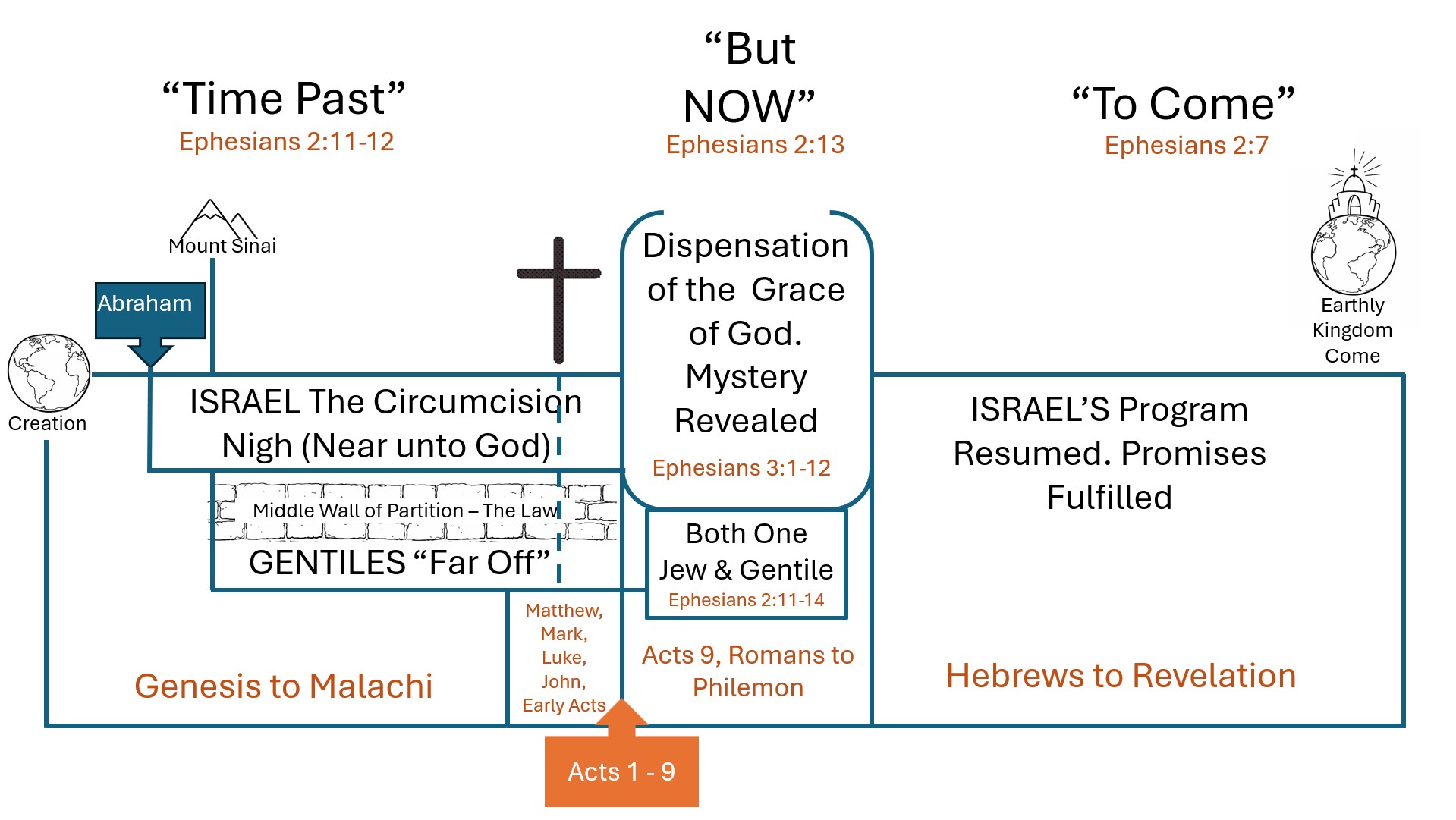
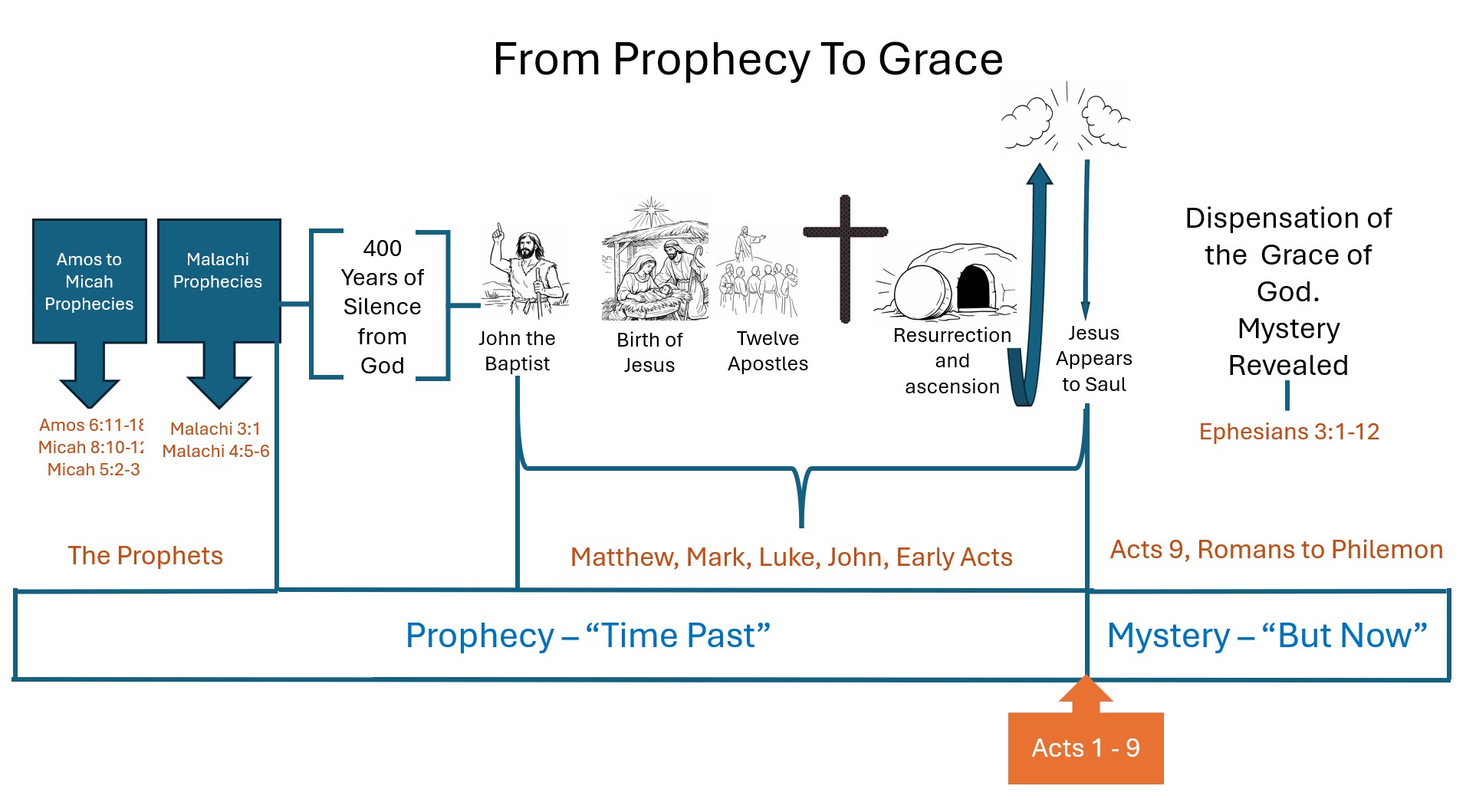
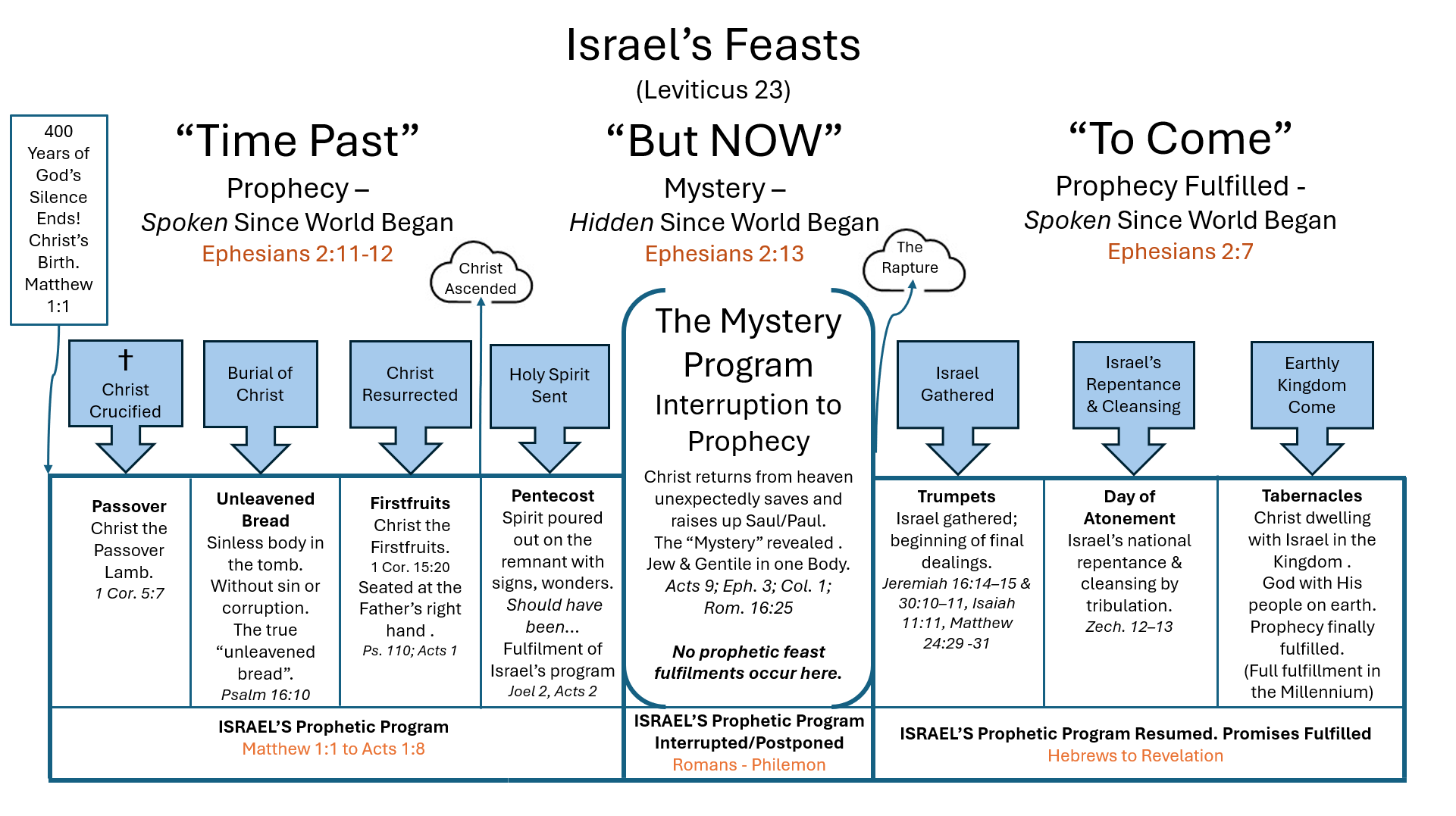
The charts we’ve made to help explain these time periods that are crucial to understanding the bible are still included below this recording. On the charts, we can see this parenthesis or bracketed chunk on the timeline, which is the dispensation of grace, the “but now” interruption in God’s plan that up till then was primarily for His nation, Israel, with us Gentiles being blessed through that nation.
In this episode, we return to our program for today, the dispensation of grace. Again, everything we studied in the last several episodes—Matthew, Mark, Luke, John, and Acts 1–7—belongs to the “time past” period, or God’s prophetic dealings with Israel. That whole section is what the prophets spoke about “since the world began.” But what we live in today is something different, something God kept secret “since the world began,” until He raised up Paul, our apostle to the Gentiles.
Rightly dividing the word of truth, as we’re told to by Paul in 2 Timothy 2:15, is not dividing the Old Testament from the New Testament. It’s dividing prophecy (Israel’s program) and mystery, our program for today, for both Jew and Gentile.
Time past = Genesis through Malachi, the gospel accounts, and Acts 1–7. But now = Romans through Philemon, the revelation of the mystery given to Paul. Ages to come = Hebrews to Revelation, when God resumes and finishes His program with Israel after this dispensation ends.
So, to summarise once again, God has two programs that can be clearly seen when we divide the bible rightly:
- Prophecy – Israel, spoken by the prophets since the world began.
- Mystery – the Body of Christ, kept secret since the world began.
Israel’s program is not cancelled. It’s temporarily suspended. The prophets are not being fulfilled today. God will resume Israel’s program after the dispensation of grace ends with the rapture, the mystery coming of Christ that only Paul speaks about.
This’s why we can’t take our doctrine, promises, or instructions from Matthew, Mark, Luke, John, or early Acts. Those books deal with the climactic stage of Israel’s program—the earthly ministry of Christ, the ministry of the twelve, and the offer of the kingdom. None of that is addressed to the Body of Christ. Our doctrine comes from Paul, the apostle to the Gentiles, the one God raised up to reveal the mystery.
Paul and Moses are the only two men in Scripture whose offices God magnifies. Paul says in Romans 15 that he magnifies his office because God gave him a unique apostleship. That’s what we’re focusing on now—the uniqueness and specialness of Paul’s apostleship. This is basic material, milk of the Word, yet most Christians never learn it because there’s a satanic policy of evil that works hardest against the revelation of that mystery.
The gospel accounts, and Acts 1–7, are not the beginning of the church, the Body of Christ. They’re the continuation of Israel’s prophetic program. The Body of Christ begins only when God interrupts that program and raises up Paul in Acts 9.
So, as we move into this episode and the next and final one, keep the timeline chart below in mind:
Time Past – Israel’s program (Genesis–Malachi, Gospels, Acts 1–7), But Now – Mystery program (Romans–Philemon), Ages to Come – Israel’s program resumed after the rapture
Our instructions, promises, and identity are found only in Paul’s epistles. That’s where God speaks to you and me today.
By now, we see a lot about Paul’s unique apostleship just from what we’ve studied. There are many more differences in Scripture between Paul’s apostleship and the twelve, but even the basic things we’ve covered show how separate and special Paul’s calling is. Most Christians never see this because they’ve never been taught to let the Bible speak to them for itself.
One of the most misunderstood issues is Acts chapter 1 and the replacement of Judas. The common idea today is that Peter made a mistake, or that he “ran ahead of God,” and that Paul should have been Judas’s replacement. That is not only quite wrong, it’s also quite silly. The Bible says the exact opposite.
If people would simply read Acts 1 in light of what the Lord already taught the twelve in Matthew, Mark, Luke, and John, they would see there’s no mistake here. Peter and the others knew exactly what they were doing. They knew Scripture had to be fulfilled. They knew Judas’s office had to be taken by another. And they knew God had already chosen the man.
They were not gambling when they cast lots. Casting lots was the God‑given method for determining His will in Israel’s program, used by the high priest himself. They prayed, they quoted Scripture, they followed the Lord’s instructions, and they acted with full authority. To say otherwise is simply a result of not studying the Bible. Now don’t work yourself over about it, we’ve all been there, let’s just correct ourselves and get on with it!
Here’s the biggest proof:
In Acts 2, when the day of Pentecost was fully come, the twelve were filled with the Holy Ghost. Matthias was one of those twelve. If he were not God’s chosen replacement, he would not have been filled with the Spirit, because the promise of the Spirit was given only to the apostles to carry out their kingdom ministry in the Lord’s absence. The fact that Matthias stands there as one of the Spirit‑filled Galileans proves everything was done properly.
Now let’s look at the details in Acts 1. Peter stands up among the 120 and says Scripture, quote, “must needs be fulfilled” concerning Judas, and that’s Acts 1:16. He quotes the Psalms:
Psalm 69:25. – “Let his habitation be desolate…” and Psalm 109:8.
– “Let his days be few; and let another take his office.”
Then Peter lays out the qualifications. Judas’s replacement had to be someone who had been with them from John’s baptism all the way to the Lord’s ascension. Paul doesn’t even come close to meeting that requirement. He wasn’t even a believer then—he was persecuting the church. He even looked on as Stephen was stoned to death.
So the idea that Paul should have been Judas’s replacement is impossible.
Two men fit the qualifications: Joseph called Barsabbas and Matthias. They prayed, asking the Lord to show which man He had chosen. Then they cast lots, and the lot fell on Matthias. And the Scripture says plainly in Acts 1:26:
“He was numbered with the eleven apostles.”
Everything was done decently, in order, and according to God’s will.
Paul was never meant to be the twelfth apostle. He was meant to be something far greater—the apostle of the Gentiles, the steward of the mystery, the man through whom God revealed the dispensation of grace. His apostleship is separate, distinct, and unique.
Understanding this is part of rightly dividing the Word of truth. It keeps Israel’s program where it belongs, and it keeps our program, for the Body of Christ, where God put it, in Romans through to Philemon.
We’ll build on this more in the next and last episode.
Before we look again at Acts 1, we should remember that in the first seven chapters of Acts, the Lord had already spent forty days with the eleven after His resurrection, teaching them through the Holy Ghost. Acts 1:1–3 says He gave them commandments through the Spirit and taught them things pertaining to the kingdom of God. They weren’t guessing. They were trained for what they had to do in His absence during that extension of mercy and forbearance before the day of wrath that we showed last time.
To understand this, let’s go back to John 16. Before the cross, Jesus told the eleven He had “many things” to say, but they could not bear them yet. When the Spirit of truth came, He would guide them into all truth and show them things to come. That refers to the Spirit’s coming at Pentecost, not the forty‑day period in Acts 1.
But the Lord also had things they needed to know before Pentecost, so they could function as soon as He ascended to heaven. For that, He gave them the Spirit in a special, temporary way. In John 20:21–23, we see that He breathed on them and said, “Receive ye the Holy Ghost.”
This was not the full baptism with the Spirit—that would come at Pentecost—but a special enabling so they could understand His commandments and carry them out before the Spirit was poured out.
One of those commandments that had to be done before Pentecost was the restoration of the full number of twelve apostles.
Remember, the twelve apostles correspond to the twelve tribes of Israel of Matthew 19:28, where we read,
And Jesus said unto them, Verily I say unto you, That ye which have followed me, in the regeneration when the Son of man shall sit in the throne of his glory, ye also shall sit upon twelve thrones, judging the twelve tribes of Israel.
Eleven won’t do. Thirteen won’t do. The kingdom program requires twelve.
Judas was prophesied to fall, as we see in Psalm 69 and Psalm 109.
His office, or his “bishopric” as Peter called it, had to be taken by another. The Lord had already prepared the apostles for this. That’s why Peter stands up in Acts 1 with full confidence and authority. He isn’t guessing. He isn’t being “impulsive Peter.” He’s obeying the commandments the Lord gave them during those forty days.
Peter quotes Scripture and says in Acts 1:16,
“This scripture must needs be fulfilled.”
He lays out the qualifications: the replacement must be someone who’s been with them from John’s baptism to the ascension.
And, as we’ve already said, that alone proves Paul could never have been Judas’s replacement. He didn’t meet a single qualification.
Two men fit the requirements: Barsabbas and Matthias. They prayed, asking the Lord to show which man He‘d chosen. Then they cast lots—not gambling, but the God‑given method for determining His will in Israel’s program. The lot fell on Matthias, and Scripture says plainly in Acts 1:26,
“He was numbered with the eleven apostles.”
Everything was done properly and in order according to God’s will.
The final proof is in Acts 2:1-4.
When the day of Pentecost was fully come, the twelve, note twelve, were filled with the Holy Ghost. This was before the quote, “Devout Jews of every nation who were dwelling in Jerusalem had come together there to see what was going on.”
Matthias was one of the Spirit‑filled Galileans speaking in tongues.
If he were not God’s chosen apostle, he wouldn’t have been filled with the Spirit, because the Spirit was only given to the apostles at that stage. Again, Saul/Paul was nowhere on the scene.
Peter understood the Scriptures better than most Christians today because the Lord had given him commandments through the Holy Ghost during those forty days after the resurrection in Acts 1:1–3. He wasn’t guessing. He wasn’t acting in the flesh. He had the Spirit in a special, temporary way so he could understand what needed to be done before Pentecost.
Acts 1:15 shows Peter standing up among the 120. He recognises that the first of the two prophecies he quotes from Psalms—Judas’s habitation becoming desolate—was already fulfilled by Judas’s own actions as we see in Acts 1:18–19. But the second part—“his office being taken by another”- was still unfulfilled. And that part was their responsibility, not the nation’s. The rulers who betrayed Christ couldn’t replace Judas. Only the remaining apostles, filled with the Spirit, could do that.
Peter knew that Psalm 109 said Satan stood at Judas’s right hand, and at the right hand of the rulers who helped betray Christ. So the replacement had to come from within the faithful remnant, not the apostate, unbelieving nation. That’s why Peter says in Acts 1:21–22 that the replacement must be someone who had been with them from John’s baptism to the ascension. That is the Lord’s own qualification, not Peter’s idea.
Paul could never meet that requirement. He wasn’t with them from John’s baptism. He wasn’t with them during the Lord’s earthly ministry. He wasn’t even a believer. Only two men in the entire group of 120 met the qualifications: Joseph Barsabbas and Matthias, as Acts 1:23 tells us. That alone proves Paul was never intended to be Judas’s replacement.
We point out again, because of its importance, that Peter also knew the Lord had already taught them about the twelve thrones in the kingdom. In Matthew 19:28, Jesus said the twelve apostles would sit on twelve thrones, judging the twelve tribes of Israel. That’s why there must be twelve, not eleven or thirteen. The number is tied to Israel’s kingdom program.
So Acts 1 shows no mistake, or confusion, or human guessing. It shows the apostles obeying the Lord’s commandments, operating under the Spirit’s guidance, and preparing for the next stage of Israel’s prophetic program.
All of this sets the scene for this great contrast of Paul’s apostleship.
Now that this issue’s settled, we can look more at the details of Paul’s unique apostleship and why God magnified his office for us today.
God knew the tactics of the satanic policy of evil against you and me and how the message of this dispensation of grace was going to be bombarded in order to get Christians to be biblical and scriptural, but not dispensational, not rightly dividing the Word of Truth. God’s already provided the key to counter all that. It just requires us to pay attention to his word and go by exactly what He says, regardless of what others say or what’s popular.
Now look at Romans 15:15-16. Paul says he writes “more boldly” because of the grace given to him by God, that he should be the minister of Jesus Christ to the Gentiles, ministering the gospel of God, that the offering up of the Gentiles might be acceptable, being sanctified by the Holy Ghost.
He won’t boast in himself, but he will boast in what Christ has wrought by him in Romans 15:18. God magnified Paul’s office—just like He magnified Moses’—so that we’d stick with Paul, because our program comes through him.
Romans 15 shows the two programs side by side:
-Prophecy: Christ’s earthly ministry to Israel in verses 8–12, and
– Mystery: Paul’s ministry to the Gentiles in verses 15–21.
Paul says in verse 16 that the offering up of the Gentiles is “sanctified by the Holy Ghost.” It’s acceptable to God. He writes boldly, so it becomes acceptable to you and me, so we fully understand what God’s doing today.
Colossians 2:1–3 shows Paul fighting a spiritual battle so that believers, you and me, come to “the full assurance of understanding to the acknowledgement of the mystery.” Satan fights hardest against this truth.
If we don’t stand firm in Paul’s message, we’re playing into the adversary’s hands.
In Romans 15, Paul talks about fully preaching the gospel of Christ “from Jerusalem and round about.” That sounds strange for the apostle of the Gentiles—until we read Galatians 2, where Paul explains why he went to Jerusalem, how God sent him there by revelation to explain the change of programs to the Jerusalem apostles and saints.
Their program—Israel’s prophetic program—was now in postponement, and they needed to be updated.
In Galatians 2:1–2, Paul says he went up “by revelation” and communicated to them quote, “that gospel which I preach among the Gentiles.” He didn’t go to compare notes with the other apostles, Peter and the like, or to check if they were preaching the same thing. He went to teach them, because they knew nothing about the mystery. He communicated that to them.
Communicated here means to lay out, to explain, and to educate. God used Paul to educate the former leaders of Israel’s program about what He was doing now.
Paul took precautions because the message was radically different—no circumcision, not under the law, Jew and Gentile in one body. Titus, a Greek who Paul took with him, wasn’t compelled to be circumcised, as we see in verse 3. False brethren tried to bring them into bondage in verse 4, but Paul says he didn’t give in, “no, not for an hour,” as he puts it, so the truth of the gospel would continue.
Then Paul says something powerful in verse 6 (Galatians 2:6) and we’ll read that,
But of these who seemed to be somewhat, (whatsoever they were, it maketh no matter to me: God accepteth no man’s person:) for they who seemed to be somewhat in conference added nothing to me:
Peter, James, and John—once the pillars of Israel’s program—added nothing to Paul. Instead, Paul added to them. He taught them what God had revealed to him.
Then Galatians 2:7-9 is critical. It says:
But contrariwise, when they saw that the gospel of the uncircumcision was committed unto me, as the gospel of the circumcision was unto Peter;
(For he that wrought effectually in Peter to the apostleship of the circumcision, the same was mighty in me toward the Gentiles:)
We clearly see here two distinct gospels, not one gospel to two groups, but the gospel of the uncircumcision, and the gospel of the circumcision. Two different messages for two different programs. Many modern translations change this verse to fit their theology, but that’s man’s change, not God’s.
Peter’s gospel—the gospel of the circumcision—belongs to Israel’s prophetic program spoken of since the world began. Paul’s gospel—the gospel of the uncircumcision—is the mystery, kept secret since the world began and revealed first to Paul. That’s why God sent Paul to Jerusalem fourteen years later—to reveal it to them, those of the circumcision.
Galatians 2:8, which we just read, says the same God who worked effectually in Peter for the circumcision worked mightily in Paul toward the Gentiles. Two apostleships. Two messages. Two programs.
The Jerusalem apostles recognised the difference.
Galatians 2: 9–10 reads,
And when James, Cephas, and John, who seemed to be pillars, perceived the grace that was given unto me, they gave to me and Barnabas the right hands of fellowship; that we should go unto the heathen, and they unto the circumcision.
Only they would that we should remember the poor; the same which I also was forward to do.
The great Jewish apostles of the circumcision gave Paul and Barnabas the right hand of fellowship, acknowledging the change. They agreed Paul would go to the Gentiles and they to the circumcision. They understood God had shifted programs.
Paul’s ministry is unique.
Romans 15 shows God magnified his office so we would stick with Paul, just as Israel had to stick with Moses. Paul’s message—the mystery—is the only place where God’s program for today is revealed, and we’ve just seen in Colosians 2 Paul fighting a spiritual battle so believers come to “the full assurance of understanding” and “the acknowledgement of the mystery.”
Many Christians treat the Bible as one big block and assume that everything in it is written directly to them. But God gave different instructions to different people at different times. All Scripture is profitable, but it must be rightly divided because it contains different contexts, operations, instructions, and audiences.
Our basis throughout this series has been Paul’s command to you and me today in 2 Timothy 2:15. Also in 2 Corinthians 2,3 and 4, he warns against those who handle the word of God deceitfully, which means with the intention to deceive, to falsify, to corrupt, to adulterate or to bait or trap.
He’s warning against using Scripture in a way that misleads, manipulates, or corrupts the truth, and this all starts with a failure to divide the word into its correct divisions and contexts.
If we ignore this, contradictions appear, confusion grows, and believers adopt promises and commands never given to them.
Most churches do not rightly divide the Word of Truth. They look similar on the outside with their buildings, their programs and their preaching—but the harm’s inside the people. Wrong division produces confusion, instability, and bad doctrine. More teaching is not better if the teaching’s wrong.
Timothy was facing this problem in Ephesus. He taught what Paul taught him, but some taught other doctrines.
Paul warned Timothy in 1 Timothy 1:3 to “charge some that they teach no other doctrine.” Paul didn’t stand for a mixed bag when it came to doctrine.
That means some doctrines shouldn’t be taught. It’s not enough to be “biblical.” You must teach the right doctrine for this dispensation. Some teachings in the Bible are not for us, even though they’re profitable and necessary for us to learn.
Paul told Timothy to stop wrong doctrine because wrong doctrine harms the church.
Paul warns Timothy in 1 Timothy 1:4 not to give heed to fables and endless genealogies. These things, such as Jewish traditions, religious stories, and Christian legends, are outside Scripture—
This is why we never put our faith in any Christian testimony or stories of healings or anything else that they say God may have done with them.
They may be touching, but they’re not doctrine. They “minister questions rather than godly edifying,” Paul says. Wrong doctrine creates confusion.
Many church speakers today speak passionately and emotionally, labouring on motivating the people to have a better life with more stuff, but people leave the room with no growth in their understanding of God, even though they may be temporarily motivated.
They’re taught to ignore their confusion by “Just having faith,” as if blind faith covers ignorance. But faith comes by hearing the Word, as we see in Romans 10:17, hearing correct doctrine from the truth that only God’s Word provides. Faith must be based on the hearing of the truth in order to do what it’s supposed to, the truth about Christ and the gospel.
In 1 Timothy 1:6, Paul says some have “swerved” from this and turned aside to “vain jangling.” Their heart, their conscience, and their faith are corrupted, so their charity’s corrupted too. What caused the swerving? Wrong doctrine, especially misusing the law.
Moses told Israel in Deuteronomy 32:46–47 that the law was “not a vain thing,” because it was their life. But Paul says in this dispensation that some desire to be teachers of the law and calls that vain jangling. Paul’s talking about law and grace. Grace has been given to him. We’re not under the law today. The law kills; grace gives life. If people leave the results of grace and try to teach the law as the rule of life, Paul says they “understand neither what they say, nor whereof they affirm.”
Paul warns in 2 Corinthians 11 that Satan’s ministers appear as “ministers of righteousness.” They preach righteousness by the law. They preach Sabbath‑keeping, tithing, and self‑made rules as the way to becoming a better, more successful Christian. That’s law, and that’s bondage. Walking by grace means our hearts are changed from the inside out. The law just cannot do that.
In the next and final episode in this series, we’ll look at this satanic policy of evil that works actively against the right division of God’s Word.
Until then, may God bless you and keep you.


Leave a Reply
Want to join the discussion?Feel free to contribute!