
Understanding The Bible – Episode 8
We’re now in episode eight of our Understanding the Bible series, and we’re picking up where we left off in the last episode.
We’re dealing with the second big issue that proves the gospel accounts and the early chapters of Acts belong to God’s program with Israel and not the dispensation of grace that we live in today.
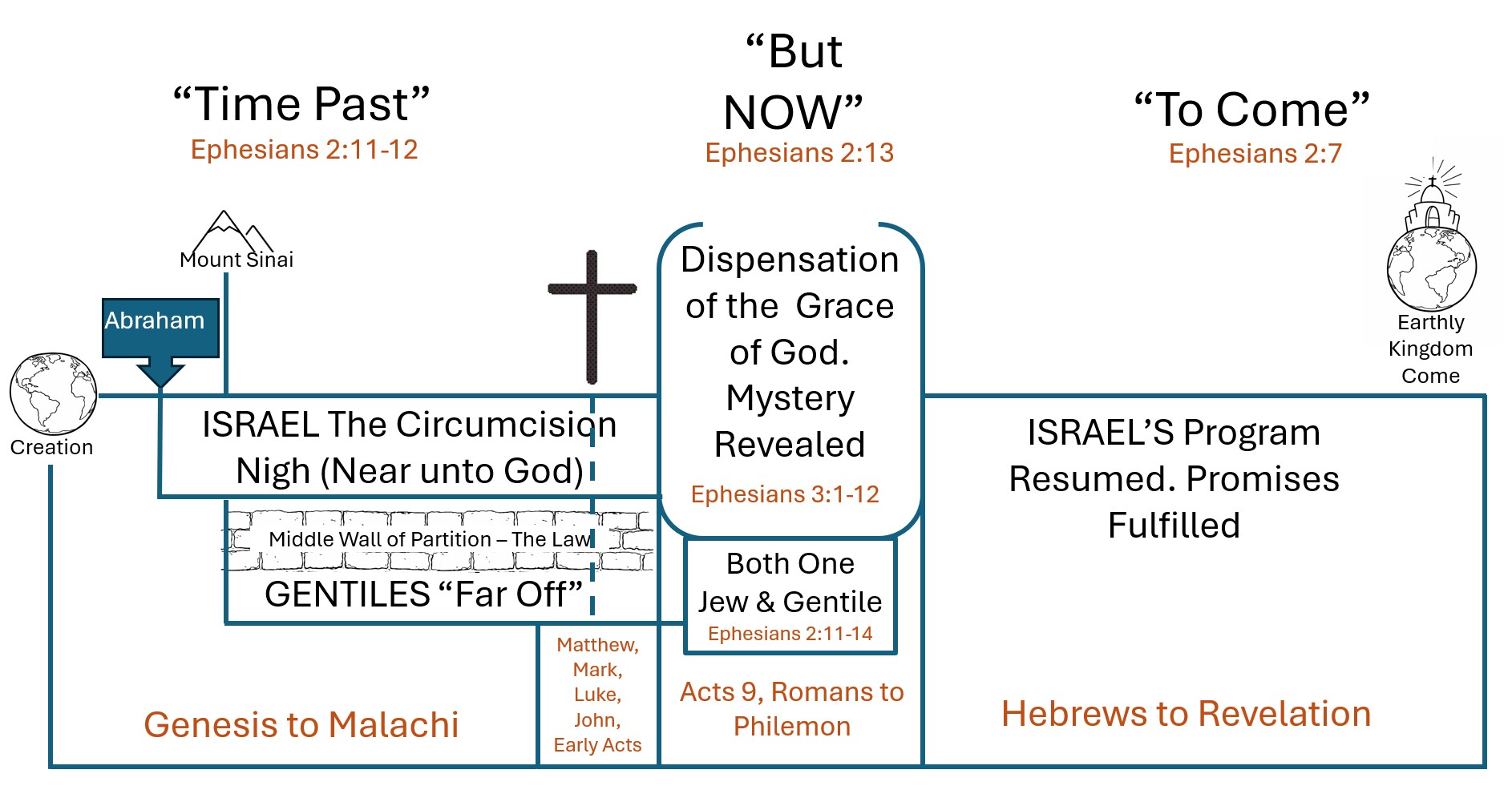
When we’re in Matthew, Mark, Luke, John, and early Acts, we’re in the time past section of our charts, not in the mystery program Christ revealed to us through Paul.
“Speed Slider”
 Press Image To Enlarge
 Press Image to Enlarge
Understanding The Bible – Episode 8 – Transcript
As a reminder of where we are on the timeline charts that we’ve included again below the audio.
We’ve been looking at the gospel of the Gospels, the message preached when Israel’s prophetic clock had reached its climactic stage, and we’ve only scratched the surface, but enough to show us what to look for as we study further.
Let’s turn to Matthew 24.
Last episode, we said we’d look at a few more things about that kingdom gospel. As the Lord’s earthly ministry moved toward the cross, He prepared Peter, James, John, and the remnant for what would happen after He returned to the Father, and, on that timeline, there’s no dispensation of grace in view. That’s our present age, and it hasn’t been revealed yet, at that point in the timeline. What they saw coming at that time was “the wrath to come”, which was right on their doorstep.
A few days before the cross, the Lord taught them how to go through that time. They did not expect a rapture or a deliverance out of the tribulation; there’s no rapture in the gospel accounts. That’s why so many Christians get confused because they mix Israel’s program with Paul’s. The only place the rapture, the catching away of the body of Christ, is revealed is in Paul’s epistles. Paul calls it part of the mystery in 1 Corinthians 15, especially 1 Corinthians 15:12.
Since the mystery wasn’t revealed until Paul, we won’t find the rapture in Matthew 24 or anywhere in the gospel records.
Rightly dividing the Word of truth is the only way to see it. If we try to make Matthew 24 and 1 Thessalonians 4 talk about the same event, we’ll stay confused, always looking at jigsaw puzzle pieces but never connecting them to the completed picture.
Now look at Matthew 24 again. The disciples only knew of one coming, the one Jesus said would happen immediately after the tribulation. That’s when He returns in power and great glory to set up the kingdom. He was preparing them to go through the day of His wrath. He told them they’d see the abomination of desolation spoken of by Daniel, and when did they were to flee into the mountains where God would provide for them. This is all Israel’s program.
The wars and rumours of wars in Matthew 24 are not what we read or hear about in the media today. These are specific prophesied events from Daniel 11, Isaiah 19, and other passages, which are the exact forerunners to the day of the Lord.
In the Olivet Discourse, in Matthew 24, our Lord actually lays out Daniel 11–12, and adds details that fulfil the “increased knowledge” Daniel spoke about there in Daniel 12:4.
Look at Matthew 24:15,
When ye therefore shall see the abomination of desolation, spoken of by Daniel the prophet, stand in the holy place, (whoso readeth, let him understand:)
Then let them which be in Judaea flee into the mountains:
“When ye therefore shall see the abomination of desolation…”
Only people in Judea will see that, not people here in Australia, or America or Europe. It’ll be set up in Israel’s temple, and they’re told to run. The law’s still in effect, and the Sabbath’s still operating. This is Israel’s last days, not the body of Christ.
Then Matthew 24:21-22:
For then shall be great tribulation, such as was not since the beginning of the world to this time, no, nor ever shall be. And except those days should be shortened, there should no flesh be saved: but for the elect’s sake those days shall be shortened.
That runs until Christ returns and destroys Israel’s enemies and establishes the kingdom. The elect here are Israel’s elect, the remnant, not the church.
Then Matthew 24:29:
Immediately after the tribulation of those days shall the sun be darkened, and the moon shall not give her light, and the stars shall fall from heaven, and the powers of the heavens shall be shaken:
That’s the coming they were looking for.
In Matthew 24:30, the Lord tells Peter, James, and John exactly what’ll happen after He goes away. He says,
And then shall appear the sign of the Son of man in heaven: and then shall all the tribes of the earth mourn, and they shall see the Son of man coming in the clouds of heaven with power and great glory.
And he shall send his angels with a great sound of a trumpet, and they shall gather together his elect from the four winds, from one end of heaven to the other.
That’s the only “coming” these men knew about. No rapture or secret catching away, or meeting Christ in the air. They expected Him back after the tribulation of those days, just as He said.
Acts 1 confirms it. As the Lord ascends from the Mount of Olives, two angels say He will return in like manner. And where does prophecy say He returns? Zechariah 14:4,
His feet stand on the Mount of Olives at the end of the tribulation to deliver Israel.
That’s “the coming” they were taught, and it’s the only “coming” they had any knowledge of.
People talk about the “second coming,” but there’re actually four comings. They are:
- His birth.
- His unexpected return from heaven to raise up Saul, who’d become Paul.
- The rapture, or the great catching away, as revealed only to Paul.
- His return after the tribulation to set up the kingdom.
But the apostles only knew about that last one.
Now, before we look at the message Jesus told the 12 apostles to preach, we need to see the context. After the Lord’s rejected, crucified, raised, and ascends to the Father, the message does not change. The program is still Israel’s program. The message is still the gospel of the kingdom. Look at Matthew 24:14,
This gospel of the kingdom shall be preached in all the world… and then shall the end come.
That’s the same message John the Baptist preached, the same message Jesus preached for three years and the same message the Twelve preached with Him. After He leaves, they keep preaching the same gospel of the kingdom, fully expecting they’ll go through the soon expected day of the Lord’s wrath.
The cross didn’t change the message. The Lord never told Israel that the cross cancelled the kingdom. He said it was necessary!
Luke 24:26.
Ought not Christ to have suffered these things, and to enter into his glory?
The program remains the same.
Now look at Mark 16:15,
And he (Jesus) said unto them (the disciples), Go ye into all the world, and preach the gospel to every creature.
People quote that as if it’s our commission today. But the gospel there is the gospel of the kingdom. Jesus had just told them in Matthew 24 that this same gospel would be preached among all nations during the tribulation. Five days later, in Mark 16, He hadn’t changed it. He’d just risen from the dead, and this is the first time He sees them again since His crucifixion, but the message is the same.
Mark 16:16 proves it,
He that believeth (beliveth what? The gospel of the Kingdom from verse 15). He that believeth and is baptized shall be saved; but he that believeth not shall be damned.
That’s kingdom‑gospel salvation is the same message John preached – water baptism for the remission of sins.
Luke 7 says the Pharisees rejected the counsel of God by not being baptised of John. You couldn’t believe that message without water baptism. But Paul says in 1 Corinthians 1:17 that he was not sent to baptise, and that again shows the difference between Israel’s program and the dispensation of grace.
So the point’s simple: after the cross, the apostles still preach the gospel of the kingdom, because the program’s still Israel’s. The mystery program and Paul’s gospel had not yet been revealed.
Those opening chapters of Acts are still Israel’s program as well. Nothing changes until Acts chapter 9, when the risen Lord unexpectedly appears to Saul, the great persecutor of those who believed that the kingdom was at hand and that Jesus was the Christ.
He becomes Paul, the apostle of the Gentiles. That change was not prophesied and not looked for. It was the revelation of the mystery truth that God had kept secret since the world began. That alone shows the gospel of the kingdom and the gospel of the grace of God are not the same message.
Everything we’ve looked at so far should make it clear that the dispensation of grace was not operating in the gospel accounts. We just don’t find our instructions, our promises, or our marching orders in Matthew, Mark, Luke, and John. Those books record Christ’s ministry under Israel’s covenants, fulfilling what was spoken by the prophets since the world began.
Rightly dividing the word of truth is not dividing between Malachi and Matthew, it’s recognising the difference between:
Israel’s program — spoken since the world began, and the mystery — kept secret since the world began, then revealed to Paul.
Romans through to Philemon is our mail in this dispensation of grace. Genesis through to Acts and Hebrews through to Revelation belong to Israel’s program, both time past and the ages to come.
Now we move to the third issue in the gospel accounts: the signs of the kingdom.
Turn to Matthew 4: 17, where Jesus begins to preach. It reads:
From that time Jesus began to preach, and to say, Repent: for the kingdom of heaven is at hand.
This is the gospel of the kingdom, the same message John the Baptist preached. Even the location of His ministry was prophesied. Matthew 4:13–16 quotes Isaiah 9:1, the light would shine first in Zebulun and Naphtali, in Galilee of the Gentiles. Every word Jesus spoke, and every step He took, could be traced somewhere back to the prophets. He told them in John 5:39,
Search the scriptures; for in them ye think ye have eternal life: and they are they which testify of me.
Now look at Matthew 4:23,
And Jesus went about all Galilee, teaching in their synagogues, and preaching the gospel of the kingdom, and healing all manner of sickness and all manner of disease among the people.
His fame spreads because He heals the sick, casts out devils, cures the tormented, the lunatic and the palsied. All of it. Why? Because the healing ministry was part of the kingdom program. It was prophesied. The signs weren’t side‑shows. They were signs of the kingdom, absolute proofs that the kingdom was truly “at hand.”
A sign validates something, and these miracles validated the message. They proved beyond doubt that Jesus was indeed the promised Messiah and the kingdom was at hand.
By the way, in relation to healing today, look at Matthew 8:16. When the even was come, they brought unto him many that were possessed with devils: and he cast out the spirits with his word, and healed all that were sick:
Notice that Jesus healed ALL that were sick! What a contrast to today’s so-called healing ministries.
Luke 8:1 says,
And it came to pass afterward (that’s after the incident of the woman wiping Jesus’ feet with tears), that he went throughout every city and village, preaching and shewing the glad tidings of the kingdom of God: and the twelve were with him,
Note that! The preaching and showing! The message and the signs go together, and that’s the point. The healings, miracles, and casting out of devils were kingdom signs, proving Israel’s promised kingdom was near. They belong to Israel’s program, not the dispensation of grace.
Jesus’s preaching came from His mouth; the showing came through healings and casting out evil spirits. Those two categories, healing physical infirmities and casting out unclean spirits, were the hallmark signs of the kingdom. They weren’t random miracles to impress people; they were prophesied signs, proving the kingdom of heaven was truly at hand and that the message being preached was from God!
These miracles validated the message because the prophets said that when Israel’s Messiah came, and the kingdom drew near, two things would happen in the land. Israel’s physical infirmities would be healed, and unclean spirits would be driven out.
Isaiah chapters 34 and 35 look ahead to the time when God judges Israel’s enemies and brings joy and restoration to the land. The desert blossoms, the curse is lifted, and Israel sees “the glory of the Lord.” This is kingdom glory, not Israel’s modern irrigation projects. Then Isaiah 35:4 says, “Your God will come… He will come and save you.”
When He does, verse 5 says, “the eyes of the blind shall be opened… the lame man shall leap… the tongue of the dumb shall sing.” That’s kingdom life. No sickness, no lameness, no dumbness. All healed!
So what did the Lord do in His earthly ministry? He gave Israel a foretaste of that kingdom. Hebrews 6:5 calls it “tasting the powers of the world to come.”
That’s exactly what happened. He healed the blind, made the lame walk, cleansed lepers, cast out devils, all signs of the kingdom, signs of the times, proofs that the promised kingdom was near.
That’s why in Matthew 11:2-7, when John the Baptist sends two disciples asking, “Are you the one, or do we look for another?”, Jesus doesn’t just say “Yes.” He points to the signs: the blind see, the lame walk, the lepers are cleansed, the dead are raised, and the gospel’s preached to the poor. Why? Because that’s exactly what Isaiah 35 said would happen when the Messiah came, and Jesus was, in effect, saying, tell John you know I’m He by the signs.
These signs tell us what program we’re in when we read the gospel accounts. We’re in Israel’s program, in the climactic stage of prophecy. The dispensation of grace is not operating there. Israel’s receiving her prophesied signs.
Now look at Zechariah 13:2.
It speaks of the unclean spirit being removed from the land. That’s why the Lord cast out devils everywhere He went. It’s another sign of the kingdom — the land being cleansed, just as the prophets said.
Come back to Isaiah 8:16, which speaks of binding up the testimony and sealing the law among His disciples. Those disciples in the gospel accounts — Peter, James, John, and the rest — are prophesied people, functioning under the law, in Israel’s program, receiving and performing the signs God said would accompany the Messiah’s days.
So the point’s simple:
The miracles in the gospel accounts are not church‑age miracles. They’re kingdom signs, proving Israel’s promised kingdom was at hand.
Isaiah 8:18 explains the whole sign‑ministry of the Lord, and we read:
Behold, I and the children whom the LORD hath given me are for signs and for wonders in Israel from the LORD of hosts, which dwelleth in mount Zion.
The “I” here is the Messiah. The “children” are His disciples, Jewish disciples. That’s why the Lord performed signs and wonders in Israel, and why He gave Peter, James, John, and the rest of the Twelve power in Matthew 10 to heal the sick and cast out devils — the two hallmark signs of the kingdom. They were fulfilling Isaiah 8:18.
Hebrews quotes that same verse because Hebrews 1–2 re‑orients Israel to the program that was operating before it was cut off. It reminds them that the Lord, and those who heard Him, confirmed the message with signs and wonders, just as Isaiah said.
So when you see the Twelve — and later the Seventy — performing miracles, we’re watching the increasing signs of the kingdom.
And the Lord said in John 14:12,
Greater works than these shall ye do, because I go unto my Father.
That’s not talking about us today. That’s talking about them, in Israel’s program, with the sign‑ministry intensifying after His ascension. Those signs in Mark 16 — tongues, healings, casting out devils — are Israel’s signs, not the body of Christ’s. None of that belongs to the dispensation of grace today because that period of time was interrupted, and God brought in a new, temporary dispensation.
This’ll cause a lot of Christians to scoff at this series because it’s so contrary to what most modern pastors and teachers have taught. And that’s really the sad fact, that it’s from those pastors and teachers that most people get their understanding and knowledge of God, not through actually immersing themselves into the scripture on their own.
That intensified sign‑ministry in early Acts was prophesied in Joel 2, which is why Peter quotes it on Pentecost. We’ll see that when we study Acts 1–7.
But for now, the point is simple: the signs and wonders in the gospel accounts prove that Israel’s program is operating at that time, not ours.
The two hallmark signs are: Physical healings and casting out demons.
Now look at Zechariah 13.
When the kingdom is established, God opens a fountain for cleansing, destroys idols, and removes the unclean spirits from the land. No demonic activity, no false prophets. Satan’s bound, and his demons are imprisoned. That’s kingdom life. So a sign that the kingdom is at hand would naturally be the casting out of devils, and that’s why the Lord did it constantly.
Now go to Matthew 12:22, where they bring Jesus a man possessed with a devil and blind and dumb. Jesus heals him so that he both speaks and sees. The people say, “Is not this the Son of David?” See, they recognise the kingdom signs. But the Pharisees, the religious hierarchy, the pastors and teachers of the day, accuse Him of working by Beelzebub, the name given to Satan. The Lord exposes their foolishness, then gives the key statement:
If I cast out devils by the Spirit of God, then the kingdom of God is come unto you.
Why? Because Zechariah 13 said the kingdom would have the unclean spirits cast out of the land. His miracles were the proof.
Luke 11:20 says the same:
If I with the finger of God cast out devils, no doubt the kingdom of God is come upon you.
Jesus is saying here what these signs should mean when we read the gospel accounts. They validate the gospel of the kingdom. They show the kingdom was truly at hand. And they show that no such signs are being carried out today, because the kingdom’s not at hand in the dispensation of grace. These are Israel’s signs, not ours.
In Luke 10:1-24, the Lord sends the seventy out with the same kingdom signs He gave the Twelve. He tells them in verse 9,
Heal the sick… and say unto them, The kingdom of God is come nigh unto you.
The healing wasn’t just kindness. It was a sign proving the truth of the gospel of the kingdom. The miracle validated the message. If they believed it, they became part of the little flock, the children of the kingdom who’d be provided for through the coming day of wrath and enter the kingdom when the King returned.
These ones who the Lord sent out were a “sign” themselves, from Isaiah 8:18. They themselves were living demonstrations of the coming tribulation period when God would miraculously provide for the believing remnant. But in Luke 10:10, Jesus tells them if a city rejected the message of the kingdom, they were to shake off the dust, which was a gesture of disassociation, but to still declare to those cities,
Be sure of this: the kingdom of God is come nigh unto you.
Their rejection didn’t change the truth. The signs proved the kingdom was at hand.
These instructions were not for us today. They were for the lost sheep of the house of Israel as we see in Luke 10:1 and Matthew 10:5–6.
Now look at Matthew 16. The Pharisees and Sadducees demand a sign from heaven, but the Lord rebukes them by pointing out,
You can discern the sky, but you cannot discern the signs of the times.
They’d already seen two years of kingdom signs, the healings, devils cast out, and miracles performed – all signs – fulfilling Isaiah 35, Isaiah 61, and Zechariah 13. If they’d searched the Scriptures as He told them to in John 5:39, they would’ve recognised the clear and plain signs. The prophetic clock was at 98%, with only the final 2% — the tribulation — left before the kingdom.
These signs validated the message of Isaiah 40 — the comforting news that Israel’s God was coming to reign, fulfilling the Abrahamic covenant.
Now come to Luke 18:31-33, which really seals the issue. After nearly three years of preaching the gospel of the kingdom, the Lord takes the Twelve aside and tells them plainly what’s about to happen in Jerusalem, and we read,
Then he took unto him the twelve, and said unto them, Behold, we go up to Jerusalem, and all things that are written by the prophets concerning the Son of man shall be accomplished.
For he shall be delivered unto the Gentiles, and shall be mocked, and spitefully entreated, and spitted on:
And they shall scourge him, and put him to death: and the third day he shall rise again.
But look what verse 34 (Luke 18:34) says:
And they understood none of these things: and this saying was hid from them, neither knew they the things which were spoken.
They’d been preaching the gospel of the kingdom for almost three years with Jesus, and they knew nothing about the death, burial, and resurrection. That proves the gospel they preached was not Paul’s gospel. How could it be? You can’t preach what you don’t know.
The common idea in Christianity is that the apostles were preaching the cross all along, but the Scripture says the opposite. They didn’t understand it. It was “hid from them”. The gospel of the kingdom contained no reference to the cross because the cross wasn’t yet revealed as good news. It was still a mystery.
So the evidence is overwhelming, the signs were kingdom signs, the message was the gospel of the kingdom, the apostles knew nothing of the cross, and Paul’s gospel was revealed later, by the risen Christ. The gospel in the gospel accounts is not the gospel for today.
One of the saddest things I know is that God, in His infinite wisdom, has made all this infinitely clear, but because most professing Christians, pastors and teachers included, would rather base their knowledge on what a man says. So often, that man tries to convince others that He’s being spoken to by God in a special and different way than everyone else in the body of Christ and that God somehow picked him out and gave him a ministry.
They’d rather listen to that man for 30 minutes one day a week and fool themselves they’re coming into the knowledge of God, than search the scriptures themselves and rightly divide God’s incredible Word. I know because I was that person for more years than I care to remember.
So, to really push home this vital point about the times, and the signs, and the gospel being preached in the four gospels, look again carefully at Luke 18:34. God tells us three times in that one sentence that the Twelve did not understand the Lord’s words about His death, burial, and resurrection:
The first time was when He said, “They understood none of these things.” Not some. None.
The second time was when He said, “This saying was hid from them.” God Himself didn’t allow them to grasp it. The third time was when He said, “Neither knew they the things which were spoken.” Even as they thought on it, they couldn’t figure it out.
That means for almost three years, while they preached the gospel of the kingdom, they knew nothing about the cross. They weren’t expecting it, they weren’t looking for it, and they certainly weren’t preaching it. And yet the cross, the Messiah’s death, burial and resurrection is crucial to salvation by grace to all, Jew and Gentile. That’s the gospel of salvation by grace, as Paul later points out in 1 Corinthians 15:4.
Now go to Matthew 16:21-22 again. This is at about the two‑and‑a‑half‑year mark of Jesus’s earthly ministry. Jesus begins to tell the apostles for the first time that He must go to Jerusalem, suffer, be killed, and rise again. But what does Peter do in verse 22? He rebukes the Lord!
Then Peter took him, and began to rebuke him, saying, Be it far from thee, Lord: this shall not be unto thee.
That’s not a man who understands the cross. That’s a man trying to stop it. He saw no value in it, and he didn’t even know it was necessary. Luke 18 says God hid it from them.
So, let’s think about that. If they’d been preaching the same gospel we preach today — the gospel of Christ’s death, burial, and resurrection — how did they preach what they had no idea of? How did they preach what God had not only not yet revealed to them but actually purposely hid from them? How could they preach what they actively opposed?
You just can’t preach what you don’t understand.
This is why the gospel of the kingdom is not the gospel of the grace of God that Paul preached later, after Christ had risen. The gospel of the kingdom said nothing about the cross. It was the good news that the kingdom was at hand, the King was present, and Israel’s long‑promised deliverance was near.
But today, in the dispensation of grace, the whole message is the preaching of the cross as in 1 Corinthians chapter 1.
That message was revealed later, to Paul, by the risen Christ. It’s part of the mystery truth kept secret since the world began.
So when the Word of God confronts us with this, we don’t brush it aside. We believe what God says! We don’t listen to what tradition says. At the judgment seat of Christ, we stand alone. God will hold us accountable for what He said in His Book, not what someone told us to think.
In the next episode, we move into Acts 1–7 to watch Israel’s program continue right up to the point where God interrupts it and brings in the dispensation of grace through Paul. Then we’ll look at Paul’s unique apostleship and why Satan attacks it so fiercely.


Leave a Reply
Want to join the discussion?Feel free to contribute!