
Understanding The Bible – Episode 6
We don’t follow Paul, we follow Jesus, but we recognise that following Jesus in this day and age means following Him through what he has revealed to us, to you and me, through Paul.
What we’re studying are Christ’s words, not Paul’s opinions. When we make a big issue of Paul, we’re not exalting the man. Paul always put himself far below Christ, and even us. He refers to himself in Ephesians as “least of all saints.”
What we magnify is the office Paul held as our apostle, the apostle to the Gentiles, and we magnify it because God magnifies it.
“Speed Slider”
 Press Image To Enlarge
 Press Image to Enlarge
Understanding The Bible – Episode 6 – Transcript
Here we are at Episode 6 in our Understanding the Bible series.
Turn again to Romans 15 in your Bibles, and we’re picking up where we left off last episode.
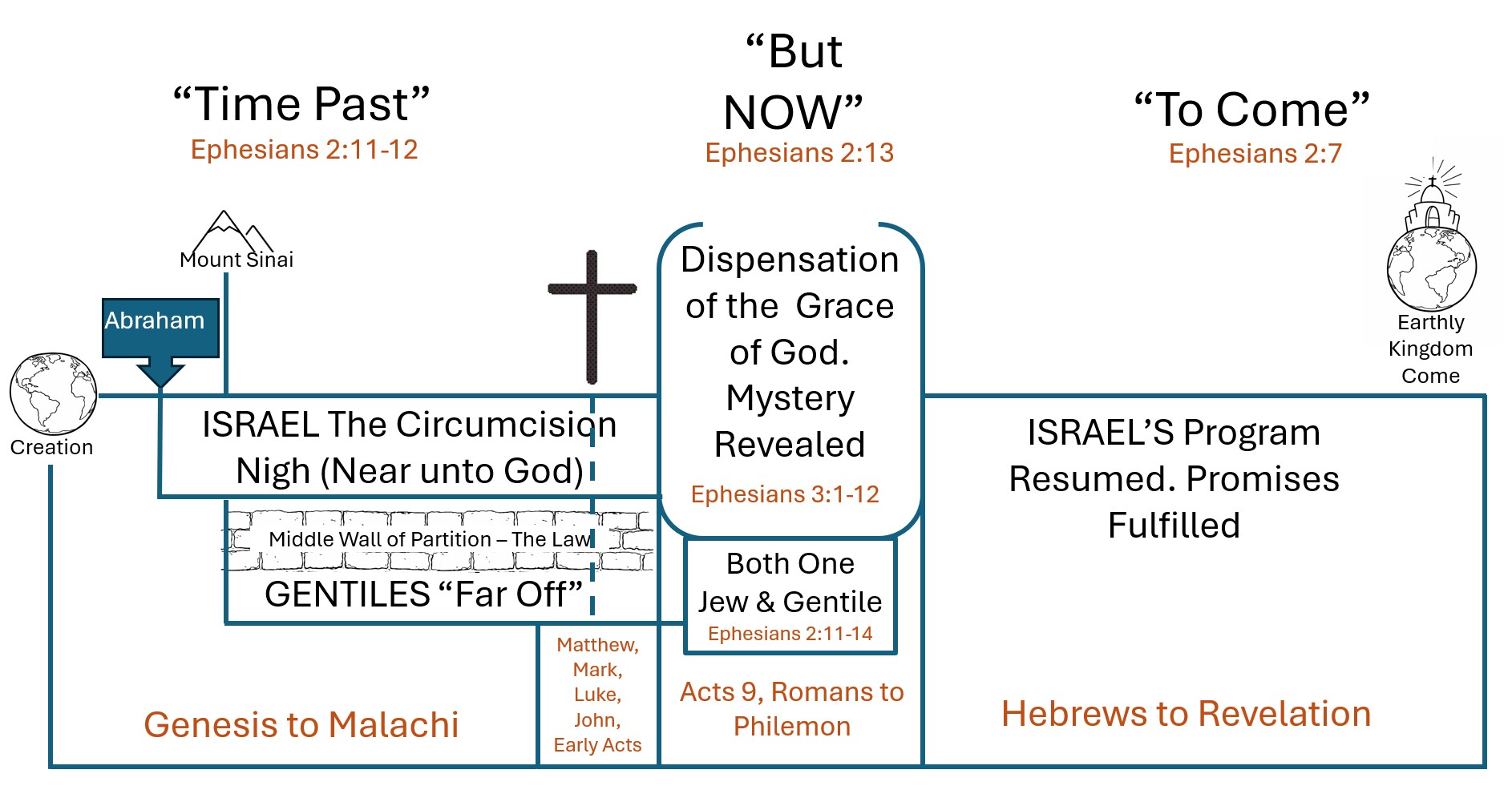
As with all episodes so far, we have our timeline chart, in fact, two timeline charts below this recording. Very often, a visual representation of what we’re saying is extremely helpful in placing events in their correct sequence.
Last time we looked at two verses where the Apostle Paul, speaking from the standpoint of the dispensation of grace, looks back to time past and reminds us again of God’s program with Israel.
He also reminds us of his unique apostleship and how God raised him up for this present dispensation. But our focus today is especially on the earthly ministry of the Lord Jesus Christ and the early Acts period before Paul was raised up.
We should always keep in mind that whenever I say “Paul says,” I mean Christ speaking through Paul.
We don’t follow Paul, we follow Jesus, but we recognise that following Jesus in this day and age means following Him through what he has revealed to us, to you and me, through Paul.
What we’re studying are Christ’s words, not Paul’s opinions. When we make a big issue of Paul, we’re not exalting the man. Paul always put himself far below Christ, and even us. He refers to himself in Ephesians as “least of all saints.”
What we magnify is the office Paul held as our apostle, the apostle to the Gentiles, and we magnify it because God magnifies it.
God only had two men in the whole Bible magnify their office because they stand at the centre of His twofold plan: Moses and Paul.
Many men wrote Scripture, but only these two were told to magnify their office so strongly that God even spoke of His Word as their word. That’s why Scripture calls it “the Law of Moses.” Moses didn’t invent it—God spoke it through him—but God wanted Israel to understand Moses’ office.
Jesus Himself said, “Moses gave you the law… and Moses said…” It wasn’t exalting Moses above God; it was honouring the office that God magnified.
The only other man God did that with is Paul.
Now look again at Romans 15:15–19, Paul speaking,
That I should be the minister of Jesus Christ to the Gentiles, ministering the gospel of God, that the offering up of the Gentiles might be acceptable, being sanctified by the Holy Ghost.
I have therefore whereof I may glory through Jesus Christ in those things which pertain to God.
For I will not dare to speak of any of those things which Christ hath not wrought by me, to make the Gentiles obedient, by word and deed, Through mighty signs and wonders, by the power of the Spirit of God; so that from Jerusalem, and round about unto Illyricum, I have fully preached the gospel of Christ.
Illyricum is north of Macedonia, on the Adriatic Sea.
Paul says he wrote “more boldly” to put them in mind because of the grace given to him—that special apostleship with the mystery of Christ.
He says he is the minister of Jesus Christ to the Gentiles, and that Christ worked through him “to make the Gentiles obedient.” To make us obedient to what God’s telling us today, through Paul. He fully preached the gospel from Jerusalem outward by the power of the Spirit.
Paul speaks boldly here because what he’s teaching will be attacked by the satanic policy of evil.
In Romans 16, he warns that men will come speaking contrary doctrines, especially denying Paul’s apostleship and denying the true nature of Christ’s earthly ministry.
In fact, we should read that in Rom 16:17-20.
Now I beseech you, brethren, mark them which cause divisions and offences contrary to the doctrine which ye have learned; and avoid them.
For they that are such serve not our Lord Jesus Christ, but their own belly; and by good words and fair speeches deceive the hearts of the simple.
For your obedience is come abroad unto all men. I am glad therefore on your behalf: but yet I would have you wise unto that which is good, and simple concerning evil.
And the God of peace shall bruise Satan under your feet shortly. The grace of our Lord Jesus Christ be with you. Amen.
They’ll say Jesus was ministering to Gentiles the same way He was in His earthly ministry. But Romans 15:8 says plainly: “Jesus Christ was a minister of the circumcision.”
His earthly ministry had the world in view only through Israel’s kingdom—not through the dispensation of grace.
Today God deals with Gentiles in spite of Israel, not through Israel’s rise.
The why of that is as simple as it is powerful, and we’ll see it as we go on.
So when we make a big issue of Paul, we’re doing exactly what God does here in Romans 15. Just as God made Moses the spokesman for Israel, He made Paul the spokesman for you and me, the Body of Christ.
If you want confirmation of what “the grace given to me” means, hold your place in Romans 15 and look at Ephesians 3:1-4, where Paul says,
For this cause I Paul, the prisoner of Jesus Christ for you Gentiles,
If ye have heard of the dispensation of the grace of God which is given me to you-ward:
How that by revelation he made known unto me the mystery; (as I wrote afore in few words,
Whereby, when ye read, ye may understand my knowledge in the mystery of Christ)
That’s the same grace he’s talking about in Romans 15.
Now let’s go to Ephesians 3:7–8, where Paul says,
Whereof (and the “whereof” is the gospel), Whereof I was made a minister, according to the gift of the grace of God given unto me by the effectual working of his power.
Unto me, who am less than the least of all saints, is this grace given, that I should preach among the Gentiles the unsearchable riches of Christ;
When Paul talks about “the grace given unto me,” he means that special apostleship God gave him—the mystery of Christ kept secret since the world began, now revealed to him for us in this dispensation of grace. That’s the same thing he means in Romans 15, where he wants us always to remember “the grace given to me of God.”
Romans 15:16 defines it clearly:
That ye may with one mind and one mouth glorify God, even the Father of our Lord Jesus Christ.
That’s Paul’s God‑given role. He’s our minister, appointed by Christ to preach the gospel of God so the “offering up of the Gentiles” might be acceptable, sanctified by the Holy Ghost. That offering wasn’t happening in time past—as our charts below show—but it is happening now.
Because of this new Gentile program, Paul says in Romans 15:17 he has reason to “glory through Jesus Christ.”
He’s not boasting in himself—he already said he’s the least of all saints—but he is magnifying the office God gave him, so we know exactly where to go in the Bible to find God’s instructions for us today: Romans through to Philemon, Paul’s 13 epistles.
This is why Scripture contrasts Christ’s earthly ministry with His ministry from heaven through Paul. Those two ministries match God’s twofold plan.
Now back to Romans 15:8, where we read,
Now I say that Jesus Christ was a minister of the circumcision for the truth of God, to confirm the promises made unto the fathers:
Before Christ came back from heaven and raised up Paul, His earthly ministry was “a minister of the circumcision for the truth of God, to confirm the promises made unto the fathers.”
He was that minister—past tense. Now He ministers to Gentiles from heaven through Paul.
Then Paul quotes four prophetic passages from Old Testament prophecy in Romans 15:9-12, and we need to read them,
And that the Gentiles might glorify God for his mercy; as it is written, For this cause I will confess to thee among the Gentiles, and sing unto thy name. (Quoted from Psalm 18:49)
And again he saith, Rejoice, ye Gentiles, with his people. (Quoted from Deuteronomy 32:43)
And again, Praise the Lord, all ye Gentiles; and laud him, all ye people. (Quoted from Psalm 117:1)
And again, Esaias saith, There shall be a root of Jesse, and he that shall rise to reign over the Gentiles; in him shall the Gentiles trust. (Quoted from Psalm 11:1-10).
These prophecies show that God always planned to bless Gentiles, but through Israel’s rise, not through Israel’s fall.
The Abrahamic covenant promised, “In thee shall all families of the earth be blessed.”
That blessing comes when Israel becomes that great nation with Jehovah dwelling in their midst, and then they bless the world in the Davidic kingdom. Every passage Paul quotes here points to Gentiles glorifying God in Israel’s kingdom, not in the dispensation of grace.
So we don’t ever think that the dispensation of grace means God never spoke of the Gentiles before that. The issue is how He deals with them. Today, He deals with Gentiles in spite of Israel, with Israel’s program paused. That’s the “offering up of the Gentiles” Paul speaks of.
But when Christ was on earth, He was confirming the promises made to Abraham, Isaac, Jacob, Moses, David, and the prophets. He wasn’t fulfilling them yet—that comes in the last stage of Israel’s program—but He was confirming them in the stage just before the kingdom.
So Romans 15 teaches two things clearly seen on our charts:
- Christ’s earthly ministry belonged to Israel’s program.
- Christ now ministers to Gentiles from heaven through Paul, in a program never spoken of before.
You and I need to let the Bible tell us what’s going on, friends. Not theologians, not teachers, and most important of all, not me. You check the verses yourself and be honest with what’s written. Understanding the Bible and God’s plan and purpose for mankind, and each one of us personally, will never be achieved by simply listening to short sermons by a preacher in a church building or on video, who’s more often than not speaking about some sort of lifestyle message of his own and using a scripture here and there to somehow “prove” that what he’s saying is from God.
Look, if we can’t deal honestly with the plain statements of Scripture, then clinging to tradition is just dishonesty of heart and leads to a terrible condition that many Christians suffer from, self-deception. 2 Timothy 3:13 warns,
But evil men and seducers shall wax worse and worse, deceiving, and being deceived.
Zeal without knowledge doesn’t impress God—Romans 10:2, in fact, the whole of Romans 10 shows that clearly.
Bible study is serious business. God expects precision, not a loose “verse‑here, verse‑there” approach.
Some people might say we’re splitting hairs. Well, God is the greatest hair‑splitter in the Bible. Look at Israel’s program—how exact the sacrifices had to be, how exact the instructions were. If they weren’t precise, people died. God says what He means ans means what He says. Every word matters.
That’s why the Lord told Satan in Matthew 4:4,
…It is written, Man shall not live by bread alone, but by every word that proceedeth out of the mouth of God.
Every word.
That’s also why paraphrased Bibles and loose translations won’t work for real study. They’re not dealing with every word—just some man’s idea of the words.
Now, with that seriousness in mind, we must face what the Bible says about the gospel accounts.
When Jesus said, “Go not into the way of the Gentiles,” in Matthew 10:5, He meant it. To go to a Gentile was disobedience. That tells us plainly that during Christ’s earthly ministry, a dispensation of grace was NOT in effect. If you and I had lived then, Jesus would not have been sent to us as Gentiles. We would have had to come through Israel, blessing Israel first, before He’d even listen.
There are only two times in Jesus’ earthly ministry that He dealt with Gentiles—one woman, one man—and both came through Israel’s mediation. Let’s look at one of them.
Matthew 15:21–28. Jesus enters the coasts of Tyre and Sidon, and a Canaanite woman—a Gentile—comes crying to Him, and we’ll read the passage,
Then Jesus went thence, and departed into the coasts of Tyre and Sidon.
And, behold, a woman of Canaan came out of the same coasts, and cried unto him, saying, Have mercy on me, O Lord, thou Son of David; my daughter is grievously vexed with a devil.
But he answered her not a word. And his disciples came and besought him, saying, Send her away; for she crieth after us.
But he answered and said, I am not sent but unto the lost sheep of the house of Israel.
Then came she and worshipped him, saying, Lord, help me.
But he answered and said, It is not meet to take the children’s bread, and to cast it to dogs.
And she said, Truth, Lord: yet the dogs eat of the crumbs which fall from their masters’ table.
Then Jesus answered and said unto her, O woman, great is thy faith: be it unto thee even as thou wilt. And her daughter was made whole from that very hour.
This is almost the exact opposite of the picture most Christians paint of Jesus—arms open to everyone, helping everyone. But here, a desperate woman cries for mercy, and He ignores her. Why? Because He was following the program God sent Him to fulfil.
Even the disciples tell Him to send her away. They weren’t being cruel—they were obeying Matthew 10. They were doing exactly what He told them: don’t go to Gentiles.
Jesus explains it Himself in verse 24 of that passage. Matthew 15:24,
But he answered and said, I am not sent but unto the lost sheep of the house of Israel.
Who was He sent to? Israel.
Does a Gentile woman qualify? No.
Would we have qualified back then? No.
Now, our religious traditions may cause us to reject that. We may not like how it sounds, but – that’s – what – the – Bible – says.
And we’ve got to decide whether we’ll go by Scripture or by how we think things should be according to the popularly held views.
This passage forces us to face the truth we see on our charts:
That in the gospel accounts, the dispensation of grace is NOT operating.
Christ’s earthly ministry belongs to Israel’s program, not ours.
And if we set aside what the Word actually says, or try to change and mix it all together, it’ll cut us to pieces—because it’s alive, powerful, and sharper than any two‑edged sword as Hebrews 4:12 points out to us.
Now look at Matthew 15:25 and 26 in the passage we just read.
Then came she and worshipped him, saying, Lord, help me. But he answered and said, It is not meet to take the children’s bread, and to cast it to dogs.
Jesus is not using some sort of random slogan here. He’s speaking directly to the situation. In His mind, there are two groups:
children being Israel, and dogs being Gentiles.
That’s not new language. The Old Testament uses it. David called Goliath an “uncircumcised” dog in 1 Samuel 17:26 and 1 Samuel 17:43. Gentiles were outside the covenant. This woman was not a child of Israel. She was a Gentile dog—just like we were in time past, as Ephesians 2:11–12 points out.
Jesus says it’s not right to give Israel’s bread to Gentiles. That bread was the spiritual food Israel needed in this crucial stage of their program, as it was climaxing to prepare them for the kingdom. At this point in time, the Gentiles’ blessing would come later, through Israel, after Israel’s program is fulfilled.
But here’s where this woman shows real understanding. She doesn’t argue with Jesus. She submits. In Verse 27, she says.
“Truth, Lord.”
She accepts her “Gentile dog” status and asks only for a crumb—not the bread.
She knows the kingdom blessings are future, but she also knows crumbs are falling now because Israel’s not receiving what God’s giving them.
Her faith is not vague. Faith is based on one thing only—the Word of God.
She believes exactly what God said about Israel, about Gentiles, and about the Abrahamic covenant. She believes in the truth of her place in Israel’s program.
And then Jesus says to her, “Oh woman, great is thy faith.” Her daughter is healed—not because a dispensation of grace was in effect, but because the Law made provision for a Gentile who blessed Israel and came through Israel.
Mark 7 gives the same account. There, Jesus adds, “Let the children first be filled.” That’s the order in Israel’s program. Gentiles are blessed after Israel is filled, not before. That’s why in the Great Commissions they must finish with Israel first. That’s why He told them they would not cover all the cities of Israel before He returned.
The only other Gentile Jesus dealt with was the centurion, and even he came through Israel’s mediation.
The Jews said he was worthy because he had built them a synagogue. Again, he came through Israel, not apart from them.
All of this shows plainly on our charts that during Christ’s earthly ministry, the dispensation of Gentile grace was NOT operating. Jesus was functioning exactly as Romans 15:8 says:
“A minister of the circumcision for the truth of God, to confirm the promises made unto the fathers.”
Even in John’s Gospel, when two Greeks wanted to see Jesus, He didn’t deal with them.
Here’s what happens there. John 12:20–21,
And there were certain Greeks among them that came up to worship at the feast:
The same came therefore to Philip, which was of Bethsaida of Galilee, and desired him, saying, Sir, we would see Jesus.
In John 12:22–24, Philip and Andrew tell Jesus, but instead of meeting them, He speaks of His coming death:
The hour is come, that the Son of man should be glorified… Except a corn of wheat fall into the ground and die, it abideth alone.
So Jesus doesn’t deal directly with the Greeks — He turns the moment into a prophecy of His death and resurrection, showing that access to Him would soon come through the cross, not a personal audience.
He reminded the disciples that the time for Gentiles had not come yet.
So in the gospel accounts, circumcision vs. uncircumcision still stands. Israel are the children. Gentiles are the dogs. And Jesus tells His apostles plainly: “Go not to the Gentiles.”
This all testifies clearly that Christ’s earthly ministry belonged to Israel’s program, not the dispensation of grace.
When we’re back in the 4 gospels, Matthew, Mark, Luke and John, there’s still a big difference between Jew and Gentile. Anyone can and should see that. And whenever that difference exists, we know we’re not in the dispensation of grace, because in this dispensation “circumcision availeth nothing, nor uncircumcision,” and there is no difference between Jew and Greek as Galatians 3:28 and Ephesians 2 explained, which we’ve already seen. In those gospel records, the middle wall of partition is still standing. That alone tells us where we are on our timeline chart.
Now, let’s bring in the second issue in the gospel accounts, and that’s the actual gospel message being preached.
The message preached by John the Baptist, by the Lord, and by the twelve apostles is not the gospel of the grace of God, and it was not the mystery revealed to Paul.
Now that statement’s going to rock some traditional boats, for sure! But stick with it and remember this is not personal opinion, personal “insight” or personal interpretation of the Word. What we’re saying is actually written clearly and plainly in God’s Word for all to see, at least by those who’re desperate for fact over fiction.
Paul said that the gospel was “committed to my trust” in 1 Timothy 1:11.
The message in the gospel accounts is the gospel of the kingdom—the good news that the prophesied kingdom of heaven for Israel was at hand. It is the gospel of the circumcision, as Galatians 2:7 labels it. God’s program with His circumcised nation, Israel, was ready to move into its next stage.
To see this clearly, turn to Luke 1:31-33 and see what the angel Gabriel tells Mary,
And, behold, thou shalt conceive in thy womb, and bring forth a son, and shalt call his name JESUS.
He shall be great, and shall be called the Son of the Highest: and the Lord God shall give unto him the throne of his father David:
And he shall reign over the house of Jacob for ever; and of his kingdom there shall be no end.
Not only will Mary bear the long-prophesied Messiah, fulfilling Isaiah 7:14, which said,
Therefore the Lord himself shall give you a sign; Behold, a virgin shall conceive, and bear a son, and shall call his name Immanuel (which means God with us).
This passage also tells us why this is happening in God’s program.
That’s the goal. Not a dispensation of grace. Not the Body of Christ. Not a new program for Gentiles. The goal is the Davidic kingdom promised in the Abrahamic and Davidic covenants. The Angel Gabriel says He “shall be great”—not just great in the sense of being God in the flesh, but great because Israel’s greatness promised in the covenants is vested in Him.
Israel’s greatness was never going to come from their own flesh; the law proved that. Their greatness comes from Jehovah dwelling among them, and the Messiah is the One who brings that to pass.
So the whole purpose of Christ’s coming in the gospel accounts is tied to Israel’s kingdom program, not the dispensation of grace as we see on our charts.
The message He and the twelve preach—“the kingdom of heaven is at hand”—fits perfectly with that. You can’t preach that message today and tell the truth, because in the dispensation of grace, Israel’s program is set aside, and the kingdom’s not at hand.
Many churches today try to claim that kingdom program for themselves, but that’s not correct. Only Israel will fulfil that program. It belongs to them alone.
In our next episode, we’ll look more closely at this passage and then examine the gospel message in the gospel records. Read on in Luke 1 and look at what John the Baptist’s father says. We’ll pick it up there next time.
May God bless you in the knowledge of Him.


Leave a Reply
Want to join the discussion?Feel free to contribute!